Barristers set to fully withdraw from all Crown Court cases

 Pacemaker
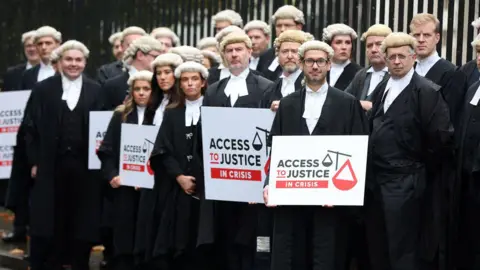
Criminal barristers in Northern Ireland are to fully withdraw from all Crown Court cases following a dispute over legal aid fees.
An ongoing withdrawal from some cases will be extended to involve the a withdrawal from all current Crown Court cases from 5 January 2026.
In a statement, the Criminal Bar Association (CBA) said it has been "sounding the alarm on an access to justice crisis for some time now".
The justice minister has accused the CBA of leveraging "further trauma and stress on victims and witnesses to advance their arguments".
The action voted upon was "in light of the failure by the Department of Justice to provide reasonable renumeration for work properly done in legally aided court cases".
"Counsel will not appear in the Crown Court from the 5 January 2026 in respect of any legally aided Crown Court cases."
A total of 193 criminal barristers took part in the vote with 171 voting in favour and 22 against - which equated to just under 89% voting in favour of the industrial action.
 PA Media
The Justice Minister Naomi Long said her "priority is ensuring that the justice system doesn't exacerbate the trauma and distress already endured by victims and witnesses; steps are being taken to mitigate the harm that will arise as a result of the Criminal Bar's entirely unnecessary decision".
She also claimed that as a result, the action "will create further delay in the court system and individuals may spend more time in custody than may be necessary".
"I am working with a constrained budget and it is incumbent upon me to ensure that any expenditure by the Department of Justice represents value for money", Long added.
'Reluctant to even acknowledge'
The CBA claim that "barristers want to be in court, representing their clients, running and resolving criminal cases".
The statement said the Bar Council regrets the situation and "acknowledges that this escalated action will have a profound impact on Northern Ireland's criminal justice system including upon victims of crime, defendants and civilian witnesses".
It also said that that the Bar Council had been engaging with groups representing those affected in advance of the CBA vote.
They said their withdrawal comes after an extended period of patient "amidst a steadily worsening crisis, a crisis which the Department of Justice appears to be reluctant even to acknowledge".
An interim increase in legal aid fees had been announced in December 2024 and whilst the CBA say they welcomed the increase, it "fell significantly short of 20 years of accumulated inflationary pressures".
They said it is not expected to be delivered until January 2026 at the earliest, "almost 18 months from the date when the increase was recommended".
It added that despite engagement, "no other increases have been agreed to date and there is no guarantee of any further increases in the near future".
'Absolutely disastrous decision'
Geraldine Hanna, the commissioner designate for victims of crime, said she was "angry, I'm really angry".
"I think this is an absolutely disastrous decision for the victims of crime," she told Radio Ulster's Evening Extra programme.
"I meet practically on a weekly basis with victims who have experienced the trauma of the crime, but they will also be going through continuing trauma and distress and upset because of delay and avoidable delay.
"This action is adding more uncertainty and we can't even say when it's going to end
"What does that mean if you have come forward and reported a rape? What does that mean if it's your family member who has been murdered whose case was scheduled to take place in January?
"What do we tell those victims?"
The Bar Council will meet in full to discuss this development early next week and will "engage with all concerned parties in the time ahead".
What is legal aid?
Legal aid for criminal court cases allows representation.
These cases usually take place in the magistrates' courts or Crown Court.
The CBA previously stated that legal aid rates for lawyers, when adjusted for inflation, have plummeted between 47% and 58% since 2005.
In November 2024, criminal barristers began withdrawing services in certain categories of criminal cases, such as refusing instructions in murder and manslaughter cases.
