'Anyone can do it' - Turner Prize winner's inspirational effect

 BBC
BBCIt is the morning after Nnena Kalu won the Turner Prize and excitement is in the air at an unassuming studio in Glasgow's Trongate.
Project Ability is a charity based at the studio that supports artists of all abilities - and their number previously included Kalu, who on Tuesday became the first learning disabled artist to land the Turner Prize.
Now other artists who use the studio are looking at her success and feeling inspired by it.
Kendal, an 18-year-old who specialises in large canvas paintings of mountains, told BBC Scotland News Kalu's victory showed "anyone can be an artist - it doesn't matter what they have."
Nnena Kalu is autistic and has limited verbal communication, but to those at Project Ability the deeply expressive art she creates on the canvas and in sculpture has sent a clear message - learning disabilities are no barrier to success.
The 59-year-old was born in Glasgow but moved to England when she was a child. However, her roots in the city came to the fore in 2018 when she was invited to stage her first solo exhibition at the Glasgow International art festival.
The studio that hosted her was Project Ability.
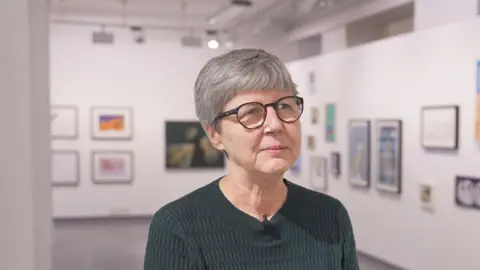
Elisabeth Gibson, the charity's executive artistic director, described the first time she observed Kalu creating her works as "mesmerising".
She said: "It's uniquely Nnena. Her action, the sound that she makes with the chalk on the paper, everything about it was really captivating."
Kalu's work uses brightly coloured sculptures, haphazardly wrapped in layers of ribbon, string, card and shiny VHS tape, and drawings of swirling, tornado-like shapes.
Ms Gibson believes the gallery takeover in 2018 was a hugely significant step for the artist.
"This was her first solo exhibition and it's a really important festival for the city. Lots of curators come, lots of artists come and it gave her work really high visibility and other opportunities fell on after that."
Now others at the Trongate studio are feeling inspired as a result.
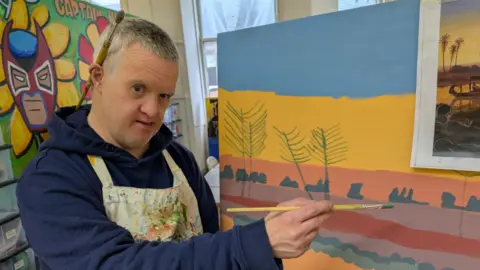
Andrew, 50, a fellow learning disabled artist said the win was "inspiring".
"Good for her. I've got learning difficulties as well, and I've also got Down's. And I think that's amazing what one person can do. There's also one on Strictly Come Dancing. She was an amazing dancer. I think good for them."
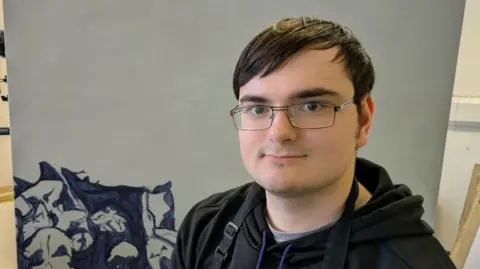
Kendal described Kalu's success as "pretty amazing."
He added: "It's a very great achievement for her and it shows that no matter what, anyone can go through with achieving goals. Anyone can be an artist. It doesn't matter what they have or if they're struggling."
Ms Gibson was watching on TV when Kalu was announced as the winner on Tuesday night.
"We were absolutely thrilled, absolutely delighted," she said. "She deserved it. She's honestly such a hard-working artist.
"It means a huge amount. People maybe didn't take work by learning disabled artists as seriously as they might have artists in a different context.
"I think it will mean people may be more open to it and not be so judgmental."
Her work was praised by judges at the Turner Prize, who said she created "really compelling sculptures and drawings that could only be made by Nnena."
Jury chairman and Tate Britain director Alex Farquharson said her drawings had "a beautiful intricacy to them" and "look like swirling vortexes."
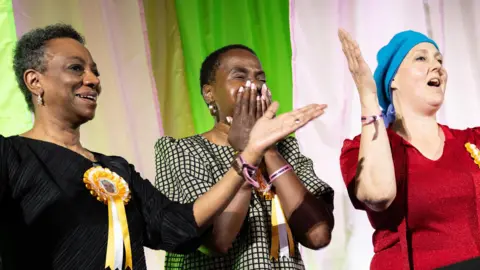
Charlotte Hollinshead, who has worked with Kalu for 25 years, said on stage at the ceremony that the win was seismic and had "broken a very stubborn glass ceiling."
Not everyone felt the same way.
Waldemar Januszcack, the chief art critic for the Sunday Times, described Kalu's work as "up there with the worst art I have seen at the Turner" and accused judges of "virtue signalling".
Gibson responded: "It's just so narrow-minded but it's to be expected. The Turner Prize is always criticised.
"It's almost part of its job to invite controversy, discussion and debate."
While opinions on the work vary, those at Project Ability are simply getting on with helping artists like Nnena Kalu, Andrew and Kendal fulfil their potential.
In Andrew's case, that includes a new goal.
Asked if he could win the Turner Prize next, he replied: "I can do it. Anyone can do it."
