Bedroom to the battlefield: How the UK military is embracing gamers and coders

 Ministry of Defence
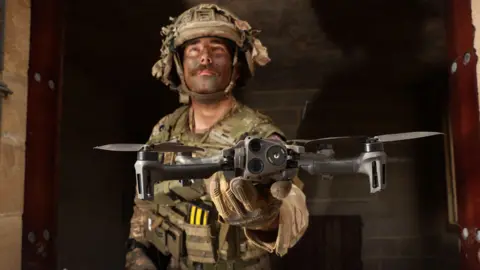
"All the lads here play Call of Duty Warzone, Battlefield... and I'm into Helldivers at the moment," says Charlie Bugby.
"Everyone plays games nowadays."
Like millions of young people up and down the UK, Charlie likes to unwind in front of a console or PC.
But unlike many others, the Army Lance Corporal puts his skills to use on the real-life battlefield, where he works with drones.
The Ministry of Defence (MoD), the government department in charge of the UK's military, has made no secret of the fact it wants more gamers to consider a career in the Armed Forces.
L/Cpl Bugby tells BBC Newsbeat it makes sense to him.
"I guess you could say it's a specific skill when you think about hand-eye coordination," he says. "Especially with drones."
Last year Defence Secretary John Healey, the politician in charge of the MoD, also appealed to "top coders" to consider a career in the armed forces.
There's been a steady decrease in recruits since 2012, when 180,000 people were enrolled in Britain's military, up to 2025, when 137,000 were members.
Healey was speaking as he launched a special scheme to fast-track "cyber military recruits" as part of reforms aimed at getting more people into the armed forces.
Corporal Alex, one of the first people enrolled via the new scheme, tells Newsbeat he's gone from modifying games in his bedroom to fighting daily cyber attacks against the UK.
The 27-year-old, whose surname has been withheld for security reasons, started intensive training last January and was one of 26 recruits who recently graduated.
He says modern warfare is "changing quite drastically", and believes people with his background are suited to helping to tackle it.
"Gaming is a natural gateway into a better understanding of computers," he says.
"Gamers come with their own skillset."
Newsbeat understands the Cyber Direct Entry Scheme used to enlist the group is now being expanded.
Adverts for the programme say those who enroll won't be required to serve in "dangerous environments".
But Cpl Alex says his training put him "under a certain amount of pressure" to see how he would react to stressful scenarios.
He says the impact of cyber attacks can be "really significant" for those fighting them, and they are "one of the bigger imminent threats to the country".
The MoD says about 90,000 cyber attacks are aimed at the UK each year and are designed to cause disruption by targeting vital services, business or private individuals.
The government recently sanctioned a number of Russian cyber attackers and accused China of being behind malicious campaigns against MPs in 2024, which Beijing denied.
Alex says he understands why some people might not be keen on a career in the military, but believes the cyber roles are "really important".
Should the military be targeting gamers?
 Ministry of Defence
Some of the most popular video games in the world have a military theme, and have been accused of glamourising or glossing over the reality of armed conflicts - something the companies behind them reject.
In 2024, the MoD scrapped a planned Fortnite collaboration called Operation: Belong but insisted it wasn't being used to recruit people.
Campaign group ForcesWatch, which raises concerns about the ethics of recruitment, tells Newsbeat "armed forces are increasingly occupying an important leisure space for teenagers, for their own purposes".
The group says online activity is "largely unregulated and invisible to those not directly involved", and argues it's impossible for parents to "understand the extent to which their kids are being targeted by online military marketing".
Official figures from last year show 92.2% of armed forces recruits were aged between 18 to 29.
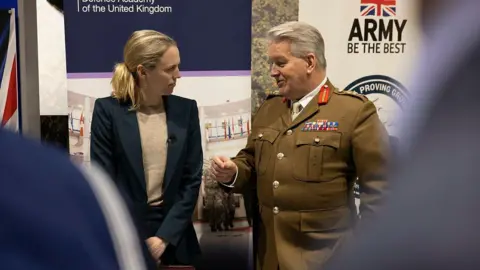
Speaking to Newsbeat at the MoD's London offices last month, Defence Minister Louise Sandher-Jones said recruitment was "always going to target the youngest demographics".
She said the MoD needed to ensure it reached young people via platforms that were popular with the age group.
"If they're on Twitch, then that's the kind of conversations that we need to be having," she said.
"This isn't just about going on to do something that looks cool.
"We recognise how important these skills are to defence, so it's definitely about targeting these skills."
 BFBS
BFBSThe armed forces are embracing video games in other ways too.
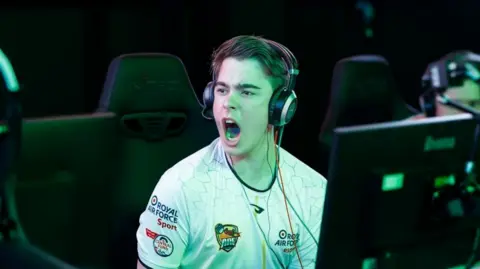
Esports was officially recognised as a military sport in 2024, allowing personnel to choose it over physical sports like rugby and football as a free-time pursuit.
RAF Air SpecialistRoman Davies plays Rocket League - a popular online multiplayer game - for the RAF Stormshadows team at esports tournaments.
He tells Newsbeat friends back home have become more interested in signing up to the armed forces when he tells them about his gaming experiences.
At work, he says gaming is a "fantastic morale booster" and one that has wider benefit to those in the military.
"You've got to be quick, you've got to be on it," he says.
"Especially competing at a young age as well, the pressure starts rising.
"Why not be able to transfer that into a military role as well?"
Roman says the fast decisions and performing under pressure developed as a gamer can also help to prepare you for real-life scenarios.
It's been seen in Ukraine, where the country's army has developed games to train soldiers.
"That's all being used with gaming controllers," Roman says.
"It's all being done miles away from where the actual front line is.
"Technology is advancing.
"We cannot stick to the old ways of how we do things."

