'Flying Concorde was beyond my wildest dreams'

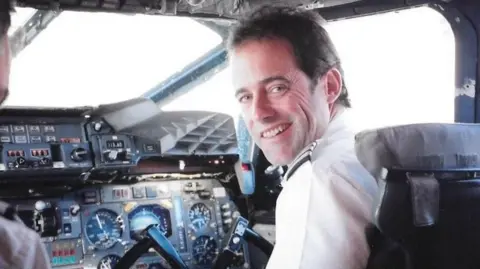 John Tye
A former Concorde pilot said having the opportunity to fly the supersonic plane was "beyond my wildest dreams".
John Tye, from Bristol, watched from the fence at London Heathrow as the inaugural flight to Bahrain took off on 21 January 1976. Twenty-three years later, he piloted a Concorde jet himself.
According to British Airways, Concorde flew almost 50,000 times with more than 2.5 million passengers until it was retired in 2003. It flew at more than twice the speed of sound at 1,354mph (2,179 km/h).
"It was one of humankind's greatest technical achievements, without doubt," Tye said.
Fellow crew members also reflected on their fond memories of Concorde to commemorate the 50th anniversary of its first commercial flight.
Julie Reynolds, a British Airways cabin crew member, said her younger colleagues have an "insatiable appetite" to hear about her experience working onboard Concorde.
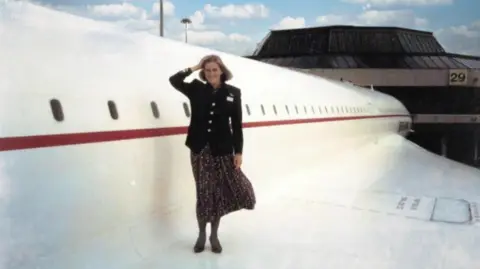 Julie Reynolds
"We were very, very blessed and privileged as a group of people to be able to say we flew at the edge of space, we saw the curvature of Earth and we met all these amazing people," she said.
She added that working on Concorde was "the most unique experience" of her career.
Marion Perks, a fellow cabin crew member, said flying Concorde was "magical".
"I wouldn't have wanted to do anything else," she said.
"Just to walk out to this magnificent piece of machinery and get on board was incredible. Then taking off and thinking to yourself 'oh my goodness, I'm going somewhere at twice the speed of sound and on the edge of space' was just the most incredible feeling," she added.
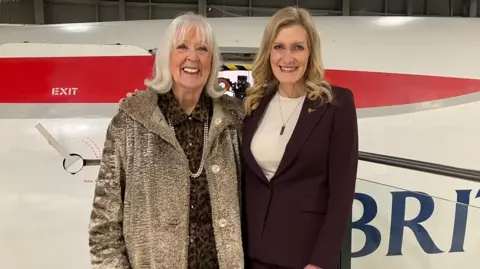
Jock Lowe, a former chief pilot, said flying Concorde was a "different" experience to flying other commercial jets and nothing could have prepared him for the power of the plane.
Speaking about his first time piloting Concorde, he said: "It was very daunting because I hadn't actually seen the aeroplane before.
"I remember looking at it and thinking 'goodness gracious, wow, what a machine' and then an hour later I was taxiing it out.
"It was exciting... it was a good experience," he added.
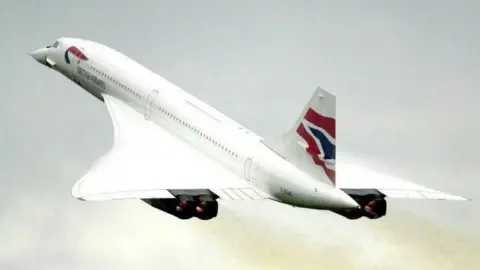 PA Media
After its first flights in 1976, Concorde began its signature route from London Heathrow to JFK Airport in New York in November 1977.
From 1985, Concorde also flew supersonic journeys from Gatwick Airport.
On 25 July 2000, Air France Flight 4590 crashed shortly after take-off, killing all 109 people on board and four on the ground. It was the only fatal incident involving Concorde.
Investigators found one of the plane's tyres had struck a small piece of sheet metal that had fallen from an aircraft that had taken off five minutes earlier.
Commercial operations never fully recovered from publicity after the crash, and concerns over pollution and ground noise contributed to the joint Franco-British decision to cease the flights.
The last Concorde to take flight landed at Filton Airport on 26 November 2003. The Alpha Foxtrot has been housed in a purpose-built hangar at Aerospace Bristol ever since.
Follow BBC Bristol on Facebook, X and Instagram. Send your story ideas to us on email or via WhatsApp on 0800 313 4630.
