Potholes compensation: How much is your council paying out?

 Getty Images
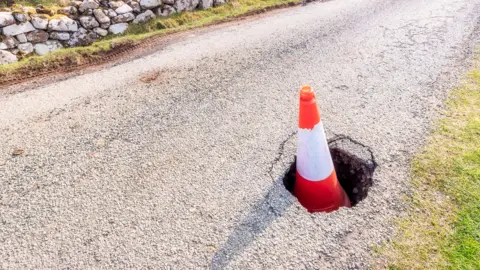
Scottish councils paid out more than £2m in pothole compensation over the past five years, a BBC investigation has found.
Between 2020/21 and 2024/25, local authorities received more than 18,600 claims for pothole-related vehicle damage across Scotland, but only around a quarter received compensation.
Drivers and mechanics told BBC Scotland that hitting a pothole can result in expensive repairs.
Cosla, which represents Scotland's councils, said authority finances were under "intense pressure", adding that authorities were having to "juggle competing priorities".
The Scottish government said it had provided "record funding" to local authorities as part of the 2026/27 Budget.
'They're everywhere and it's scary'
Although not all pothole claims are paid out, Marie McCallum, a mobile hairdresser from Macduff, told BBC Scotland she successfully claimed compensation from Aberdeenshire Council when her car hit a pothole in 2024.
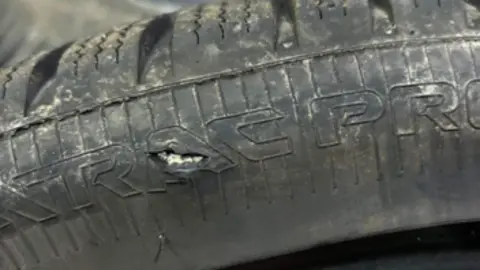
"I was annoyed the pothole just ripped the tyre and there was no warning on the road," she said. "It happened on a bend and there was a lorry coming the opposite way so I had no choice but to go over it. It was a bit scary."
 Marie McCallum
 Marie McCallum
Describing the compensation process, McCallum said: "I sent an email to the council, not expecting compensation back. I had to send in photos, which luckily I took at the time, and my receipt. It went to Aberdeenshire Council and then it had to go to their insurance company. I think I got 90% of the bill."
The pothole caused nearly £200 worth of damage to her car.
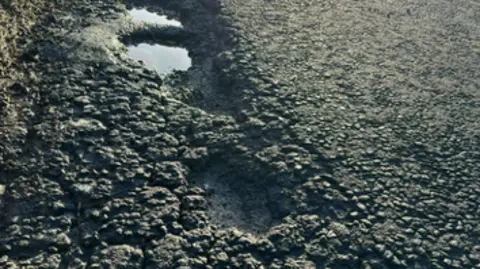
"I live in Macduff and on the main road there is a big pothole, you've got to avoid it every time or slow down. I'm frightened I'll go over it and rip the tyre again."
She added: "Every time you go on the road you've really got to watch where you're going because there are so many potholes."
 Marie McCallum
Which councils have paid out the most?
Figures obtained by the BBC through freedom of information requests show councils in Scotland paid out a total of £2,029,045 for pothole-related vehicle damage. However, complete data was only provided by 25 out of the 32 Scottish councils, so the true figure will be higher.
On average, 22% of claims were successful in Scotland, slightly lower than the average across Britain of 24%. In total, nearly 5,500 claims received payouts.
Compensation varies significantly by local area, however.
City of Edinburgh, North Ayrshire and South Ayrshire councils paid out just 6% of claims, while Highland Council paid out 74%.
Highland Council also had the largest pothole bill of all councils, paying out almost £580,000 over the five-year period. Orkney Islands Council, which paid compensation to only one of its five claims, had the lowest total compensation bill of £727.
Dumfries and Galloway received the greatest total number of claims, with over 3,100, while Shetland Islands Council received just one.
And in Aberdeenshire where Marie McCallum lives, 22% of claims were successful, resulting in total payouts of nearly £140,000.
Is the problem getting worse?
The AA recorded 5,241 pothole-related incidents in Scotland in March, an increase of almost 8% on the previous month. It said its monthly average for 2026 is tracking at 5,295 incidents, higher than in recent years.
Lewis Mennie, manager at Westhill Cars, told BBC Scotland his garage had also seen a "significant increase" in the amount of cars requiring repairs for suspension components, wheels, tyres and wheel alignment.
"It causes a lot of frustration for our customers because those repairs can be expensive," he said.
"These components aren't needing replaced for any other reason other than due to the road conditions. We're seeing cars that are maybe one or two years old requiring replacement parts that they shouldn't be needing. It's purely down to the road conditions."

He added: "It's getting to the stage now where it could become a safety issue because of people swerving potholes."
Despite figures suggesting Scotland's pothole problem is getting worse, drivers are not automatically entitled to compensation from councils. Drivers could only be entitled to a payout if the council is legally liable. The same would apply for cyclists and pedestrians.
A pothole-related claim would need to be in relation to a road maintained by the council - but there are instances where even this might not be applicable, such as if an incident happened because a third party was working on the road.
Claims can generally be made for vehicle damage, personal injury or property damage/loss.
Stretched council budgets
The figures come as Scotland's councils face increasing pressure to balance the books, with some introducing inflation-busting tax hikes for the new financial year.
A spokesperson for Cosla - the umbrella body which represents the 32 local authorities - said: "Councils are committed to keeping roads for which they are responsible safe and carry out critical maintenance where necessary.
"After another year of flat cash capital settlement, council finances are under intense pressure which has an impact on local authorities' capital programmes and revenue spend. This means that the funding needed to meet the high standards and efficiency for essential services, including road maintenance, must go even further and councils need to juggle competing priorities.
"This will inevitably have consequences which councils do their best to minimise for their communities."
The Scottish government added: "The Scottish Budget 2026/27 provides record funding of £15.7bn to local authorities, including £250m of unrestricted general revenue grant.
"It is for individual local authorities to allocate the total resources that are available to them on the basis of local needs and priorities."
£13.5m payouts across Britain
Across Britain, over 146,000 claims were submitted for pothole-inflicted vehicle damage over the past five years, with councils paying out £13.5m in claims. However, this only covers a fraction of the total number of claims submitted.
Out of 207 local authorities that hold the information, 147 provided information to the BBC about the number of pothole claims received in the last five years and the ones that were successful.
Additional reporting by Ben Philip and Marta Leshyk
