Town pioneers research into mine water heat technology

 Mining Remediation Authority
A mine water heat scheme is transforming a town's mining legacy and advancing the potential of mine water heat technology by providing "incredibly rare" data to researchers around the world.
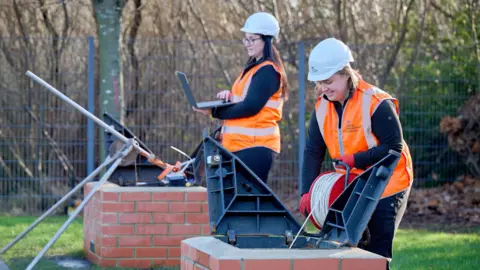
The open-access Living Laboratory, in Gateshead, was launched in early 2025 to monitor the interactions between three operational mine water heat schemes in the north-east of England.
Led by the Mining Remediation Authority, the first year has generated thousands of hours of data looking into how such schemes can be scaled up to provide renewable energy to more homes and buildings.
"It's about turning that mining legacy into a low-carbon heating solution," said Dr Fiona Todd, geoscientist and project lead.
The three local schemes include Gateshead Energy Company's mine water heat network, which heats buildings such as the Baltic Centre for Contemporary Art and Gateshead College, and another privately-funded scheme nearby, at Lanchester Wines warehouses, close to the River Tyne.
Mine water heat technology uses the naturally warm water held in flooded former mines to provide a secure, low-carbon heat source.
Around 350 homes and businesses in Gateshead are already supplied by mine water heat schemes, with other developments under way, including at Seaham Garden Village in Country Durham.
"This heat is not going somewhere else - it's not getting sent somewhere else, it's being used by the local community," said Todd.
She said the North East, as home to the largest mine water heat network in Great Britain, provided a unique research environment to study how multiple schemes co-exist - and what kind of opportunities this presents.
 Mining Remediation Authority
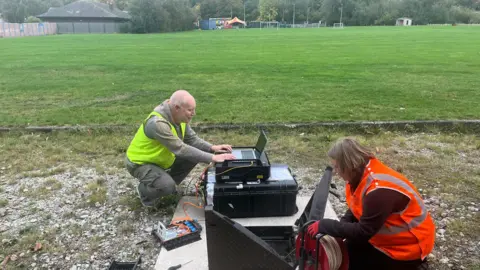
Data is collected from the Gateshead system every 15 minutes and made publicly available, allowing researchers, regulators, policymakers and academic institutions anywhere in the world to make use of the outcomes.
Researchers from Lawrence Berkley National Laboratory, managed by the University of California for the US Department of Energy's Office of Science, are among those engaging with the data.
As Dr Christine Doughty, staff scientist, explained, "their experience of actually extracting energy from these systems is still limited".
"The Living Lab will help us learn how to systematically develop these systems and optimise performance," she said.
"Access to real-world mine water data at this scale is incredibly rare," said Todd.
"It's a proven technology, but the research development that I'm doing is trying to unlock the potential further and really help drive it forward.
"Gateshead is like the pioneer for this, in the UK and the world."
