Why are parents flooding MPs with demands to ban social media?

 Getty Images
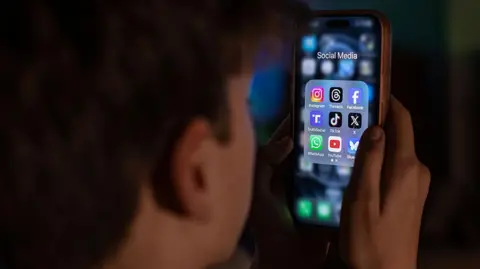
MPs have been facing a tidal wave of letters from parents demanding social media is banned for under-16s.
More than 235,000 people have now written to their MP calling for action, and on Monday the government announced it would consult on whether it should impose a ban.
Some say their children have been shown pornography and violent content by school peers, while others claim online platforms push bullying beyond the classroom.
So what do those fighting for change say - and why do they feel so strongly about it?
 Martin Giles/BBC
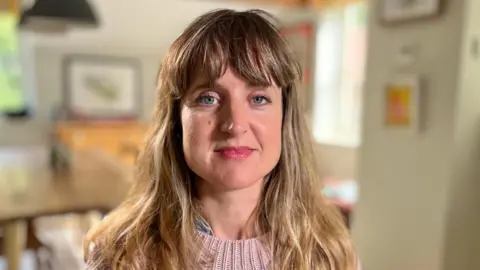
Daisy Greenwell, from Woodbridge, Suffolk, started Smartphone Free Childhood (SFC) as a small WhatsApp group with a friend.
Its popularity has since exploded, leading to the creation of regional SFC splinter groups across the country, and making national headlines.
The 42-year-old is behind the surge of letters sent to MPs - a movement she launched on 13 January.
"Right now, it's really difficult for parents, families and kids to negotiate these platforms, which are so addictive," Greenwell says.
"There is so much harmful stuff on there; content that we would never show our kids in real life."
Her campaign has led to the average MP receiving about 350 emails over the past week.
It has been encouraged by landmark action in Australia that outlawed social media for under-16s in December.
But speaking to BBC Radio 5 Live Breakfast, Sophia, a 14-year-old from Brisbane, said it was easy to dupe the authentication processes and remain online.
"I haven't had a single friend that's been banned," she reveals.
 Getty Images
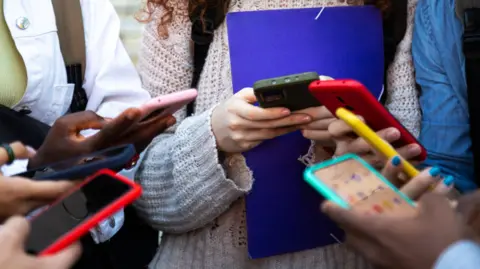
A quarter of 13-18 year olds surveyed for BBC Bitesize and BBC Radio 5 Live in 2024 revealed they used their phones for about five-and-a-half hours on a typical day.
"That's 35 hours a week - a full-time job," Greenwell says.
"It's removing what kids should be doing, which is being together face to face, playing sport, reading, listening to music.
"The addictiveness of these platforms has sucked this away from children."
Robina Kaye, from Royston, Hertfordshire, agrees.
The mother-of-two fears what her children - aged five and eight - could be exposed to if they join social media one day.
"I find it terrifying that somebody could present themself as a 12-year-old gamer, but in actual fact they are an adult trying to get a child to do other things," she says.
Bullying is also worsened by the constant inter-connectivity among children, Kaye believes.
"I was bullied a lot when I was young, but when I went home that was it – I was safe," she adds.
"But with social media they can never leave it behind and that is terrifying."
 Paul Arnold
Announcing its consultation, the government said "immediate action" would give Ofsted the power to check policies on phone use when it inspected schools.
It also expected schools to be "phone-free by default" as a result of the announcement.
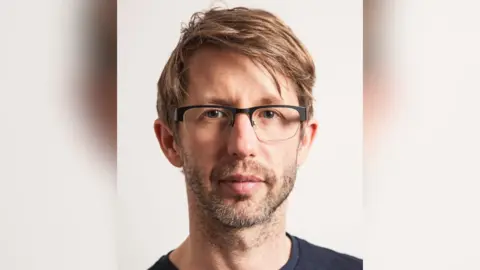
Paul Arnold, whose son attends a secondary school in north Essex, is among those who believe a social media ban does not go far enough.
He wants smartphones to be banned in schools for all children, who could instead carry a device unable to use the internet.
"Social media is toxic for kids as they're addicted to the algorithm and their life can be taken away from them by staring into their phones," he says.
"But for me, social media is the drug and the smartphone is the drug dealer."
'False sense of safety'
Arnold says some pupils at his son's school have used their mobiles to show others pornography and pictures of dead babies.
"If a social media ban happens and it takes kids offline then great, but they're still going to find other stuff to dive into," he says.
The NSPCC, Childnet and suicide prevention charity the Molly Rose Foundation are among 42 individuals and bodies who argue a ban would be the "wrong solution".
"It would create a false sense of safety that would see children – but also the threats to them – migrate to other areas online," the organisations wrote.
 UK Parliament
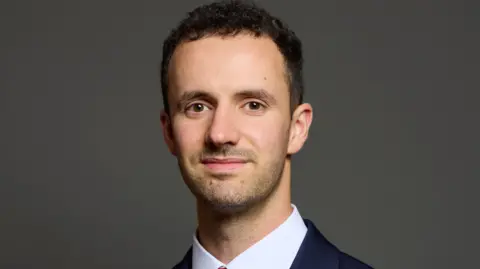
North East Hertfordshire MP Chris Hinchliff has become acutely aware of the strength of feeling.
He is among the 61 Labour MPs to have signed a letter, sent to the prime minister, calling for a ban.
Hinchliff received more than 800 emails from constituents in the week after the SFC campaign started, 100 of which were sent on Monday alone.
"Australia has shown that governments can stand up to the big tech companies and put young people's well-being first," he says.
"It's time for the UK to look seriously at similar safeguards."
The MP argues while social media can be a "powerful tool", it can also "expose children to harmful content, distort development and erode mental health."
Conservative leader Kemi Badenoch has also said her party would seek to ban under-16s from accessing social media if they won power.
 John Fairhall/BBC
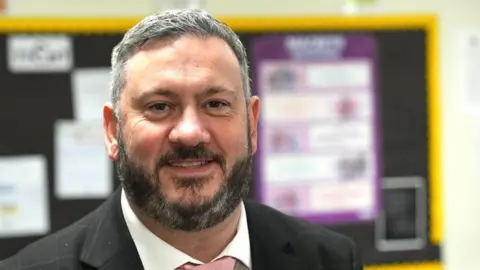
A novel approach to tackling issues brought on by social media and smartphones was taken at The Stanway School, near Colchester.
Pupils gave up their phones for 21 days and their behavioural changes throughout were monitored by experts as part of a Channel 4 documentary.
The study found a 17% reduction in anxiety and depression symptoms among those taking part.
Head of school John Player said: "The project was very useful for us as it highlighted at that highest level about the potential risks of smartphones.
"The results were quite clear and have helped us raise this question to the national level.
The government is due to respond to its consultation in the summer.
Follow East of England news on X, Instagram and Facebook: BBC Beds, Herts & Bucks, BBC Cambridgeshire, BBC Essex, BBC Norfolk, BBC Northamptonshire or BBC Suffolk.
