What would happen if Storm Desmond hit today?

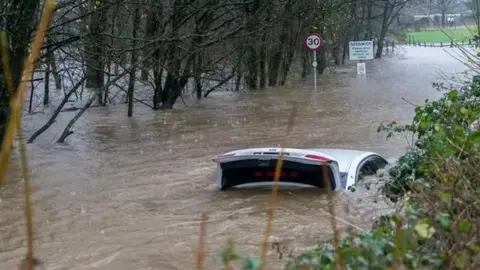 Great Impressions/Weather Watchers
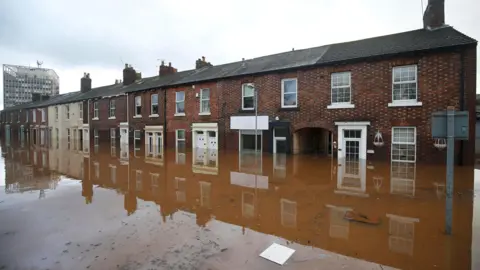
Storm Desmond led to thousands of homes and businesses being flooded in northern England in 2015.
One study suggested it was one of the most extreme floods to the hit the area in 558 years.
The Environment Agency (EA) has said that it and its partners have spent more than £600m on reducing flood risk in Cumbria and Lancashire in the time since.
But is this enough? Scientists are not so sure.
In addition to Cumbria and Lancashire, parts of Northumberland and Scotland were also hit by Storm Desmond.
According to Northumberland County Council, the worst hit areas were Corbridge, Hexham and Haydon Bridge after the River Tyne breached its banks.
The EA previously said it had invested £20m in the Tyne Valley since Storm Desmond to reduce the area's flood risk.
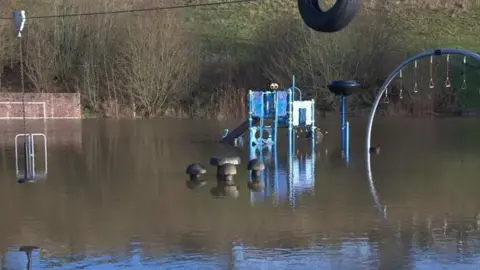 Falstone Janet/ Weather Watchers
Geomorphologist Dr Richard Johnson at the University of Cumbria said it was "really difficult" to determine whether northern England would be better protected against a major storm today compared to 2015.
The question is so difficult to answer in part due to climate change, he said.
"The conditions which we are defending are shifting," he said. "With climate change, the frequency and magnitude of these events is not static.
"Clearly, a storm of that significance is [still] going to cause problems."
The EA estimated it had strengthened protection in Cumbria and Lancashire for 41,000 properties.
 REUTERS/Andrew Yates
Dr Johnson said the EA should be commended for the flood defence work it had carried out in north-west England since Storm Desmond but questioned whether it was enough to protect locals in the face of stronger and more frequent storms.
Hydrologist Dr Nick Chappell at the University of Lancaster said the region could not "rest on its laurels".
He pointed to the EA's work in Grange-over-Sands as evidence that newer "nature-based" flood management techniques were effective and should be expanded.
"There's one small area [there] that has been at really high risk of flooding," he said.
But flood defence work including installing a bund, which is a mound of earth built to hold back water, had massively cut this risk, he said.
The EA said it had spent £25m over the past decade on these so-called natural flood management (NFM) techniques.
But Dr Chappell said: "We really have to scale up what we're doing."
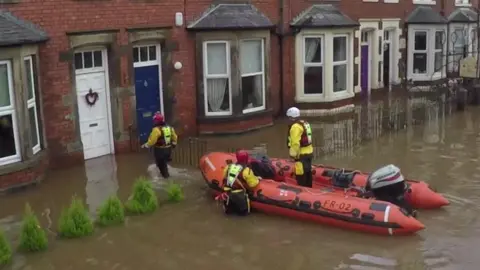
Coastal geomorphologist Prof Iris Möller at Trinity College Dublin questioned whether a more long-term solution needed to be considered.
"Storm Desmond, when it does reoccur, in a future climate is likely to be more intense," she said.
More sea walls and other flood defences may not be enough, she said.
Ultimately, it could mean the government taking seriously the fact that some people, in particularly high-risk coastal areas, will have to move, she said.
"Now that is a very difficult task," she said. "It needs to be done with communities and with individuals… it's happened in history and it can be done much better than just letting people's homes fall into the sea."
