Australian fugitive Dezi Freeman shot dead after months on the run, police believe

 Nine/A Current Affair
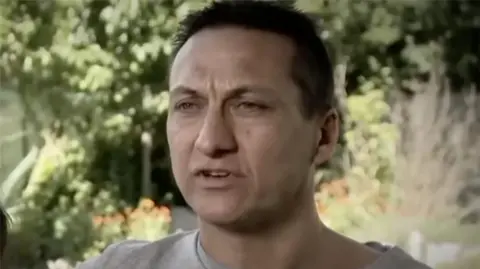
Australian fugitive Dezi Freeman has been shot dead by police after seven months on the run.
In August, Freeman, 56, gunned down two police officers on his property in the small Victorian town of Porepunkah before fleeing into dense bushland and evading extensive searches.
Victorian Chief Commissioner of Police Mike Bush on Monday said a man had been killed after an hours-long armed standoff at a rural property in north-east Victoria shortly after 08:30 local time. A formal identification process was underway, but the man was believed to be Freeman.
Freeman had "an opportunity to surrender peacefully" but did not, Bush added.
"Should [his identity] be confirmed … this brings closure to what was a tragic and terrible event."
Investigations will now focus on anyone who may have helped Freeman while he was on the run.
"It would be very difficult for him to get to where he was... without assistance," Bush said, and "if anyone was complicit, they will be held accountable".
The families of the two slain police officers were the first to be told about Freeman's death, he said, adding it that it would take 24 to 48 hours to confirm the identity of the body.
Police believe Freeman came out of a building - which Bush described as a cross between a container and a long caravan - armed and wrapped in a blanket.
"Our ultimate goal was to arrest the person... as peacefully as possible," Bush said, but "we don't determine how they act."
No police officers were hurt during the shooting, police said. The state coroner will attend the scene.
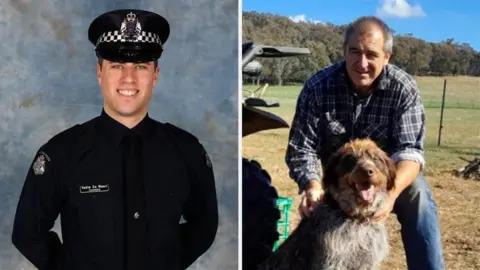
Freeman, a well-known conspiracy theorist, shot dead Detective Senior Constable Neal Thompson and Senior Constable Vadim de Waart after police went to his home on 26 August with a search warrant as part of a child sex abuse investigation.
In a statement on Monday, the Police Association of Victoria said Freeman's death was a "step forward".
"Closure isn't the right word," the statement said, adding that it "doesn't lessen the trauma" of the two police officers' deaths.
Authorities will launch an investigation into Monday's events as part of the standard process after a police shooting.
Freeman, whose real name was Desmond Filby, was a self-described "sovereign citizen", part of an anti-government movement that rejects authority and laws.
Locals in Porepunkah - an alpine tourist town beneath Mount Buffalo - said he had lived on his property with his wife and two children.
 Victoria Police
After the alleged double murder of the two police officers, the entire area was shut down and police - with the help of international and specialist teams - scoured the area for Freeman.
After almost two weeks of failed searches, police offered a A$1m (£525,000, $709,000) reward - the highest in the state's history - for information on the father-of-two.
But Freeman - who police said had strong bush survival skills - remained on the run.
Last month, police renewed their efforts to find him with a five-day search in Mount Buffalo, saying they "strongly believe" he was dead but admitted they had no evidence to prove this.
A close friend of Thompson, a long-serving police officer who was due to retire days before he was shot dead - welcomed the news of Freeman's death.
"It's a good day," John Bird told the Australian Broadcasting Corporation, adding it "doesn't change much" but brought closure on Freeman's whereabouts.
Helen Haines, the local MP for Porepunkah, said a dark cloud had hung over the town since last August and Freeman's death "draws this prolonged and devastating incident to a close".
A history of conflict with authority
Freeman was no stranger to run-ins with police.
His hatred of authority and sovereign citizen beliefs were well documented in online posts, videos and court documents.
He called police "terrorist thugs", compared them to Nazis and tried to arrest a magistrate during court proceedings.
Locals in the town of Porepunkah have told media Freeman's extremist views hardened during the pandemic, amid government rules and restrictions which were particularly strict in his state of Victoria.
He in 2021 made headlines with an attempt to have then-state Premier Daniel Andrews tried for treason, but the case was thrown out.
Police had expected their search last August wasn't going to be a straightforward interaction. After a risk assessment, they opted not to request specialist police support, instead sending ten officers to his property.
Among them was a local detective from a nearby town who was on the brink of retirement. Thompson was selected for the job because he'd had previous dealings with the target and was thought to have built a rapport with him, The Age newspaper reported at the time.
Within minutes of arriving at the property, he was shot dead, alongside De Waart.
Thompson's partner - also a police officer - said the AFL fan and adventure lover was the "best husband she'd never had". Family and friends remembered De Waart, originally from Belgium, as the kind of person who was always happy, who was always smiling and trying to make others laugh.
Their deaths revived questions in Australia about how the country deals with growing sects of anti-government conspiracy theorists.
A trio with similar anti-authority and pseudo-law beliefs ambushed and killed two officers - also gunning down a bystander - at a rural property in Queensland in 2022.
Authorities in Australia have since the pandemic warned of the growing threat of conspiracy theorists.
The Australian Federal Police have described pseudo-law believers as a group with an "underlying capacity to inspire violence", while the prime minister has said intelligence agencies are taking the danger they pose seriously.
