'Exceptionally rare' Roman lead blocks found on farmland

 Nick Yallope/Peter Nicolas
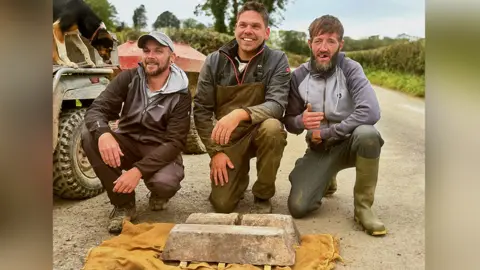
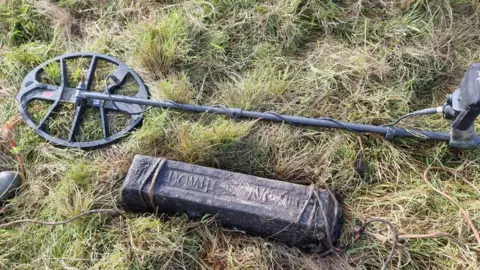
Metal detectorists have discovered two "exceptionally rare" lead blocks on farmland in west Wales.
The ingots date back almost 2,000 years to AD87, based on lettering written on the objects, which refers to the Emperor Domitian, who was known for his empire building, including expansion in Britain.
The objects, which were used to produce tools and weapons, were found on grazing land in Llangynfelyn, Ceredigion, by Nick Yallope and Peter Nicholas.
"Roman ingots are exceptionally rare and represent a tangible link to Wales' Roman industrial past," said landowner and farmer Geraint Jenkins, who granted the detectorists permission to search on the land.
Yallope said he felt "incredibly proud to have uncovered something so rare and important to our local heritage".
"Unlocking a new chapter of our area's past is incredibly exciting," said Yallope, while Nicholas said he was trying to "save history for the local community and future generations".
Carrie Canham from Ceredigion Museum in Aberystwyth said the artefacts were the first of their kind to be found in west Wales and "highlight Ceredigion's significance in Emperor Domitian Caesar Augustus's empire building".
"Ceredigion's rich mineral and ore deposits were a major reason the Romans sought to conquer this area," she added.
 Nick Yallope/Peter Nicolas
She said lead mined in the area travelled across the breadth of the Roman Empire, adding that the museum was excited at the prospect of acquiring these "remarkable objects".
It is planning to share the story in a new archaeology gallery opening in 2027.
Jenkins, the farmer and landowner where the find was made, said he was "astonished" at the discovery, adding it was "remarkable to think that land we now farm organically once played a role in a much wider Roman landscape".
What should you do if you discover treasure?
Treasure has a variety of definitions, and any treasure found in Wales must be reported to a Finds Liaison Officer within 14 days of first finding it, or 14 days of realising an item might be treasure.
Those not reporting finding treasure can face a fine or be jailed, and there are different rules for Scotland and Northern Ireland.
Those who find treasure will be contacted either by a Finds Liaison Officer or museum curator to discuss the find. They will also be issued with a receipt.
The object or objects found will then be assessed by experts to determine if they meet the legal definition of "treasure" under the Treasure Act 1996.
