Coastal defences could be moved to protect village

 Shaun Whitmore/BBC
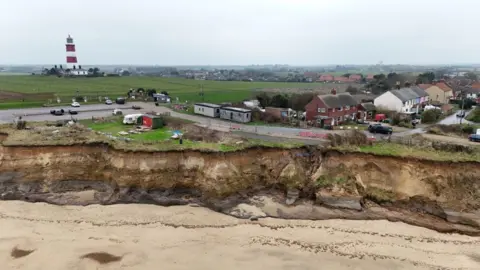
Coastal defences could be moved to better protect a village which has been ravaged by the sea in recent years.
North Norfolk District Council has agreed to explore ways to change the existing rock armour at Happisburgh.
To do so, the authority has agreed to continue leasing a stretch of foreshore from a private landowner so the coastal protection work can take place.
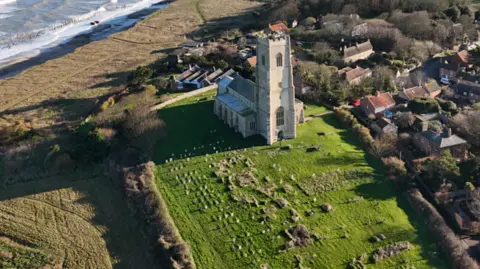
During the past 20 years, 34 homes have crumbled into the sea and the village's medieval parish church is now about 80m (260ft) away from the cliff edge.
The council's Coastwise project is reviewing the effectiveness of the rock armour and assessing alternative options for its use at Happisburgh, according to the Local Democracy Reporting Service.
Rock armour works by absorbing the power of waves to help slow erosion rates.
The changes being explored by the council could involve moving the rocks around the beach.
 Shaun Whitmore/BBC
Council cabinet member Harry Blathwayt said the lease renewal was "even more important" after the government awarded £18m towards the "most-at-risk" coastal areas last week.
The funding announced in the government's Coastal Adaptation Pilots for Norfolk, Suffolk and the East Riding of Yorkshire is not intended to be used for immediate repairs to existing defences or demolition.
"The foreshore at Happisburgh is famous for its difficulties, and if we are to carry on helping as we are, we need to get this settled," Blathwayt said.
A spokesman for the council stressed the lease renewal was part of ongoing work, which started early last year with the review of the rock armour.
He said: "This was in conjunction with exploring options for continued beach access as part of preparation for wider longer term coastal planning in Happisburgh.
"The rock has been moved on occasions in the past as the coast has eroded, but no decision as to how and when the rock will be moved has been made."
Some 14 homes in Hemsby, further down the Norfolk coast, were at threat of collapsing into the sea. Hemsby has lost 36 properties to the sea or demolition since 2013.
In Suffolk, 10 homes have been lost to coastal erosion this winter at Thorpeness.
Follow Norfolk news on BBC Sounds, Facebook, Instagram and X.
