Have £18m funds come too late to save our coast?

 PA Media
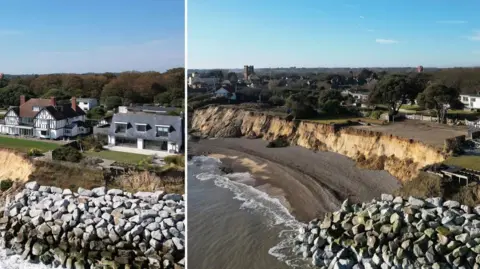
Coastal communities whose homes are falling into the North Sea are to have access to a share of an £18m government pot - but has the money come too late?
It was announced on 28 January that a total of £18m will be shared between Suffolk, Norfolk and East Riding of Yorkshire.
The Minister for Water and Flooding, Emma Hardy, said: "This new government investment will help some of our most at-risk coastal areas take practical action now, while building the evidence we need to support coastal communities across the country in the decades ahead."
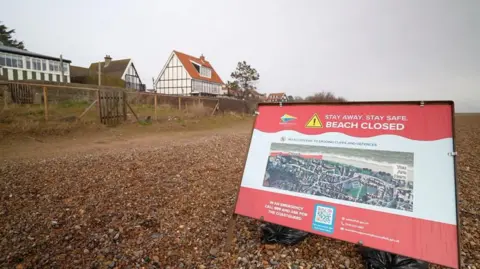
But what do residents in the holiday village of Thorpeness in Suffolk think about the cash injection with 10 homes lost to coastal erosion already this winter?
 Martin Giles/BBC
At the Dolphin Inn in Thorpeness, the monthly community coffee morning is well attended. The village, originally designed as a holiday getaway for the relatively affluent at the turn of the 20th Century, has a thriving community living there all year.
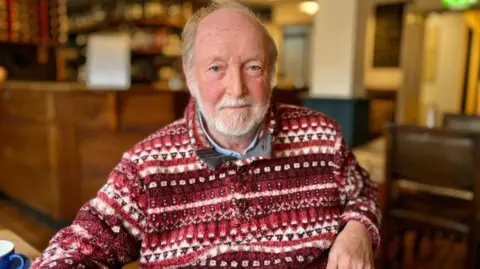
Dave McAllister's home is not at risk at the moment, but he says it is not very far from where the problems are.
He said the money coming to Suffolk was "wonderful".
However, it cannot be spent on trying to halt the erosion happening already or to save homes that are at imminent risk and that is frustrating for villagers.
McAllister said: "Every major high tide, once a month, is taking another chunk out of it [the sandy cliff].
"There are lots of meetings and discussions and planning and everything else, but we need action now. It's great to hear there's money but somebody high up needs to realise that if we spend another two months thinking about it, it's too late. It will all have gone. It's very scary."
 Martin Giles/BBC
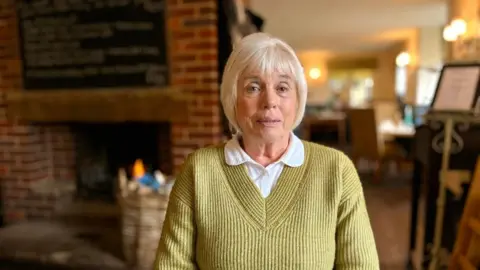
Maureen Jones, chairwoman of Aldringham-Cum-Thorpe Parish Council, was updating residents on the campaign to raise funds for temporary defences, when the BBC told her about the additional funds.
She welcomed the money, but said: "It is too late and it should be to help what is actually going on now. It would be wonderful that something could be done in the future, but we want something now.
"Homes have just been destroyed and they do not get a penny from it. It's heartbreaking".
 Martin Giles/BBC
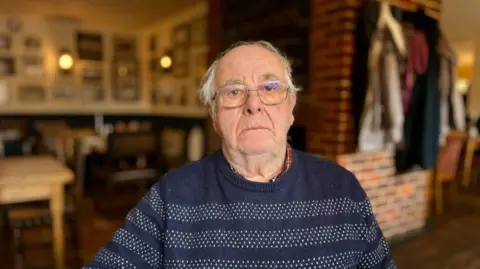
John Westrup, 82, has spent most of his life in the village. He is worried any money coming to the community will not be enough.
He said: "It will be spent in penny packets and we will actually not receive much. It needs to be one lump, one thing."
Westrup thinks there needs to be a permanent solution, although he added that even something temporary would help right now because the coastline is constantly changing.
"I used to go fishing off the beach, out of the boat, and it has changed so much. I hope it stops, but who knows?"
 Martin Giles/BBC
In the heart of the village is the meare, dug out by hand in 1913 when the hamlet of Thorpe was being transformed into a holiday destination.
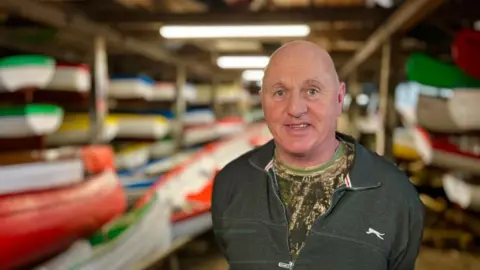
Craig Block was born in the village and has been head boatman at the lake, which he calls the "heart and soul" of Thorpeness, for 35 years.
"I have never seen erosion quite as quick or as fast as that," he said.
"If we don't get some sort of funding now and the sea does breach, the lake will then turn brackish which would mean that's half salt- and half freshwater. It's going to be a hell of an impact on the lake itself, and nature.
"We need help now, desperately."
 Martin Giles/BBC
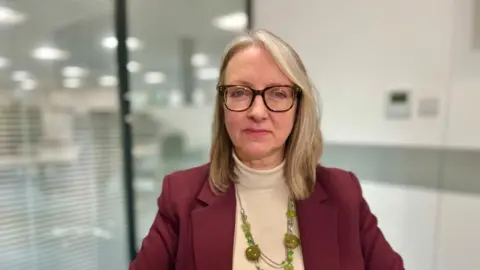
Caroline Topping is the leader of East Suffolk Council and heads up the ruling coalition of Greens, Liberal Democrats and Independents.
"Unfortunately, we cannot use this [government] money to put in defences to stop the sea coming into the cliffs," she said.
She emphasised the money was to help people who were facing losing their homes in the future.
"It's about giving them time now to think about how they want to have a dignified exit from their current living situation and be moved inland," said the Green councillor.
Topping feels the government could have a designated coastal minister "to fight our corner and to give us the funding that we need to actually solve this dire situation".
"But that does not mean that we are going to be able to put in rocks and things to stop the sea. This is about managed retreat to allow the coast to realign and giving people the dignity and time to be able to come to terms with what is going to happen," she said.
The area's Labour MP, Jenny Riddell-Carpenter, said: "It's all very well having a coastal minister, which is what I want, but we also need to make sure we bring forward the right plans with the right funding at the right time.
"There is no statutory plan to get coastal protection in place but it also doesn't stop people bring forward their plans [to relocate their homes]."
 Martin Giles/BBC
Suffolk's coastline is currently experiencing one of the highest rates of erosion in Europe right now, according to East Suffolk Council.
The Environment Agency's recent National Coastal Erosion Risk Map (NCERM) showed that about 20,000 properties could be at risk from coastal change by 2105.
At Defra, minister Hardy said: "Coastal erosion is one of the most challenging impacts of climate change and we will always support our towns to adapt where the forces of nature make long-term defence impossible.
"This new government investment will help some of our most at-risk coastal areas take practical action now, while building the evidence we need to support coastal communities across the country in the decades ahead."
Follow Suffolk news on BBC Sounds, Facebook, Instagram and X.
