How a northern port punched at a global weight
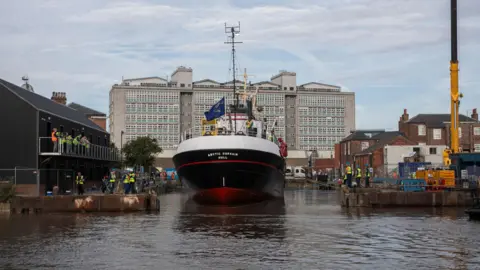
When the Arctic Corsair, an iconic deep-sea trawler, was carefully manoeuvred up the River Hull to a new home this month, the event carried echoes of earlier times.
The Corsair - a museum ship dubbed "Hull's Cutty Sark" by the team behind it - was the first ship in decades to enter the last surviving part of the city's oldest dock.
Built in the 1770s, Queens Dock helped turn Hull into a global powerhouse, as the Hidden East Yorkshire podcast has been hearing.
"It was dug out with pickaxe, shovel, wheelbarrow," says Dr Robb Robinson, a maritime historian.
"It cost about 60,000 quid to build at the time, which sounds very cheap, but that would be equated to something like 30 or 40 million today. It was a really big enterprise."
Most of the dock has been filled in, but the entrance survives and provides a permanent home for the Corsair, alongside a newly built visitor centre.

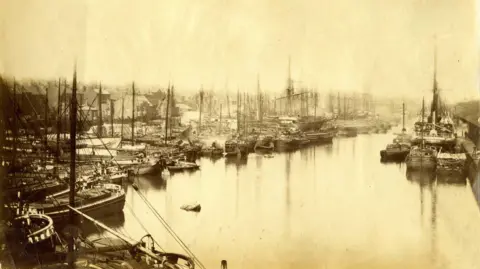
The Dock, as it was then known ("Queens" was added after a visit by Queen Victoria in 1854), was needed because the old wharves along the River Hull could no longer cope with the volume of trade being generated by booming Britain.
"The Humber Estuary links you with the powerhouses of the Industrial Revolution, which is West Yorkshire, South Yorkshire, and so on beyond, and goods were coming here to be transshipped out abroad and also raw materials brought in. So trade grew massively."
At the old entrance, it is still possible to get a sense of the scale of the development.
"We can see, envision, just how big the dock itself would have been," Robinson says. This was huge compared with what we'd had before on the quays."
 Hull History Centre
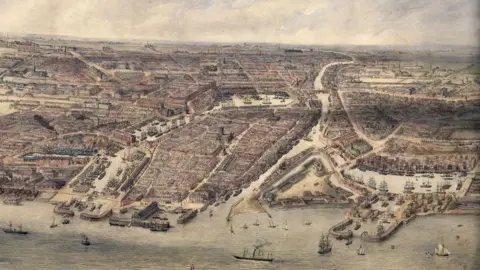
But that was just the start. Over the next century and a half, a string of docks were built, first around the city's Old Town and then along the banks of the Humber.
"Trade continues to grow," says Robinson, an honorary research fellow at the University of Hull.
"Hull is one of the biggest ports in the country. It's vying with Liverpool, Glasgow, Bristol and all sorts of places for its second or third position in the country."
One of the new docks was dedicated to timber, while another specialised in coal exports.
"But it didn't stop there," says Robinson. "They started building the Salt End jetties in 1914."
Salt End became the location of an oil refinery.
"If you think about it, this is just the period when internal combustion traffic is growing. You need petrol, you need oil."
 Hull History Centre
The final dock, Queen Elizabeth Dock, opened in 1969 as an extension to the earlier King George Dock.
"And the reason we have a series of different docks is because ships grow massively over time," Robinson explains.
As times changed, Queens Dock became redundant. It was filled in almost a century ago and turned into a public park called Queens Gardens.
Today, visitors can trace its history thanks to a series of new installations that stretch between the Corsair and the newly reopened Maritime Museum, which is housed in the former dock offices, a grand Victorian building complete with three domes.
"It shows how the town grows in prosperity," Robinson says.
"It's a very elegant building. It's got a lot of refinement. You can see that there's money in the city."
Some of the docks have been filled in, but others survive. Humber Dock, for example, now houses Hull's Marina and retains some of its old warehouses and other features.
"You can still pick out in odd places where the old railway tracks used to run, when they moved wagons around," Robinson says.
Another, Alexander Dock, has been converted into part of a Siemens plant for building and shipping wind turbines.
"We can see the turbines standing up there, but go back to the 18th Century, for example, and what would we find? We'd find that Hull was a major whaling port, and why did you go whaling? You went whaling largely for whale oil, which was used to light the streets of the burgeoning cities.
"In the 19th Century, we start exporting coal. The railways played a major role in this.
"Later we got the oil refinery, originally Salt End.
"And, of course, today we have wind farms. On the coast we have gas terminals. So it's a long continuity."
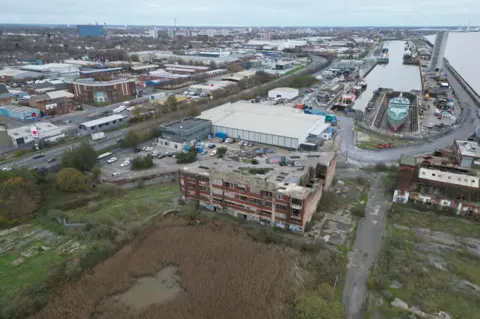
Further to the west, along the A63 dual-carriageway, relics of the old fishing industry also survive.
"Fish played a major part in this port's history," Robinson explains.
"In the middle of the 19th Century, we have the building of the railways.
"Railways provided fast transport to the interior. And that really benefited a commodity like fish.
"Fresh fish could be transported to places like Manchester within the day.
"We've got this railway network, we've got fishing vessels coming in here. And sometime between 1840 and 1860, some genius, we don't know who, put fish with chips.
"So you saw fish and chip shops on every corner. And that led to the building of the fishing industry.
"It started off actually in Humber Dock down here, and then moved down to St Andrew's Dock.
"And then at the very end, as we know, it was in Albert Dock. So lots of stories like that are linked to our docks.
"If you think about in the age when Britain ruled the waves, Hull was its third port. And that's saying something in terms of its global reach.
"This port punched at a global weight."
Listen to highlights fromHull and East Yorkshire on BBC Sounds, watch the latest episode of Look North.
Download the BBC News app from the App Storefor iPhone and iPad orGoogle Play for Android devices
