Man dies weeks before winning asbestos case against employers

 Getty Images
A man with cancer linked to asbestos has died just weeks before two of his former employers were found negligent for exposing him to the deadly substance more than 20 years ago.
John Reid, who worked as a labourer, was diagnosed with the asbestos-related lung disease mesothelioma in 2024 and died in March, aged 53.
The legal action argued MCM Building & Engineering and Pyramid Joinery exposed Reid to asbestos due to negligent health and safety practices and that these failings led to Reid developing the fatal disease.
Judge Lord Harrower found both companies were at fault, but Pyramid would have the greatest liability because regular exposure took place over a longer period.
He ruled that Pyramid was 99.908% liable for injury and MCM was 0.092% liable. Proceedings to determine compensation for Reid's family are continuing.
Reid, from Lanarkshire, was exposed to asbestos fibre while working as a labourer between 1999 and 2003, the court heard.
Between 1999 and 2000 he worked for building and civil engineering construction company MCM, which specialised in remedial work following property damage.
 Getty Images
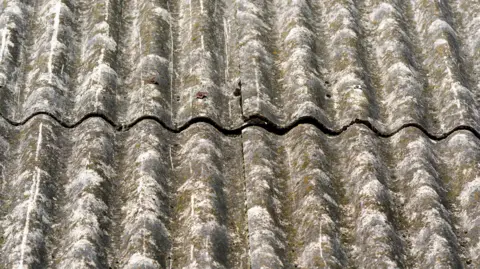
The court was told about a specific week-long project in Glasgow where Reid and his colleague were instructed to remove corrugated asbestos roofing from a row of four garages.
To remove them Reid had to use a ratchet spanner on corroded bolts or break the sheets manually with a hammer.
The sheets would break off when he pulled them, sometimes coming down into the garages where he was working.
Reid said he would catch the larger pieces but the smaller pieces landed on the floor, creating a dusty atmosphere.
He claimed MCM provided no masks, protective clothing or safety training regarding asbestos.
Reid worked as a driver and labourer for Pyramid between 2000 and 2003.
During this period the company was contracted to carry out window and door replacements on various council estates across Scotland.
The refurbishments involved the removal of asbestos panels located at the side and bottoms of windows.
Reid's main job was to sort the asbestos waste from the general waste on site.
He would pick up broken pieces of asbestos panels by hand and place the material into large clear bags to be later secured in a specialised skip.
Reid said he was never warned of the dangers associated with asbestos and the company failed to provide any protective clothing, hard hats or respiratory equipment.
'Negligently exposed'
At the Court of Session Lord Harrower said he accepted the evidence given to the court by Mr Reid and said his account has been corroborated from other sources of evidence.
He said Reid was "negligently exposed to asbestos while in the employment of each of the defenders, materially increasing the risk of his contracting mesothelioma".
Reid's solicitor Caitlyn Maccabe, said: "This ruling is both welcome and profoundly upsetting because while the court confirmed Mr Reid's mesothelioma was caused by failures from his employers, he has sadly passed away before seeing justice.
"Few can imagine what it is like fighting for justice while battling a terminal disease but Mr Reid did this.
"He never stopped believing in doing the right thing for his family, and for the knowledge that his legal victory could help other asbestos sufferers in the future."
What is asbestos?
Asbestos is a general name given to several naturally occurring fibrous minerals that have crystallised to form fibres.
The strong fibres do not dissolve in water or evaporate, and are resistant to degradation from chemicals, heat and fire.
Asbestos was once thought of as an ideal material for insulation in buildings, boilers and pipes.
But due to the health risks from inhaling asbestos, the importation of blue and brown asbestos has been banned in the UK since 1985. This ban was extended to include white asbestos in 1999.
Exposure increases the risk of lung cancer including mesothlioma as well as other cancers and non-cancerous conditions such as asbestosis or pleural disease.
Scotland, particularly the west, has some of the highest rates of these conditions in the world, as it was widely used in shipbuilding and heavy engineering.
