Scottish Power liable for worker's asbestos death, court rules

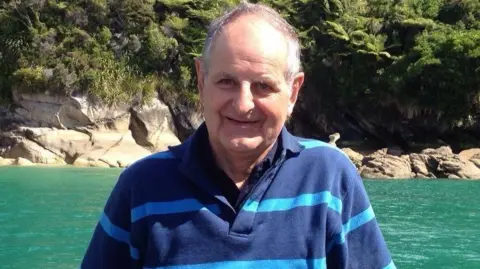 Crozier family
The family of a man who died from cancer caused by asbestos exposure can claim damages from his former employer Scottish Power, the Supreme Court has ruled.
Robert Crozier, from Livingston, previously claimed compensation from the energy company because of other asbestos-related health problems he developed in the course of his employment.
Scottish Power claimed this was the reason his family were not entitled to any further compensation after his death in 2018 - but the Supreme Court has now ruled in the family's favour following an eight-year court battle.
Mr Crozier's daughter, Elaine Veale, said the landmark judgement would help other families "in this nightmare situation".
Scottish Power said the judgement related to a "technical legal point" regarding the interpretation of Scotland's damages laws.
A spokesperson added: "We understand this has been a difficult time for Mr Crozier's family.
"This was an important test case as to how the legislation is interpreted and we welcome the clarity it provides."
Mr Crozier worked for Scottish Power as a mechanical fitter from 1969 until 1992.
In 2014 he successfully claimed compensation from the company as he had developed pleural plaques (hardened areas of scarring in the lungs) and contracted asbestosis (a form of lung disease) as a result of being exposed to asbestos on the job.
The settlement included damages relating to the risk of developing mesothelioma - a type of cancer commonly caused by asbestos exposure.
This was so that Mr Crozier could not claim again if he went on to develop the cancer - which he did.
Asbestos is a general name given to several naturally occurring fibrous minerals that have crystallised to form fibres.
The strong fibres do not dissolve in water or evaporate, and are resistant to degradation from chemicals, heat and fire. Asbestos was once thought of as an ideal material for insulation in buildings, boilers and pipes.
But due to the health risks from inhaling asbestos, the importation of blue and brown asbestos has been banned in the UK since 1985. This ban was extended to include white asbestos in 1999.
Mr Crozier died in 2018 aged 79, and his family began seeking damages from Scottish Power under the Damages (Scotland) Act 2011.
The company argued they were not entitled to this because of the previously settled claim, but the family's lawyers Thompsons Solicitors argued there was an exception to this rule where the deceased has died from mesothelioma.
Over eight years, the case made its way to the Supreme Court, where judges rejected Scottish Power's argument and have now ruled in the family's favour.
It means they can claim damages under the 2011 Act for the "distress, grief and loss of society" caused to them by Mr Crozier's death.
Family's 'non-relenting struggle'
Speaking after her family's victory, Elaine Veale said her father was "a quiet man, but never silent in the face of injustice".
She said: "The news of his win brought an intense feeling of hope and comfort after years of non-relenting struggle to bring power to account.
"We mourn the time we were supposed to have as a family with my dad, which makes the conduct of Scottish Power all the more difficult to bear.
"In my opinion, the lengthy duration of the process to bring about justice was uncaring and disrespectful on the part of Scottish Power, as it was their deliberate actions that delayed resolution and closure."
Thompsons represents a further 17 families seeking to claim compensation over their loved ones' asbestos-related deaths - all cases that the firm says will now move forward as a result of the ruling.
Jennifer Lilly, a senior lawyer at Thompsons, added: "This decision will provide comfort and certainty to the hundreds of Scottish men and women diagnosed every year with asbestos-related conditions as to how the law can protect their families in the event of the worst happening to them."
The charity Action on Asbestos said the ruling was "simply marvellous news" for other families who had been affected by asbestos illness.
A spokesperson said: "Companies like Scottish Power will now have to fully live up to their legal obligations to properly compensate the loved ones of their former employees who have died of this awful illness."
