Radar shedding light on cathedral's hidden past

 BBC
BBCA pioneering project is aiming to uncover the hidden history of one of England's greatest cathedrals.
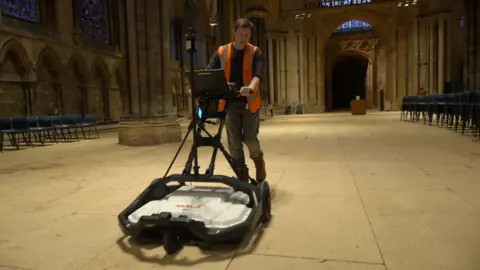
Archaeologists say Lincoln Cathedral has become the first in the country to undergo a complete survey using ground-penetrating radar (GPR).
They are hoping to uncover evidence of earlier buildings that predate the 13th-Century cathedral.
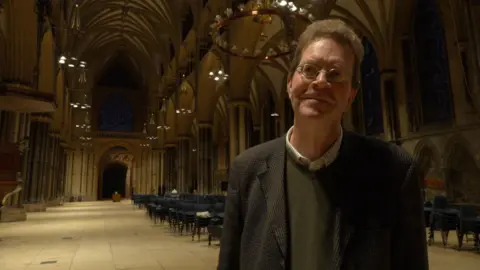
"We've got the better part of 2,000 years of history here that we're unpeeling," said Dr Jonathan Clark, the cathedral archaeologist. "Other cathedrals have had little areas that have been subject to GPR survey, but this is the first to be completely mapped."
GPR uses electromagnetic waves to map features hidden beneath the ground, without having to resort to expensive and disruptive excavations.
The survey took archaeologists two weeks, working early each morning to avoid crowds of visitors.
It was originally commissioned to check for voids beneath the paving and map the location of central heating pipework and other services.
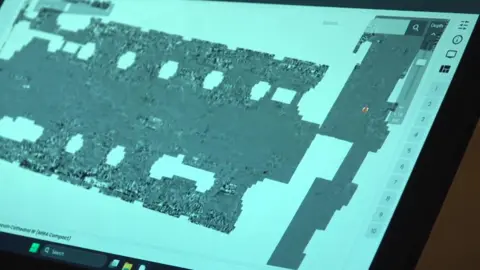
"Rather excitingly, the bonus is that we're finding out a lot more about the early history of the cathedral," said Dr Clark.
"It's like slicing through a cake. You're seeing lots of different layers and lots of different periods.
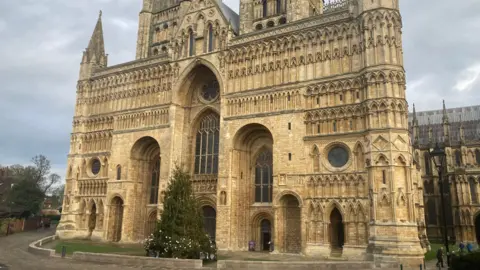
The construction of Lincoln Cathedral began in 1072 under Bishop Remigius. It was consecrated in 1092.
But in 1185 the cathedral was partially destroyed by an earthquake, leaving only the west front, which can be seen today.
It was rebuilt over the next century, with the central tower completed in 1311. The cathedral became the tallest building in the world until the spire collapsed in 1549.
Archaeologists hope the GPR survey will help them understand what the original Norman building looked like.
Chris Casswell, from Reclaim Heritage, which conducts geophysical surveys, explained how the radar focuses energy down into the ground.
"It's a little bit different from the golf balls you see on the landscape," he said.
"We get reflections not off aeroplanes but off walls, graves and anything with materially different composition under the ground."
The survey also includes mapping burials in and around the site and looking for evidence of any buildings dating all the way back to the Roman period.
Dr Clark said: "There are some very significant people buried in the cathedral and I suspect that there are quite a few people that we don't know about yet, which could lead to some interesting surprises."
"I'm optimistic we might find some quite unexpected individuals here as well."
The results of the survey are expected in the spring.
Listen to highlights fromLincolnshire on BBC Sounds, watch thelatest episode of Look Northor tell us about a story you think we should be covering here.
Download the BBC News app from the App Store for iPhone and iPad or Google Play for Android devices
