'Blind alleys are always opportunities': The scientist who developed the polio vaccine

 Alamy
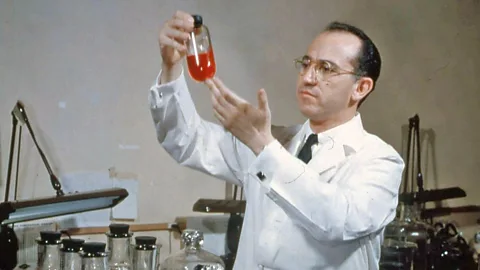
AlamyOn 12 April 1955, Dr Jonas Salk announced that his vaccine was safe and effective. It would go on to save countless lives – but he refused to profit from it. In 1982, Salk talked to the BBC about his breakthrough.
"Humanity received some of the brightest news in all its history." That is how one US reporter described the announcement, in April 1955, that Dr Jonas Salk had succeeded in developing a polio vaccine. Polio was a disease which, until then, had no prevention and no cure – and everyone was threatened by it. Interviewed on television that evening, Salk was asked who owned the patent on the vaccine. "Well, the people, I would say," he replied. "There is no patent. Could you patent the sun?"
Poliomyelitis, or polio, was a public health emergency. In 1952, the US saw a record 57,628 cases of the disease, which causes spinal and respiratory paralysis. Patients would lay confined in large metal ventilators known as iron lungs to help them breathe, which, along with the leg braces worn by children, became polio's enduring symbols. People would fear the approach of summer, the time when outbreaks were more common.
Every parent knew and dreaded the disease's symptoms, according to Jody Zogran, a ward nurse who worked at the Pittsburgh hospital where Salk and his team developed their vaccine. She told the BBC's Witness History of cases where "a little boy [was] playing football the day before, and here he is encased in this iron lung. He has no idea what's going on and he's screaming, and if his legs aren't paralysed, he's kicking the side of the respirator."
Although fewer than 1% of infections led to paralysis, the sheer scale of polio outbreaks meant that large numbers of children still ended up in iron lungs. They might remain encased from the neck down for days, months or even years. The patients Zogran cared for were still contagious, and she and her fellow nurses were told that the only protection available to them was rigorous handwashing. "We washed our hands every time we touched that patient or more, and I can remember going home at night and my hands were so sore and so chapped," she said.
While it was primarily children who were affected by polio, no one was safe. Future US president Franklin D Roosevelt, then a rising political star, contracted the virus in 1921 at the age of 39. It left him paralysed from the waist down for the rest of his life. In office, he made combatting polio his own personal crusade, and in 1938, he founded the March of Dimes, a polio charity that would turn the traditional model of fundraising on its head. Rather than seeking big donations from the few, it asked for tiny ones from the very many, and raised hundreds of millions of dollars.
By the late 1940s, scientists had shown that polio entered the bloodstream through the gut. At the same time, two researchers emerged to compete in the race for a vaccine, each taking a sharply different path. Dr Albert Sabin, a paediatrics professor at Cincinnati Medical School, had already spent two decades studying the polio virus, and believed in moving slowly and carefully, according to David M Oshinsky, author of Polio: An American Story. "He saw himself as a scientist's scientist… who worked in the lab, never left, and made discoveries one by one, using building blocks," he told a 2014 BBC documentary.
Salk, meanwhile, was a fast-moving researcher at the medical school in Pittsburgh, who had already produced a successful flu vaccine for troops during World War Two. Crucially, he had the support of the March of Dimes, which was impatient for progress. Dr Paul Offit of the Vaccine Education Centre in Philadelphia told the BBC how Salk worked with the speed and focus of a pharmaceutical company, a style that challenged traditional ideas of how scientists behaved. He said: "Salk and Sabin had fundamental differences about what would be the best vaccine. Salk thought it would be a virus that would be completely killed. Sabin thought it would be a virus that would be weakened."
Testing the vaccine on his family
The March of Dimes funding gave Salk a clear advantage. It enabled him to establish his laboratory at the heart of a working hospital in Pittsburgh, surrounded by polio patients. Salk and his team were using a deactivated polio virus to make the vaccine. It was experimental science, with nurses sending down patients' excrement to the basement from the third floor where they worked so that the laboratory could isolate the virus. But Salk and his team still had to prove that the vaccine would stimulate the antibodies needed to fight the polio virus.
The development of the polio vaccine, he told the BBC in 1982, came from patient, repeated effort. "There were indications that it should be possible to immunise against poliomyelitis," he explained. "And then [one had] to choose one of the numerous possible alternative pathways. In the course of the work, many things appeared that had not been foreseen, and opportunities had to be seized, so in that sense there were some leaps along the way." Were there blind alleys? "Blind alleys to me are always opportunities," Salk replied. "I've always taken something unforeseen as a cue, and looked quickly to see what the alternative pathways are."
In History
In History is a series which uses the BBC's unique audio and video archive to explore historical events that still resonate today. Sign up to the accompanying weekly newsletter.
The breakthrough arrived "rather quickly from my point of view", he said. Decades of prior research by others had prepared the ground. When Salk began in 1948, the virus had recently been grown in tissue culture for the first time, the tools were in place, and the three main poliovirus types had been identified. "Between 1951 and 1952 we were ready to immunise children. In 1953 the clues were clear, in 1954 the field trial was put on, and in 1955 it became available for general use."
Reports that he tested the vaccine on himself and his family were true. "Of course," he said. "That is routine if you have enough trust and confidence." By 1952, he was so confident that the vaccine was safe that he inoculated his wife and his three sons, and everyone working with him in the laboratory. His son Peter, speaking to the BBC in 2020, recalled "the day that he came home from his office bearing syringes and needles that he boiled on the stove in one of our kitchen pots to sterilise, loaded up the experimental polio vaccine that he was working on and then lined us kids up and administered the injections".
More like this:
• The first person ever to appear on TV
• The woman who redefined chimps – and human beings
• How a Norwegian weather rocket almost sparked a nuclear war
To know for sure if the vaccine worked, a much larger trial was needed. In April 1954, the biggest medical experiment in human history began, requiring the cooperation of more than 50,000 teachers across the US to immunise almost two million children. It took a year of cross-checking the results to confirm the news that so many people were waiting desperately to hear.
The announcement was made on 12 April 1955, coincidentally 10 years to the day since President Roosevelt had died. Church bells rang out across the country, factory whistles were sounded, and people wept in the streets with sheer relief. The number of cases of polio recorded in the US fell from 60,000 to 2,000 within a year of Salk's vaccine. Within a decade, polio in the US was all but eradicated.
A spoonful of sugar
With the vaccine's success, Salk became globally famous overnight. He saw the ecstatic reaction as "the feeling of the relief of fear" rather than a measure of his abilities. "[The reaction] seemed out of proportion to the scientific contributions," he told the BBC. "It was unforeseen and unexpected, although now in retrospect it should have been expected."
To avoid being distracted from his work, he decided not to take "this enormous amount of adulation" too seriously. He went on to create the Salk Institute, an independent non-profit laboratory on a clifftop in California designed to attract the world's best scientific minds. "That, I think, was the next great opus, you might say," he said. "This was a temple for creativity… a place where the human spirit would be elevated."
But what of Albert Sabin's rival vaccine? It was administered orally rather than by injection, making it more suitable for mass vaccination campaigns. It even helped to inspire one of Hollywood's most delightful songs. In the early 1960s, Jeffrey Sherman's father Robert and uncle Richard were working on music for the Disney film Mary Poppins and struggling for ideas. Jeffrey told his father one afternoon how he had received the oral polio vaccine at school that day. "Did it hurt," Robert Sherman asked. "I told him they put it on a sugar cube and you just ate it," Jeffrey Sherman wrote on Facebook. "He stared at me, then went to the phone and called my uncle Dick. They went back to the office and wrote A Spoonful of Sugar (Helps the Medicine Go Down)."
To keep the cost of the vaccines low, neither Sabin nor Salk patented their discoveries for financial gain. "A lot of people insisted that I should patent the vaccine, but I didn't want to do that," Sabin said. "It's my gift to all the world's children."
--
For more stories and never-before-published radio scripts to your inbox, sign up to the In History newsletter, while The Essential List delivers a handpicked selection of features and insights twice a week.
For more Culture stories from the BBC, follow us on Facebook and Instagram.
