Mould found on children's cancer ward at Edinburgh hospital

 BBC
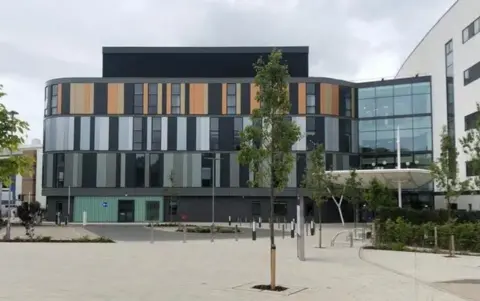
BBCAn investigation has been launched after mould was found on a children's cancer ward in the Royal Hospital for Children and Young People in Edinburgh.
The mould was discovered behind a wall covering in bathrooms in the Lochranza ward, which looks after oncology and haematology patients.
Immediate precautionary measures have been put in place to protect patients who are more vulnerable to infections because of weakened immune systems.
NHS Lothian said no patients were unwell as a result, and that patients and families had been made aware of the ongoing situation.
It comes after mould was recently found in a room on the adult bone marrow transplant unit at the Queen Elizabeth University Hospital (QEUH) in Glasgow.
NHS Greater Glasgow and Clyde is hoping to rebuild the cancer ward as a result.
The health board said the proposal was "necessary" after ongoing defects disrupted the running of the unit.
Both hospitals are subject to a national inquiry which was ordered in 2019 after concerns about unusual infections and the deaths of patients in Glasgow and a 20-month delay in the opening of the Edinburgh hospital.
Following the latest discovery at the children's hospital in Edinburgh, other bathrooms are now also being checked.
Several rooms in the ward are not used routinely, so the number of cubicles has not been reduced, allowing the ward to function as normal and remain open.
NHS Lothian also said there were also no concerns about the way the ward ventilation was functioning or maintained.
It is believed the mould was caused by a defective join between wall and floor coverings, which allowed shower water ingress.
The health board said walls in the bedrooms and bathrooms were intact, and the waterproof wall covering had provided a physical barrier between patients and the water damage.
It added that other measures had been taken to help protect vulnerable patients from infection, including the provision of filtered ultra clean air into the room.
Nurse director Alison Macdonald said she realised the incident would be worrying for some families but added that they should be assured that the clinical, microbiological and infection control teams had assessed the situation as "low" risk.
"This is being treated extremely seriously," she said. "Infection control measures have been enhanced and the situation is being monitored very closely.
"Patients may need to be moved into a new room while the investigation and remedial work is carried out, but families are being kept up to date."
An expert incident management team, made up of infection control, microbiological and clinical teams, has been established to oversee and direct the urgent programme of investigation and remedial work.
