Britain's first all-female prison stood in Surrey

 Woking History Society
Britain's first purpose built women's prison once stood on the outskirts of a Surrey town.
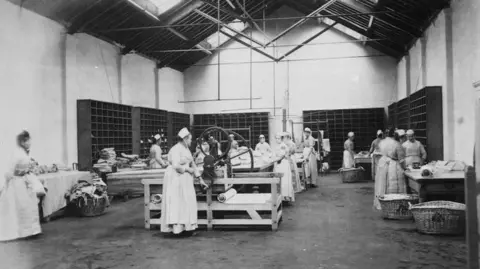
Woking Female Convict Prison opened in 1869 and could hold up to 780 inmates. Until then, prisoners would have been held in adapted wings of male prisons.
The complex cost about £45,000 to build and was constructed largely by male convicts from a neighbouring prison. But the site was closed by 1895, as female convict population had fallen sharply, and it was later passed to the War Office and was used as a military hospital during the World War One.
Rosemary Christophers, from Woking History Society, told Secret Surrey that the prison was located about two miles from the town centre.
She added: "Not much remains, except for some rows of prison officer houses, which are now terraced houses. The rest of the prison is now just houses.
"It only reached maximum capacity in its early days and when it closed, it had 195 inmates who were transferred elsewhere."
 Fiona McCarthy/BBC
When it opened, it was one of the largest female prisons in Europe, made up of long corridors, segregated wings, a chapel at the centre of daily life and extensive workrooms where inmates undertook laundry, needlework and other labour deemed suitable for women, Christophers said.
"We know what happened on a day in 1873 as a record was published," she added.
"The day was divided into 14 hours and they had two meals; each was 30 minutes long.
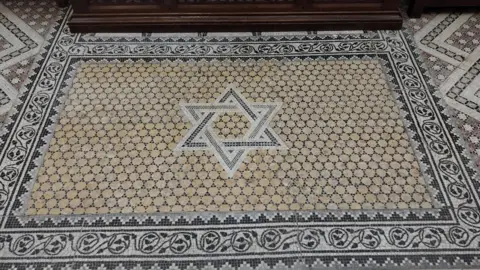
"The labour was skills that would have been useful to them when they left prison and some of them, although not a large number, did mosaic work."
Many mosaics were originally laid into paths and garden spaces around the prison grounds, but several were later removed and preserved.
Some of them can be found at St Paul's Cathedral, the V&A Museum and Young V&A and at St John's Church.
Follow BBC Surrey on Facebook, on X. Send your story ideas to southeasttoday@bbc.co.uk or WhatsApp us on 08081 002250.
