'Helping humans to the Moon is a dream come true'

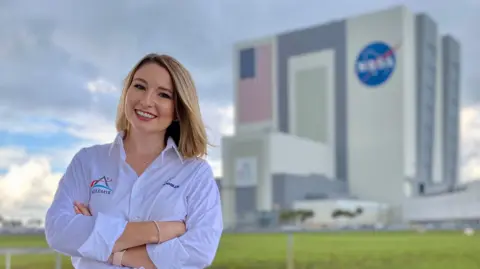 Noel Christ/Airbus
A woman who dreamed of becoming an astronaut has done the next best thing by helping build part of the spacecraft that will take humans back towards the Moon.
Sian Cleaver, originally from Chelmsford, works for Airbus in Germany which built the propulsion system for the Orion spacecraft on Nasa's Artemis II mission.
It will carry four astronauts around the Moon in a 10-day mission - the closest humans have been to the lunar surface since 1972.
Cleaver, 36, said: "I always wanted to work in the space industry and now I am doing that on a human space flight mission, which for me is a dream come true."
The Artemis II crew will travel to the Moon powered by the European Service Module, which includes large solar arrays all made by Cleaver and her team in Bremen.
The former Chelmsford County High School for Girls pupil believes we could see humans back on the Moon in a couple of years, and said it was an exciting time for space exploration.
"There are a couple of generations who haven't lived through a moon landing, it's almost becoming ancient history in a way," she said.
"To experience that with a whole new load of people on this Earth I think is going to be really special. It's also just the first step on our journey to Mars."
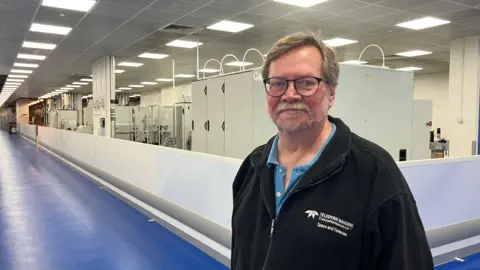 Matt Knight/BBC
Cleaver's views on an exciting time for space exploration are echoed by David Morris, chief engineer for Teledyne e2v in Chelmsford.
His team makes cameras and other imaging equipment for space agencies across the world, with some ending up at the far reaches of the solar system.
He said: "If you look back to what happened in 1969 and the transformational aspects of seeing men on the Moon, I'd like to think that similar global excitement can happen when we see it happen again. It will invigorate the world to think more about being 'the world' rather than just lots of separate nations."
He still feels the "wonder" when things made in Essex end up in deep space, including on Nasa's New Horizons mission, which visited Pluto.
Morris, 65, added: "You get both a sense of pride and no little wonder that the things that we've actually built and touched from here will end up perhaps on the Moon, or perhaps exploring the far reaches of the galaxy."
Follow Essex news on BBC Sounds, Facebook, Instagram and X.
