A&E staff fear 'worst winter' as demand rises

 BBC
BBCWalking past a line of patients being treated in an A&E corridor, Dr Richard Gorman admits the situation is "not ideal" but says people will be moved "as soon as they can".
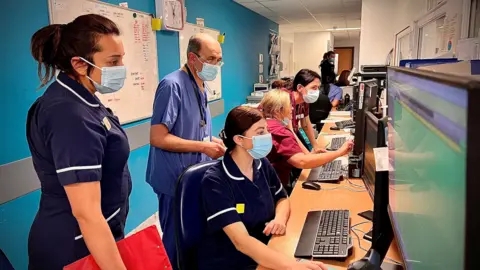
It is just before midday and there are already 102 patients in the emergency department at Pinderfields Hospital in Wakefield and every treatment cubicle is full.
The resus room, where the most poorly patients are looked after, has one bed left, and out of 30 patients waiting to be admitted to a ward, 15 have been waiting for more than 10 hours.
Dr Gorman, a consultant in emergency medicine, says there is now a genuine feeling among staff that the department is heading for the "worst winter we've ever seen".
In recent weeks, the A&E at Pinderfields Hospital has seen record numbers of patients come through the doors, with surging cases of flu adding to existing pressures.
The department would typically see between 325 and 350 patients a day but on 24 November it dealt with 426 attendances.
Staff are now being advised to wear face masks in certain areas because of the increased risk of flu.
"It's extremely busy at the moment," Dr Gorman says.
"We've got high numbers through the door, and we've got patients waiting to go to a ward.
"The resources we've put into managing our emergency department has been more this year than any other year and we're still seeing the highest numbers," he adds.
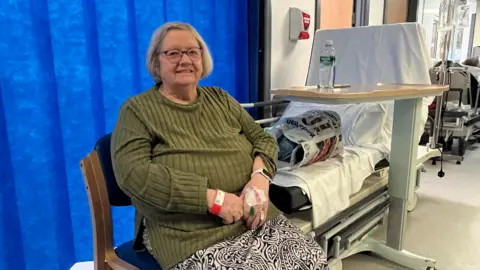
For many hospitals, corridor care has become a common sight in A&E, as the number of patients in the department outstrips the available space.
Joyce Evans, 80, was brought into hospital by ambulance after falling at home and spending eight hours on the floor.
She is being cared for in one of the corridors used as a "temporary escalation space," with three other people.
She has been assessed by staff and is waiting to be transferred to Dewsbury Hospital for further care.
"I don't know how long it's going to take," Ms Evans says.
"But I'm quite happy now as I'm not in any pain, or anything," she adds.
Corridor care is a visible sign in A&E of crowding, which, according to the Royal College of Emergency Medicine, happens when demands "exceed the capacity of that service, hospital, or health system to meet them".
It happens for many complex reasons, including too many patients coming into the emergency department, delays in assessing and treating them, and difficulty finding beds for those who need to be admitted.
Linda Jackson is being cared for in a side room after being brought in with chest pain.
The 77-year-old has been in the emergency department for 16 hours and is waiting for a bed on a ward.
"I'm not bothered," she says.
"The only thing is they don't have a television, and I like a television," she says.
Stacey Howell, the matron of the emergency department, says it is "really challenging" but the ultimate aim is to "keep patients safe and well looked after".
"Our teams are working tirelessly, day and night, to assess our patients as they arrive, identify the most sick patients so they can be prioritised, and then provide ongoing care for our patients that are waiting to be moved on to wards and departments," she says.

Ravi Parry, a clinical site manager, is part of a team that is responsible for trying to keep patients flowing through the hospital to prevent overcrowding.
She has come down to the emergency department to talk to a senior nurse about the various pinch points and what she can do to help.
But it is not an easy task.
"We have got a vast amount of patients in our bed base that need all different care from different avenues," she says.
"From medical care, to therapy care, they might need social care, so we have to look at all these aspects before we can generally move patients on."
"We've not just got patients queuing in A&E, we've got patients queuing with GPs, we've got patients queuing with other hospitals that need to come back," she adds.
In the discharge lounge at Pinderfields Hospital, they helped 528 patients leave the site in November 2025.
That is almost 250 more than in the same month the previous year.
Kim Gollings, the ward manager of the discharge lounges, says they are trying to "get patients out as quickly as possible" to create extra space because they know how challenging the situation is in A&E.
"Obviously, we've got the ones that are straightforward that we can just get out the same day," she says.
"But then we've got other patients that may be waiting for rehabilitation, they may be waiting for a package of care, or a social worker coming to do assessments.
"It's not just a case of 'the doctor says yes you can go home now' and then we can discharge you," she says.
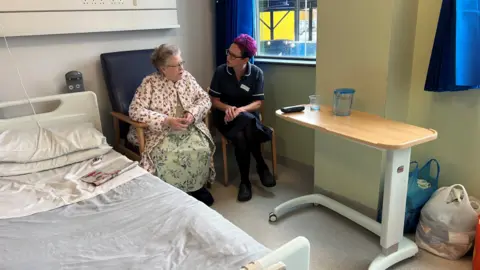
Dr Gorman says the challenge, as the hospital heads deeper into winter, is for staff to deal with this pressure "constantly" and "with no downtime".
"The message really needs to go out that if you do have a life-threatening condition, we're here for you," he says.
"But if you don't have a life-threatening condition then you really must seek alternative services."
On Monday, the British Medical Association confirmed a five-day strike by resident doctors, the new name for junior doctors, would go ahead from Wednesday morning.
Health Secretary Wes Streeting warned it was "irresponsible and dangerous" given the pressure hospitals are under with flu.
The Department of Health and Social Care has previously said it was "under no illusions this is going to be a tough winter for our NHS".
It urged everyone eligible to get their flu vaccine.
