Sign language interpreters say job can be 'emotional whiplash'

 BBC
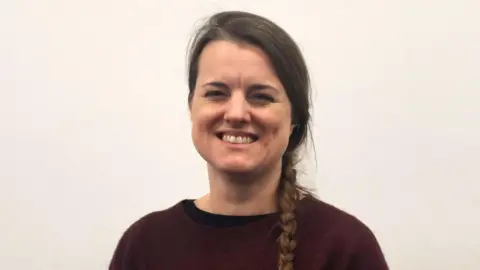
BBCAn experienced sign language interpreter has said people like her can experience "emotional whiplash" trying to manage the demands of the role with limited support.
Dr Sally Gillespie is the project coordinator of a new MA Interpreting course at Queen's University Belfast (QUB) which is preparing students for the increasing demand for interpreters.
There are 44 registered Sign Language Interpreters in Northern Ireland, however, she said this is not reflective of the number of working interpreters.
Dr Gillespie said issues with availability can mean they are often called into highly emotional situations at short notice, sometimes moving between a christening and a life-or-death situation in hospital.
"Demand has always outstripped supply," Dr Gillespie said.
"The opportunity to grow and invest in the next generation of interpreters has always been a struggle."
In February, the Sign Language Bill was introduced at Stormont to officially recognise and promote British Sign Language (BSL) and Irish Sign Language (ISL) in Northern Ireland.
Funded by the Department for Communities (DfC), the course at QUB was established to address the lack of interpreters in Northern Ireland with the newly-qualified interpreters graduating next year.
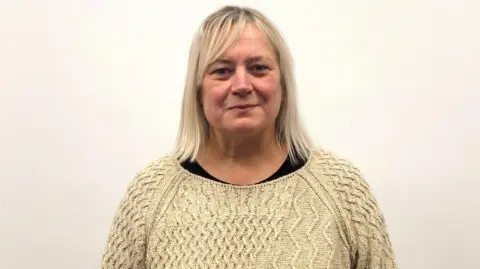
Deaf student Caroline Doherty, who is already fluent in both BSL and ISL, wanted to gain a formal qualification after helping friends in the deaf community who were struggling to access services.
She said deaf people have an indigenous understanding of the language which they can use to influence and make changes.
"We can share our skills, learn from that and learn more about the interpreting profession," she said.
The cohort of 17 students is a mix of BSL and ISL users, qualified and aspiring interpreters, as well as deaf and hearing students.
Ms Doherty is one of five deaf students taking part in the course.
"I can't explain how valuable this is. It's the first course where I have felt equal with my hearing colleagues."
Recently, Ms Doherty had a medical appointment that was cancelled four times because there weren't any interpreters available.
"I don't feel that's right. I can't live my life like that. I work full time. I contribute. I'm a taxpaying citizen. I should have the same rights as everybody else."
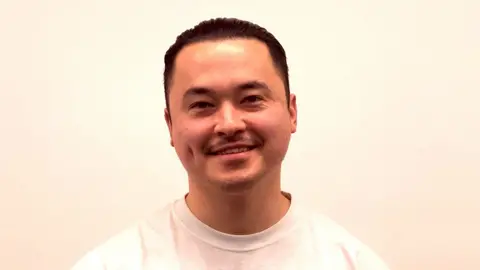
Konrad Cheng decided to join the course in memory of his aunt who was deaf and sometimes struggled to access services.
"She went her whole life without having proper access to communication," he said.
"No one really acknowledged or remembered her. I feel like this is a personal journey in remembering her life."
At first, he found the course overwhelming due to the mix of hearing, deaf and Irish Sign Language interpreters, but said it has been a "really great learning process".
"I'm learning so much from my peers, from the qualified interpreters. I'm able to go to them and ask how they would do things in their career."
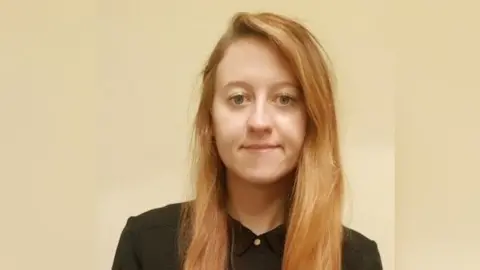 Sarah Garvey
Qualified interpreter Sarah Garvey said the profession can be an "emotional roller coaster".
"Not having enough numbers means that interpreters take on too many jobs or are in situations where there's no support," she said.
There were eight people in Ms Garvey's class when she graduated from Trinity College Dublin in 2014, of these she said only four are working in the field.
"There's a lot of different experiences, opportunities, and perspectives, but I hope as a cohort we'll be able to make a difference for the community going forward."
