I will speak out on misogyny, first female Archbishop of Canterbury says
The first woman to lead the Church of England has said she is committed to speaking out about misogyny where she sees it.
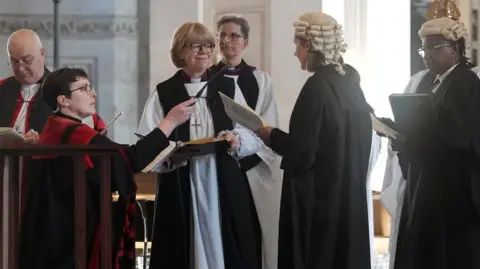
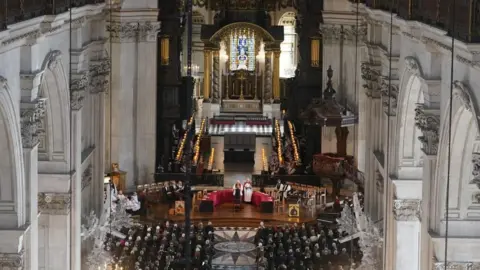
Dame Sarah Mullally has been officially confirmed as the 106th Archbishop of Canterbury in a ceremony rich with centuries-old tradition at St Paul's Cathedral.
Her predecessor, Justin Welby, resigned following accusations he did not do enough with information he had about a prolific abuser to prevent further abuse from taking place.
In an interview, Dame Sarah said it was right that there was greater scrutiny on her own record in dealing with safeguarding in the Church.

 Reuters
The ceremony in London to confirm Dame Sarah was a mix of religious service and legal process.
A heckler briefly interrupted proceedings and was escorted from the cathedral.
For part of the ceremony, the cathedral in effect became a courthouse where legal rites, written down in 1533 but with their origins much earlier, were enacted.
Dame Sarah said during the interview: "There's a sense of the weight of office that I feel, but I've also been very conscious of the huge support that I've had from people either writing [to me] or passing me in the streets."
Previously England's chief nursing officer, Dame Sarah had started the day as Bishop of London, a post she had held since 2018.
"It is fair to say that I have, both in my secular role, as well as in the Church, experienced misogyny at times," she said.
Though Dame Sarah acknowledged that throughout her ministry she had received support from many men, she said she had also learned that issues of misogyny needed to be "brought into the open", something she would do more.
"I'm conscious that being in this role, it's important for me to speak of it [misogyny], because there are some that don't necessarily have the status or power of this role, and feel more hesitant to do it. I commit myself to making an environment where all people can flourish and which is safer for all," she said.
One of the newer aspects of Wednesday's ceremony was the inclusion of a wide range of voices from across the Church and also Anglican churches globally.
Among those elements was a Portuguese reading, a nod to associations with Anglican churches in Angola and Mozambique, and also a South African Xhosa hymn.
The Church said this was done as a reminder of who was joining in prayer for Dame Sarah and "the people she has been called to lead and serve".
The role of Archbishop of Canterbury has been a notoriously difficult one in terms of holding together people with a broad range of theological viewpoints both at home and abroad. Dame Sarah is likely to face additional pressures.
Although the Church of England has allowed women to be ordained as priests since the 1990s and there have been female bishops for more than a decade, it has also allowed male bishops to continue to refuse to ordain women if they choose to do so.
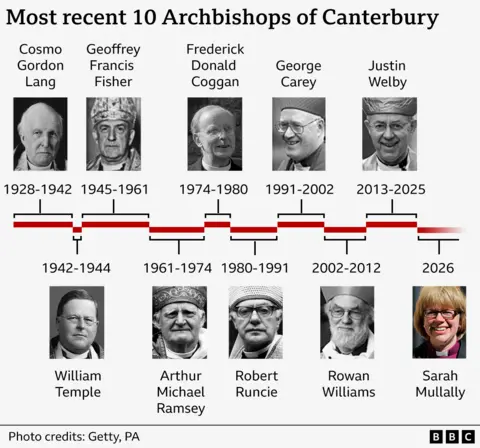
It has meant that as archbishop, Dame Sarah will now lead such bishops in England. Her election has also led some traditionalist churches abroad to threaten to leave the Anglican Communion.
"I have always understood that people may find my appointment as a woman difficult in the Church. I would, above all, want them to understand that I do hear their concerns and where they're coming from," said Dame Sarah.
As well as those theologically opposed to her election because she is a woman, there have also been some that have objected to her becoming Archbishop of Canterbury on the basis of her record in dealing with safeguarding.
The criticism has been two-fold. Firstly that she has been a senior member of clergy during a period when the Church of England has not made sufficient progress in dealing with abuse, and secondly that she has questions to answer about her own actions as Bishop of London.
"All of us should be open to having the light shone on what we do, and I recognise rightly that there is greater scrutiny on me and the actions that I have undertaken, and I reiterate my commitment to safeguarding. I also commit to ensuring that we have independence," Dame Sarah said in her interview.
 Reuters
Though critics have suggested that sufficient light has not been shone on what the Church does and that processes remain far from independent.
In one specific case in the London Diocese, Dame Sarah has been accused of acting inappropriately by directly contacting a priest about whom an abuse complaint was made, and as such contributing to the priest's harassment of the person who made the complaint.
Dame Sarah said rules around confidentiality meant that she could not talk about details relating to the complaint.
The Church has already decided that there is no case to answer for the new Archbishop of Canterbury. But given that it was the Archbishop of York Stephen Cottrell who made that decision, and that he is also someone around whom questions around handling of safeguarding have been raised, it has left victim advocates unsatisfied.
In taking up the mantle of archbishop, Dame Sarah said she would not be complacent on safeguarding and would ensure the Church moved forward.
Although she legally became Archbishop of Canterbury on Tuesday, Dame Sarah will only start performing most of her public-facing duties after her installation ceremony at Canterbury Cathedral on 25 March.
Before then though, in February, she will lead the meeting of the Church's national assembly, the General Synod.
At that meeting one of the big issues will be an acknowledgement of the collapse of the endeavour to introduce Church blessing services for same-sex couples, something that Synod voted for, but bishops have decided cannot now be delivered.
Though she supported such blessing ceremonies in the past, Dame Sarah would not be drawn on what she thought the way forward might be on the issue now, saying that it was her role to listen and help achieve through consensus.
"There's an African proverb that says, 'If you want to go fast, go alone. If you want to go far, go together' and so my desire is to go far and together."
Before her installation Dame Sarah will also "pay homage" to the King, the Supreme Governor of the Church of England, though she has already met him in recent days.
"The King was keen to hear from me about my vision for the Church, in the same way as a lot of people have. I shared with the King that I hope to be the shepherd to care for people in their parishes, for our clergy, but also to speak of Christian hope at a time where there's a lot of challenges for people."
