Nepalis vote in first election since Gen Z uprising for change

 AFP via Getty Images
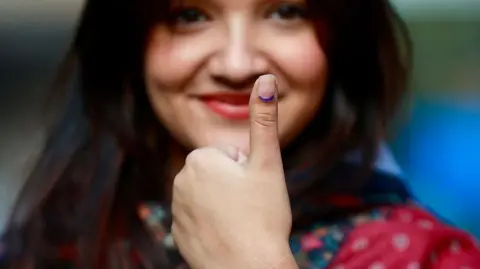
Millions of Nepalis have voted in the country's first general election since violent youth-led protests toppled the government last September.
Corruption, economic stagnation and inequality were the main issues in the vote. They sparked the uprising in which 77 people died, many of them protesters shot by police.
The election represents a crossroads for Nepal, pitting the establishment against a new generation of politicians advocating for angry, young Gen Z voters hungry for change.
Counting the votes cast for the Nepalese parliament's 275 seats is expected to take several days, and results are not expected before next week.
Nepal's mountainous terrain makes it slow and difficult to transport ballots, which are tallied by hand.
Nearly 19 million people, including almost a million first-time voters, were registered to take part in the 5 March ballot for the House of Representatives. The Election Commission, speaking shortly after polls closed, said it expected voter turnout to be around 60%.
Voting was largely peaceful, and there was a huge security presence across the country.
Leading candidates include KP Sharma Oli, the prime minister toppled in the protests, and Balen Shah, a former rapper who resigned as Kathmandu's mayor in January to take him on in his constituency, the Jhapa 5 seat, one of the key election races.
For Oli, the election will be a major test. He and his party, the Communist Party of Nepal UML, have insisted the protests were not a referendum on his leadership and that he is still beloved by the public. He told the BBC he's confident he will win this election.
The leader of the Nepali Congress, Gagan Thapa, believes younger voters are tired of "unholy alliances" and "poor governance" in previous coalitions, and that the party is listening to Gen Z voters.
Balen Shah, who is representing the Rastriya Swatantra Party (RSP), refused to speak directly to the press on Thursday, staying true to form by turning up in his signature black sunglasses and storming through a crowd of journalists.
It is a trend Nepal's media worry would continue if he took office. Yet, many of the young voters we've spoken to believe his youth and energy are exactly what the country needs, and that he represents a new chapter in Nepal's future.
Both Oli and Thapa's parties, which have been in government numerous times, have been clear in their messaging, in suggesting they have heard the calls for change. Whether voters agree remains to be seen.
Rakshya Bam - one of Nepal's Gen Z leaders - was largely unimpressed.
"I think none of the parties have incorporated the pact that was signed between the government and the Gen Z in their election manifestos," she told the BBC ahead of the vote.
"They want to sell the name of Gen Z and come into power so they are using the term Gen Z movement... I don't have much expectations from the elections."
Ispa Sapkota, who spoke to the BBC as she cast her ballot in Kathmandu, said she protested in September to "end corruption" and restore "political stability" in Nepal.
"We want a better nation," she says. "When I and others search for jobs, we're not able to get any here. Brain drain is becoming the most important problem in our country."
If Balen Shah wins, it would represent a seismic shift from the governance that has paralysed Nepal. For more than three decades, the country has seen a revolving door of coalition governments, largely dominated by three parties, two of them communist.
This election will test whether Gen Z voters have succeeded in convincing the rest of the country that it is time for a new, untested generation to shape their future, or whether veteran heavyweights who have dominated for decades will keep hold of power.
Of the 275 seats in the lower house, 165 will be elected through first-past-the-post voting, meaning the candidate with the most votes wins the seat. The other 110 MPs will be selected via proportional representation, which takes into account the proportion of votes cast for a political party nationally.
The election commission has promised to finish counting by 9 March and to release the results of the 165 directly elected seats within 24 hours of counting beginning. But the process of collecting ballot boxes from across the mountainous country and delivering them to counting centres typically takes at least a day.
It could take another two to three days to tally the results of the proportional representation vote, officials said.
A new government, formed on the basis of the seats won by political parties, will have the responsibility of leading the reforms and addressing issues like corruption and good governance.
Samikshya KC, who voted in Kathmandu, chose not to participate in the protests, but says she supported the Gen Z movement.
"Nepal is becoming very corrupt," she told the BBC. "I'm hoping for a big change."
She wants the next government to develop all of Nepal, and not just the capital.
"There are so many remote places in our country - let there be some progress there too. Whatever happens, let it be good."
