A rap star might just beat a former PM - what this says about Nepal's Gen Z election

 Getty Images
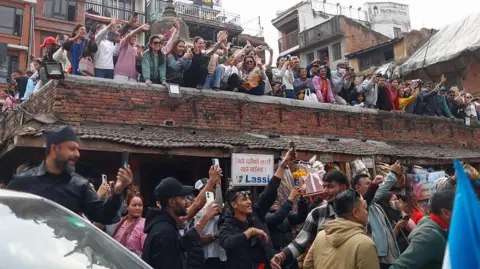
Rap music blared out around us at a campaign rally in the district of Chitwan, in Nepal.
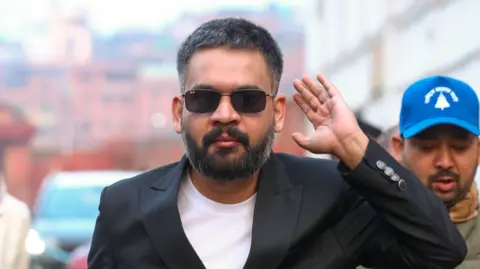
Supporters of 35-year-old rapper-turned-politician Balendra Shah screamed out lyrics to an AI-generated campaign song which translates to: "Time's up, Fake leaders, Game Over. We'll ring the bell on 5 March."
Crowds of all ages were chanting "Balen", as he's referred to in Nepal. Giant banners of the political newcomer wearing his trademark black sunglasses were mounted across the rally.
Balen Shah is running for prime minister after just three years as mayor of the capital, Kathmandu.
He is contesting in what's become a key race between Nepal's entrenched political establishment and a new generation of politicians. His party, the Rastriya Swatantra Party (RSP), came fourth in the last general election in 2022.
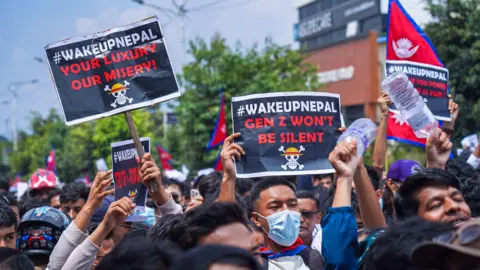
But after deadly anti-corruption protests by young Nepalis last September forced the then prime minister KP Sharma Oli to resign, there's been more appetite for new faces.
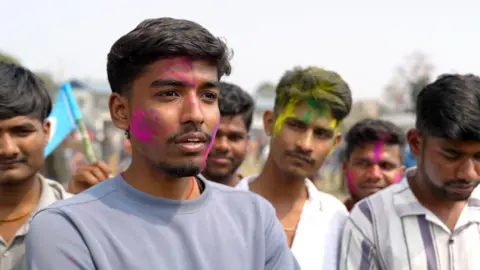
"We don't want the same old parties to rule our country," 20-year-old Ispa Sapkota tells us at the rally. "We protested because we wanted change."
 Getty Images
For more than three decades, Nepal has seen a revolving door of fragile government coalitions largely dominated by three parties. These include two Communist parties, the Communist Party of Nepal Unified Marxist–Leninist (CPN UML) and Nepali Communist Party CPN (Maoist Centre), and the centrist Nepali Congress.
"None of our governments have survived their full terms in office in decades. These are historic elections," Nischal Pande, a director for the Regional Centre for Strategic Studies in Nepal, told the BBC. "People are tired of the same old faces. They want to see a generational contest between the Gen Z and the group of older politicians from the 1990s."
Nepal's election this time will see more than 915,000 first-time voters, with nearly 19 million eligible voters in total. Balen Shah is hoping anger at the former government, and his own message on the economy, can win over voters of all generations.
Job creation has been a key message for his campaign, with youth unemployment standing at 20.6% - among the highest in South Asia, according to the World Bank.
At Balen Shah's rally, 18-year-old Nandav Yadav said he was part of the protests and believes the former mayor represents the values he marched for.
"We want to fight for the young people who died in the Gen-Z movement," he tells us.
The protests were first sparked by a social media ban, then turned into days of anti-corruption protests and anger at a lack of opportunities for young people in Nepal. Seventy-seven people were killed, many of them protesters shot by police.
"Our [former] prime minister KP Sharma Oli could have stopped it, but he didn't. That's why we're supporting Balen Shah today," Yadav says.
 Prem Boominathan/BBC
Throughout the campaign, Balen Shah has mostly avoided interviews with the press, opting to speak to voters through social media posts instead. As we and other media outlets tried to approach him for comment, he stormed to his campaign car, flanked by police and his entourage.
His critics argue this strategy has allowed him to avoid public scrutiny of his record.
As mayor he was criticised by rights groups of using the police against street vendors in a heavy-handed manner, as he worked to keep roads clear in the capital and crack down on unlicensed businesses. Shah's campaign has not responded to our request for comment.
He has chosen to run head-to-head against Oli in Jhapa-5, a constituency that for years has been a safe seat for the former PM.
But the memory of the protests, during which lethal fire was used against thousands of unarmed students, is still fresh.
This is no longer seen as an easy race for Oli.
 Prem Boominathan/BBC
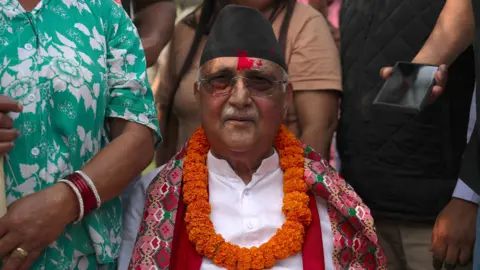
As we approached one of Oli's canvassing rallies, we see families crowded around him, offering their toddlers for him to hold.
We asked the former PM whether he has any regrets about the events that happened on his watch. He said his party "wants to understand the feelings of the new generation" and that they'll do their "best" to "develop the country".
He told us his focus as prime minister would be to restore "sovereignty" as well as "peace and democracy" in Nepal.
Despite being forced to resign, Oli still believes he has a chance to win because of his party's large grassroots operation, according to the political analyst Pande.
"They're a big political force, and he feels the protests were an international conspiracy to oust him."
Police, politicians and some protesters have alleged for months that outside agitators and politically driven groups were involved in the protests and subsequent violence, but, so far Oli and his party have not provided any evidence to back this claim.
One of Oli's supporters, 40-year-old Sushil Karki, believes Oli is a victim of a "grand design" from outside forces.
"We think that it was designed by other people, not the public of Nepal," he told the BBC.
Another supporter, Narad Prashad Luitel, 82, said Oli should finish the work he started on the country's roads and infrastructure. "Someone else shouldn't be allowed to come in and do the work he has been doing from the beginning," he said.
 Getty Images
Like elections in Bangladesh just weeks earlier, Thursday's vote in Nepal was made possible by deadly anti-corruption protests led by young people.
Should a newcomer like Balen Shah beat a veteran heavyweight like KP Sharma Oli, it would be a seismic moment for Nepal's politics.
After decades of political instability, such a result would end a shuffling of familiar faces in power, the bargaining between an entrenched political elite, and bring the first government or coalition without a communist party in many years.
The vote will test whether young Nepalis have succeeded in convincing the rest of the country that it is time for a new, untried generation to shape their future.
Additional reporting by Andrew Clarence, Prem Boominathan and Rajneesh Bhandari
