City councillor targeted by AI deepfakes

 BBC/DECLAN VINK
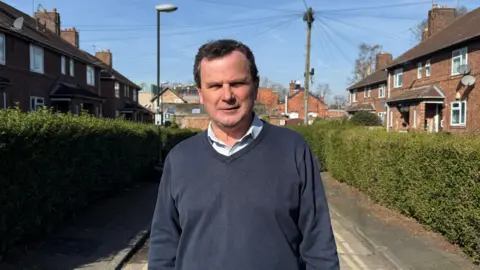
A senior York politician who has been targeted by AI-generated deepfake images has been given police advice to step up security at his home.
A fake video appears to show Pete Kilbane, the city council's Labour deputy leader, handing cash to men in balaclavas. An unspecified flag then appears behind him.
Kilbane said he was "shocked" when he first saw the video, adding: "This is an attempt to undermine democracy and make legitimate, factual debate impossible."
A City of York Council spokesperson said the material was "not satire," but was being produced "with the deliberate intention of misleading people".
Last September, after hundreds of national flags were flown across York, Kilbane said removing them could cost up to £250,000.
"It is technically illegal to hang things off a lamppost without permission," he said at the time.
"At some point, we will have to start the clean-up."
 unknown
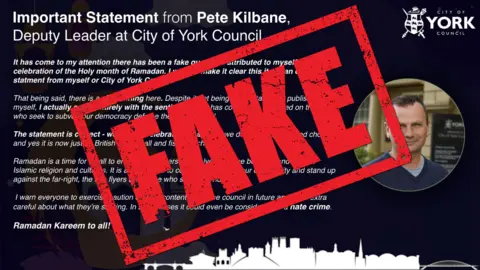
As well as the fake clip, Kilbane's likeness has appeared on still images that have been shared in social media groups and seen by the BBC.
One of them carried the likeness and a false quote about religious festivals, while another - also showing the likeness - was a fake statement warning people to "exercise caution" over misinformation about the council.
Kilbane said: "This is worlds within worlds. I was quite shocked when I first saw it.
"It kind of hits you in the stomach, and at first I was quite bewildered about why someone would bother to make a deepfake about a person who is quite a minor politician in local government."
Kilbane said police had advised him and council leader Claire Douglas to increase security at their homes.
"These deepfake videos can inspire people to commit acts that are not pleasant. It is not great, but you have to listen to police advice," Kilbane said.
"What is more worrying is people moving into debate with what is just lies, things they have made up.
"I am a politician, there's nothing I welcome more than good, honest, open debate.
"But where people are lying and twisting the truth to try to make their point we are moving into a very different world."
'Be vigilant and sceptical'
Dr Theocharis Kyriacou, associate professor of artificial intelligence at York St John University, said the use of AI deepfakes was "widespread" within local democracy and local government.
"It can be about political campaigns, smear campaigns, blackmailing of people, financial gain, trying to draw attention," he said.
"But there are good uses of artificial intelligence too and we should not lose sight of that."
After watching the clip featuring Kilbane's fake likeness, Kyriacou said a similar video could be made in "about 15 to 20 minutes".
"If you want to be more elaborate, and to fool people who are just looking at it, you need a lot more images and video of the person and several hours to do it.
"But it can still be done with equipment that we have at home."
The professor said that, if people were "vigilant and sceptical", they would still be able to separate what was real from what was fake.
He added: "We start by checking the source, ask ourselves 'does this make sense?'
"Look at artefacts and images within the videos that we can scrutinise.
"It is becoming more and more difficult - experts with specialist software can do it better - but that is a start."
The council spokesperson said officials were "actively exploring a range of steps" to prevent the spread of this type of material.
Those steps include raising awareness so residents can more easily identify misleading content, and examining potential legal avenues including the protection of intellectual property rights.
"Our priority is to protect residents, safeguard the integrity of the democratic process and ensure accurate information about services in the city continues to reach the people who need it," they added.
Councillor Brian Nelson, national secretary of the National Association of Councillors, said this "underhand practice" was becoming widespread, and "undermines democracy".
"It is obviously done to ruin the reputation of councillors and change the political make-up of councils at the next set of elections," Nelson said.
The association has found incidents like this can affect the health of councillors targeted, Nelson said.
He urged any politicians targeted to report incidents to the police, and to do what they can to take care of their personal safety and online activity.
"The National Association of Councillors are very concerned by this activity and we do include a section on this during our training sessions to councillors," Nelson added.
Listen to highlights from North Yorkshire on BBC Sounds, catch up with the latest episode of Look North.
