The primary class where ASN pupils adapt to school

 BBC
BBCScotland's schools are struggling to cope with a growing number of children who have additional support needs (ASN).
Almost 300,000 Scottish school pupils (43%) are now categorised as having ASN, with the vast majority in mainstream schools.
A report published by Janie McManus, the former chief inspector of education, on Thursday revealed there is a "growing gap" between the support ASN children need and what is happening in practice.
It highlighted the growing pressures on teachers and wide variation in access to services between local authorities, making six recommendations including looking at staffing and existing legislation and guidance.
The report commissioned by the Scottish government said additional support for learning is now central to how education provision operates on a day-to-day basis and early intervention is often overlooked due to capacity and resource issues.
But one primary school in Glasgow says it has already developed its own model of how to integrate ASN pupils into a mainstream school.
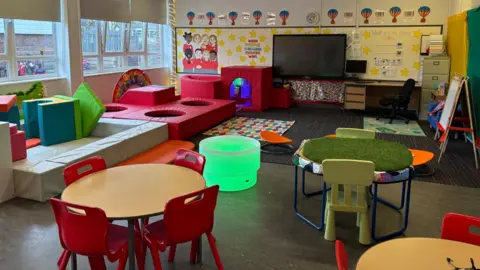
Room 1 at Corpus Christi primary in Glasgow is bright and welcoming, with a mural on the wall of the eight children who learn there.
A sign alongside reads: "When everyone is included, everyone wins."
Most of the children in the class have autism, are non-verbal and have a high level of additional support need.
So the classroom has been adapted.
At the front of the room, where you would expect to see a desk for the teacher, there is a soft play, a ball pool and sensory bubble tubes instead.
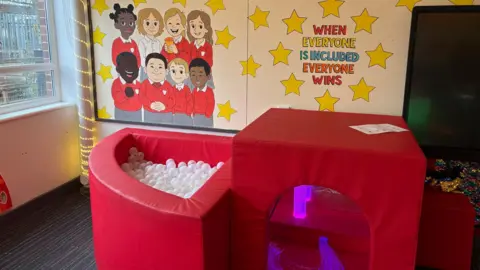
Children can bounce on adjacent trampolines or spin on sensory spinning chairs in the middle of the room.
Items such as shelving at the sides are covered up with fabric so the children can't harm themselves.
And it's noisy – the children squeal to show happiness and comfort themselves.
This is all designed for children to regulate their behaviour.
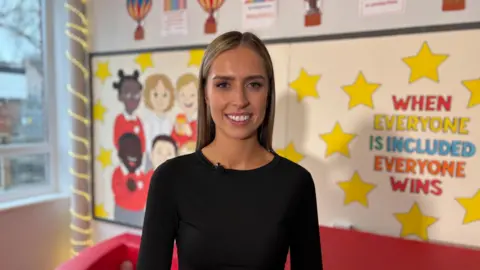
Classroom teacher Rachel Donnelly has been in Room 1, supported by several teaching assistants, since it opened in August 2024.
She says she's not delivering exactly the same curriculum as the other primary one classes.
"We use the milestones curriculum," she says.
"For a lot of the children, their targets are based on different life skills."
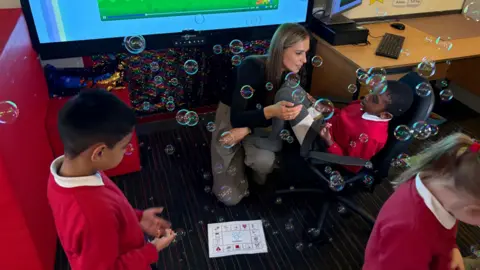
Rachel says that for some children success could be putting on their shoes or sitting at the lunch table and using a knife and fork properly or clearing away their dishes.
"We had one child who'd never sat at the table with us and she came over one day, sat down and we thought that was amazing for her," she said.
"She began eating lunch with us.
"Communicating that back with her parents, it looks like a small milestone, but for her that's massive."
Play-based learning is a significant aspect of Room 1, Rachel says.
The children work on fine motor skills and how to move their bodies around objects and space while at play.
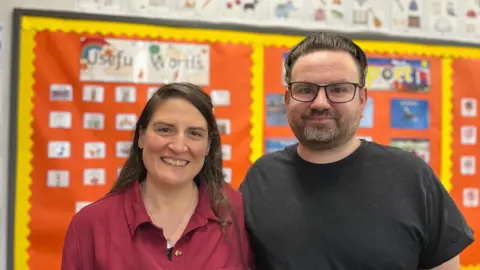
Kimberley and her husband Douglas were told their daughter Hope was autistic when she was just two and they thought she would have to go to a special school.
But her parents add the six-year-old is now "thriving" and learning to regulate her behaviour in ways they never thought possible.
"We wanted Hope to be around other children who are more neurotypical, as a way to see what other children act like," Kimberley says.
"As of right now, we are over the moon with how she's progressed."
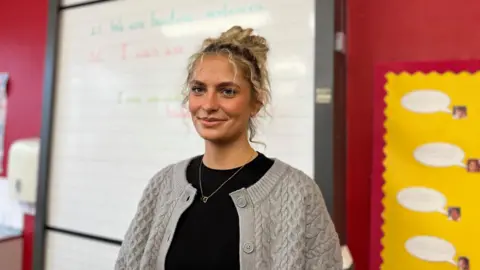
Isla says she tried to get her son Jaxon a place in a special school but was told he would need to go to mainstream.
At his first school, Jaxon was only going into school for an hour a day so she could not find the time to work or study.
By the time she dropped him off and checked he was settled it was almost time to pick him up.
"It just wasn't good mentally for any of us," she says.
Jaxon - who is autistic and non-verbal - is now aged six and his mother says he is doing well at his new school because he is being taught on his own level.
"He's understanding more words," Isla says.
"He's still non-verbal but he sneaks in a word here and there now.
"The routine the school's given him, he's more settled, he's more calm."
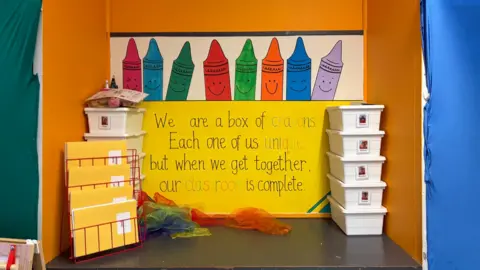
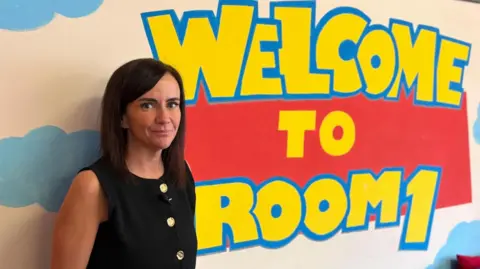
Headteacher Gayle Macdonald readily admits that she is not a specialist in ASN.
But in her seven years as a headteacher she says she has seen more children going into mainstream schools who previously would have been placed in an ASN provision.
Realising that she had more children about to come into Primary One with greater support needs, she visited a number of ASN schools to work on a solution.
The result was Room 1 which was developed using existing staff and some ASN funds.
"The experience was a learning curve", she says.
"The classroom was literally the bare bones of a classroom when we first started this.
"I thought let's just start with a basic room and then we will build as we go.
"And that's literally how the room has evolved."
'Overstimulated and dysregulated'
The children in room one do full days at the school and spend break times in the main playground to ensure they mix with the children in the rest of the school.
The aim is that the children will progress into the primary classes in future years with all their peers.
The headteacher says she is sure of the difference her adapted classroom has made.
She says without it the children would have gone into a mainstream primary one classroom where they would have been overstimulated, dysregulated and upset.
"The reality could have been that those children couldn't have coped for full days. they could manage an hour or two hours," she says.
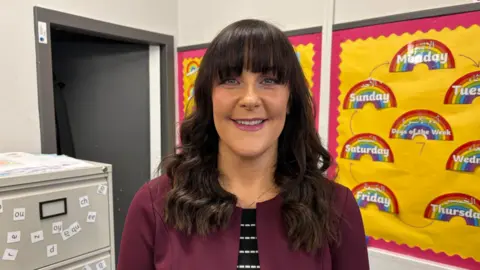
Dr Carole Campbell, an educational psychologist by profession and the head on Inclusion at Glasgow City Council, says there is an "increased complexity of need across Scotland".
She says the project at Corpus Christi shows what is possible by shifting existing resources and adapting to the needs of the children,
"That's what's so great about it," she says.
"It's not resourced or run by the local authority. It's a bottom-up approach, and it shows complete adaptability, looking at the need."
For Campbell, it's important that the children in Room 1 are in the mainstream environment, attending class trips, assembly and other events with the other children in the school.
"The aim is that they will be fully included within the classroom and all the life of the classroom," she says.
"It's just that they need a higher level of support and a longer time to be able to do that."
