UK economy flatlines in January as people cut back on eating out

 Getty Images
The UK economy unexpectedly failed to grow in January, with eating out in restaurants suffering in particular.
The zero growth for the month was weaker than had been predicted, and followed growth of 0.1% in December.
The overall picture is "subdued", said the Office for National Statistics (ONS),while analysts called it a "disappointing start to the year".
The figures underscore that the economy was fragile even before the outbreak of the US-Israeli war with Iran, which has caused a major energy shock that could have a ripple effect around the world.
The longer the war lasts, the more likely it is that there will be an effect on the UK economy, Prime Minister Sir Keir Starmer warnedon Monday.
Increased fuel costs are already being felt at the petrol pump and by heating oil users, while households under Ofgem's energy price cap will be protected from rising energy prices until July.
It could push up inflation, which before the conflict was on track to reach the Bank of England's 2% target by spring.
A pick-up in inflation could also affect interest rates. Before the Iran conflict, analysts had said the Bank of England could cut interest rates as soon as March, but they now widely expect a hold when it meets next week.
This change in expectations has already had an effect on the mortgage market. This week, hundreds of deals have been pulled by UK lenders, with average rates rising to levels not seen since last spring and summer.
If prolonged, analysts say the conflict risks hitting household spending and could jeopardise Labour's priority to grow the economy.
Chancellor Rachel Reeves said: "Our economic plan is the right one, but I know there is more to do.
"In an uncertain world, we are building a stronger and more secure economy by cutting the cost of living, cutting national debt and creating the conditions for growth to make all parts of the country better off."
Shadow chancellor Sir Mel Stride said Labour's "economic mismanagement" had left the UK vulnerable to the Iran war's potential ramifications.
"They must now axe the fuel tax, back North Sea oil and gas and come forward with a proper plan to cut the deficit and get the benefits bill down," he said.
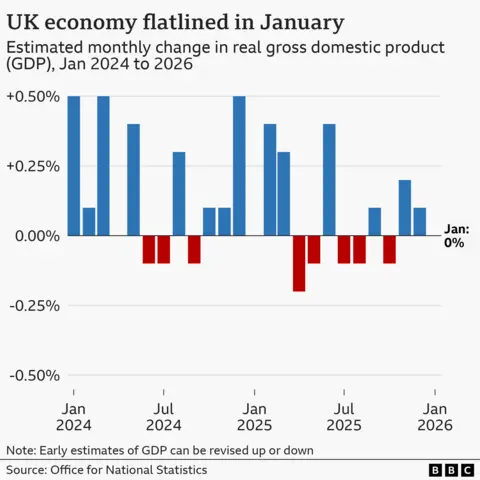
GDP stands for gross domestic product, and is a measure of all the economic activity of companies, governments, and people in a country.
The ONS said the services sector showed no growth in January. Within this, there was a 2.7% fall in food and drink service activities.
"The early months of the year are always among the most challenging for the hospitality industry and these figures clearly demonstrate how difficult the trading environment is," said Kate Nicholls, the chair of UK Hospitality.
Meanwhile production fell by 0.1%, and the construction sector grew by 0.2%.
Growth had already lost momentum in the second half of last year as consumers, anxious about possible tax increases and rising unemployment, held back.
In the three months to January, a less volatile measure in comparison to the monthly numbers, GDP grew by 0.2% - up from 0.1% in the three months to December.
In the Spring Statement in March, the Office for Budget Responsibility (OBR) - the government's official forecaster - cut its prediction for how much the UK's economy would grow this year to 1.1% from 1.4%.
Yael Selfin, chief economist at KPMG UK, said growth was "likely to remain elusive".
"The UK economy started the year on the back foot and activity is expected to weaken further amid sharply rising energy prices," she said.
She said government borrowing costs have risen in recent weeks as predictions for the future path of interest rates change.
Keeping interest rates higher for longer will be a "headwind" for businesses, Selfin added, with expectations for weaker growth plus rising costs meaning firms are likely to scale back investment plans.

Sign up for our Politics Essential newsletter to keep up with the inner workings of Westminster and beyond.
