How we got to severe drought and what is next

 BBC
BBCAt the start of 2026, records were broken for the amount of rain to fall in Devon and Cornwall.
By summer, the South West was declared as being in a drought, and now, in mid-October this has been escalated to severe drought in parts of Cornwall, Devon, Dorset, Somerset, East Sussex and West Sussex.
South West Water said water resources remained under "significant pressure", and there was "no significant rain forecast in the coming weeks".
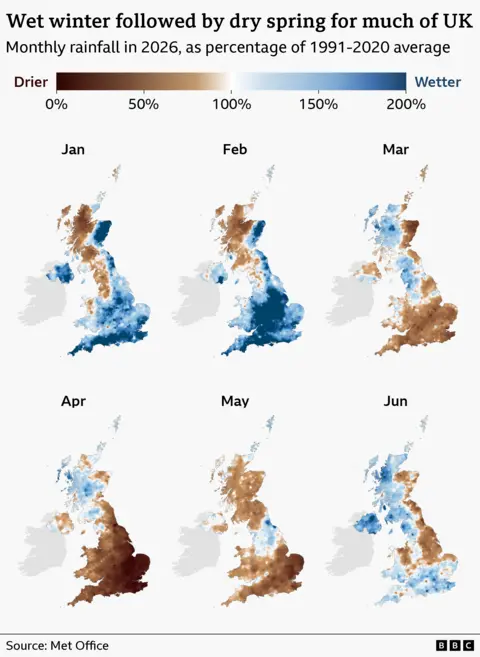
Over December, January and February, Cornwall recorded its wettest winter in 190 years, with rain totals reaching about 150% of the long-term average.
The weather station at Cardinham near Bodmin had 55 consecutive days of rain.
Devon also had relentless rain, with the Met Office reporting the county received about 518.7mm during the winter season - 131% of the seasonal average.
By March, South West Water's reservoir storage levels were close to 100%.
Dry spring and summer
Within three months the picture had changed significantly as from April onwards rainfall was below average.
The Environment Agency said it had been "the driest April to September in over a century".
At the end of May, 2026 had its first heatwave followed by another in mid-June with amber and red heat-health alerts and temperatures up to 35C (95F).
It was when a third heatwave hit in July, and very low monthly rainfall of 2.6mm in Newquay, and some parts of Devon having no rain at all, that South West Water announced its first hosepipe ban.
This came into force on 14 July and covered parts of Devon and Dorset.
By the end of the month, a drought had been officially declared by the Environment Agency for Cornwall, Devon and the Isles of Scilly and much of the rest of England.
On 8 August the hosepipe ban was extended to cover the whole South West Water area - and this remains in place.
The company said reservoirs had been "significantly impacted" by higher demand after the hottest summer on record.
Ordinarily, autumn would bring more rain, and while it has, the amount falling has again been lower than average.
September was "characterised by notably warm conditions across the UK, with temperatures widely above the long-term average and many regions enjoying more sunshine than usual", the Met Office said.
There has also been lower than average rainfall between 1 September and 15 October:
- Culdrose – 92mm (average 1 Sept – 15 Oct is 117mm)
- Plymouth – 104mm (average 1 Sept – 15 Oct is 128mm)
- Exeter – 49mm (average 1 Sept – 15 Oct is 106mm)
Reservoir levels
Rather than replenishing, reservoir levels have continued to fall to the point where on Thursday, the severe drought was declared.
Wimbleball on Exmoor has dropped to 14.9% capacity.
Rachel Gilmour, MP for Tiverton and Minehead, said: "If you've got reservoirs that are running dry, there is obviously a problem."
The latest figures from South West Water show its four other main reservoirs are also at low levels.
In Devon, Roadford is at 36.8%, and Burrator is at 33.6% capacity.
In Cornwall, Colliford is 35% full, with Stithians at 21.9% - the latter was recently declared as being too shallow for water sports.
In West Sussex, South East Water said Ardingly Reservoir had fallen below 20% capacity.
The reservoir can hold 4,773 million litres of water - equivalent to approximately 1,880 Olympic-sized swimming pools, according to the company. But the reservoir is now 19.4% full.
Earlier this month, South East Water updated hosepipe restrictions, and in September it was granted a drought permit by the Environment Agency, to keep more water in the reservoir.
The agency would expect reservoir storage to be about 75% for this time of year.
The Environment Agency said further dry weather was expected for the rest of October: "The usual seasonal rainfall has yet to arrive, and 82% of England remains in drought."
In some areas, 120% of the expected rainfall was needed for the next six months or "drought conditions will continue and could worsen", it said.
Severe drought is the most serious level, and is declared "when evidence shows drought is causing, or will soon cause, serious harm, and that emergency action is needed to protect people, water supplies, the environment, farming, infrastructure or other critical services".
The agency said: "Until enough rain brings recovery, we will not hesitate to take the action needed to protect water supplies.
"We continue to monitor conditions closely, working with partners and the government to reduce the impact of severe drought to communities and the environment."
