Headstone installed for last woman executed in UK

 Bettmann Archive/Getty Images
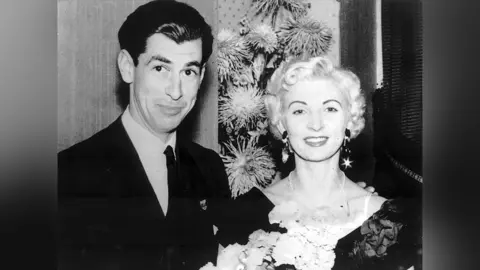
A headstone for Ruth Ellis, the last woman to be executed in the UK, has been installed after a special request from her eldest grandson.
Scott Walker said he was determined to have something "poignant and punchy" in place at St Mary's Cemetery in Amersham, Buckinghamshire, to mark what would have been his late grandmother's 100th birthday.
Ellis was hanged at London's Holloway Prison in 1955 at the age of 28 after being convicted of murdering her lover, David Blakely. She had been interred in an unmarked grave.
Previous memorials at the cemetery had been vandalised after her body was reburied in Amersham in 1971.
 Matthew Lockwood/BBC
 Matthew Lockwood/BBC
Walker said the idea for the headstone came about after he visited the cemetery with his daughters in 2024.
Ellis was "sort of lying in an unmarked grave with a few stones and people kept pinching stuff off it. A wooden cross went missing and it just looked a bit sad," he said.
He then contacted Amersham Town Council, which was "pleased" to support a memorial that would make "people stop and think".
Plans for the headstone were discussed by a "family committee", with relatives living in Dubai, Spain and Canada, before it was finally installed.
Who was Ruth Ellis?
Born in Rhyl in Wales, Ellis worked as a glamour model in London in the 1940s and 50s, before reportedly living and working as the manager at the Little Club in Knightsbridge until 1954.
In April 1955, she fatally shot her lover David Blakely, a racing driver, outside The Magdala pub in Hampstead. During her trial, the judge told the jury to disregard the fact that the mother-of-two had been "badly treated by her lover" as a defence.
Her grandson believed Ellis "was a very broken, depressed woman on the stand".
She was found guilty of premeditated murder and sentenced to death after a three-day trial. On 13 July 1955, three months after the shooting, she was hanged at Holloway Prison.
She was buried within the prison grounds, which was customary for executed prisoners.
Why and when was she pardoned?
 PA Media
Ellis' case provoked a public outcry and came two years before legal changes introduced diminished responsibility as a defence.
In 2015, new legislation introduced the offence of controlling or coercive behaviour under section 76 of the Serious Crime Act 2015.
In July 2026, Ellis was granted a posthumous conditional pardon after a campaign by her family for her murder conviction to be overturned. They argued she was a victim of domestic, physical and emotional abuse at the hands of Blakely.
The then Justice Secretary, David Lammy, described it as an "act of mercy" but added that it did not mean Ellis was innocent, but "replaces the death penalty with a sentence of life imprisonment to recognise a profound injustice in this exceptional case".
Amersham Museum said the legislation was an "important consideration" in the decision to grant Ellis a conditional pardon.
The impact on her family
 Matthew Lockwood/BBC
Ellis' execution had a devastating impact on everyone involved in her trial but particularly on her family and her two children.
Both Andre and Georgina suffered from trauma and mental health issues throughout their tragically short lives. Andre died from an overdose of anti-depressants in 1982, weeks after smashing up his mother's headstone on his final visit.
Walker said his mother Georgina, who died of cancer shortly after her 50th birthday, "was never a settled woman and I think that was purely attributable to the shock and awe [of the case] and finding out what happened to her at such a young age".
Walker visited the cemetery on Friday and said he was relieved that "everything had come together" in time for what would have been her 100th birthday.
"Forget the pardon, you know, [it] doesn't change anything. She's in the ground and you need to put something there," he added.
Kelly Thornton, the deputy mayor of Amersham, said: "Honouring [Ellis'] memory means supporting women's rights and public services that understand trauma, recognise coercive control, safeguard children and help survivors find safety.
"It also means respecting her family's privacy and wishes concerning her resting place."
Do you have a story suggestion for Beds, Herts or Bucks? Contact us below.
Follow Beds, Herts and Bucks news on BBC Sounds, Facebook, Instagram and X.
