Bad taste or a new way to educate? The proposed Troubles game explained

 Getty Images
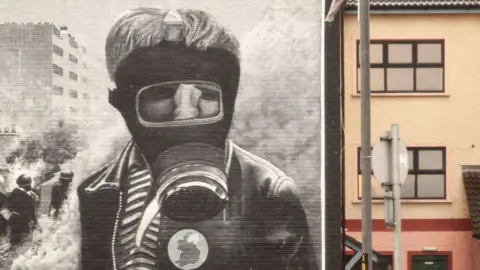
Crass or historical? A potential board game, which puts the spotlight on Northern Ireland's Troubles, has received pushback from some victims' groups.
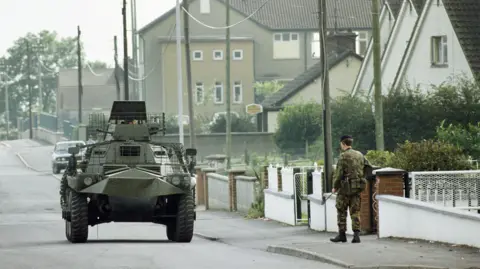
More than 3,500 people died and thousands more were injured during the 30 years of violence.
But now, events from the decades-long conflict have been reimagined into a "card-driven simulation" game, allowing players to take on the roles of unionist or nationalist politicians, the Royal Ulster Constabulary (RUC) or even paramilitaries.
The game is not complete or available for purchase, and developers say it could be years before it's available to the public.
BBC News NI has been taking a look at the proposed game, and what is being said by victims' groups and the people behind it.
What is The Troubles game?
The Troubles: Shadow War in Northern Ireland 1964-1998 is a one to six player game, mainly using cards to retell significant events throughout the conflict, such as the Sunningdale Agreement, Hunger Strikes and the deadliest period of the Troubles between 1970 and 1974.
It was created by Scottish secondary school teacher Hugh O'Donnell and is being produced by Connecticuit-based games production company, Compass Games, who specialise in historical games.
O'Donnell declined an interview bid by BBC News NI, adding the game is part of a PhD project and wanted to be mindful of the "academic process and, more importantly, the sensitivities of those affected by the Troubles".
However in an email, he said the project is "intentionally interdisciplinary" and aims to understand how historical board games can potentially foster "empathy and engagement with contested narratives".
Players take on different "faction" roles, including nationalist and unionist politicians, the RUC, the Ulster Defence Regiment (UDR) or paramilitary groups like the Irish Republican Army (IRA) or the Loyalist Paramilitaries (LOY).
During gameplay, which is estimated to take about six hours per scenario, players use dice, some 260 cards and tokens, with some labelled as "bombing", "The Nutting Squad", "dawn raid", "sniper" and "car bomb".
What have victims' groups said?
The proposed game has been criticised by some victims' groups - with some labelling it as "crass" or accused it of minimising what people endured during the deadly conflict.
Kenny Donaldson, from the South East Fermanagh Foundation (Seff), said while he has not seen or engaged with the game, there could be a "very suspect portrayal of what exactly the narrative of this place is".
"I feel educate is a stretch... it actually is a minimisation of what this was and we have to be very, very straight that the Troubles are not past tense," he told BBC Radio Ulster's The Nolan Show.
"The Troubles continue to be lived day in, daily, in Northern Ireland," he said.
He added a "common thread" between victims and survivors is that the game is in "bad taste", or described it as "exploitative".
'Risks being in very poor taste'
 Getty Images
Dr Paul Gallagher, from the victims' group Wave, said while he understands the game comes from a historical perspective: "For some people, it's daily life."
In 1994, Gallagher was left wheelchair-bound at the age of 21 after loyalist gunmen burst into a west Belfast home and shot him six times.
"I'm someone who's a victim of the things on these cards... I'm into history, but there's better ways of doing it," he told BBC News NI.
He added the content of some of the cards in the game "doesn't sit right" with people within Wave and colleagues who often work with clients who have been victims of attacks.
"It's a massive part of the population that's affected," he said.
"It might be alright breaking this out at a kitchen table in Surrey or New York, but for so many other people, their kitchen table has an empty chair there."
A statement from the Commission of Victims and Survivors in Northern Ireland said as the game is still being developed, it is "difficult to comment fully on its content".
"However, the use of a dice and cards format to represent a period marked by violence, loss and deep trauma risks being in very poor taste," it added.
"Such an approach may fail to recognise the ongoing and complex issues faced by victims, survivors, and their families, many of whom continue to live with trauma, including intergenerational trauma, as a direct consequence of our past."
What do the developers say?
Speaking to BBC News NI, the president of Compass Games Bill Thomas said he understood the sensitivities around The Troubles in Northern Ireland.
"I think what people went through at that time is horrible," he added.
However, he believed there is an educational merit in "interacting" with history through board games.
He expressed that many of the games his company produces are all historically based, and that it was likely only a "niche" group of people who are interested in that specific period of history would potentially order the game.
Thomas also questioned why some groups would take issue with board games, and not television shows, movies or even books which focused on the Troubles.
The game has been in development for a number of years, Thomas added, and while potential players can register their interest, they will only be charged after the game is released, if at all.
There has also been an uptick in interest in the past week from across the world since issues were first highlighted.
"We have lots of people from the UK and Ireland looking to buy it," he explained.
He said that it is "just a different form" to educate people, and added: "the people that are yapping and yipping have probably never played an historical board game before."
