Myfanwy the mammoth roamed 15,000 years ago, testing shows

 BBC
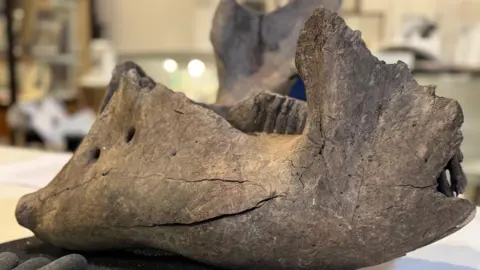
BBCA woolly mammoth nicknamed Myfanwy roamed Anglesey 15,000 years ago, radiocarbon dating has revealed.
Scientists believe the animal was about 32 years old when it died, but despite its feminine name the results of its sex are yet to be confirmed.
Last November, experts from the Natural History Museum took samples from the fossilised jawbone and molar tooth, which are on display at Holyhead Maritime Museum.
The testing showed the mammoth - whose remains were first found by Victorian workers 160 years ago - most likely lived about 14,900 or 14,600 years ago. This makes Myfanwy one of the oldest known mammoths to have re-populated Britain towards the end of the last Ice Age.
The remains were originally uncovered in 1864 when workers were connecting the London North Western Railway to Holyhead's harbour.
They were dredged from harbour mud and saved by amateur archaeologist Lord William Owen Stanley, who later donated them to the Natural History Museum.
Holyhead Maritime Museum has had the remains on long-term loan since 2006.
'We may have to look for another name'
Small samples were drilled from the tooth root and sent for analysis to determine the mammoth's age, diet and environment.
The extracted material has also been sent for ancient DNA testing to explore genetic links with other mammoth populations around the world, it is hoped the results will be returned in the next few months.
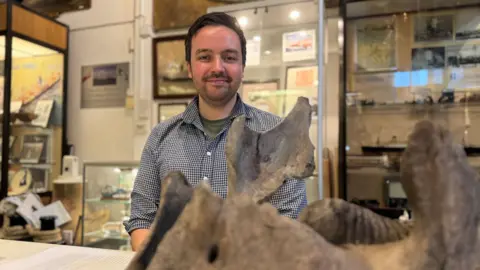
Barry Hillier, a trustee of the museum, said scientists are still waiting for the DNA results, which are being analysed in Sweden and could confirm whether Myfanwy was male or female.
"Now, we christened it Myfanwy just to give us a Welsh name and we've adopted it as a female mammoth," he said.
"We had no reason to say whether it was a female or male, but, you know, it was a good idea at the time.
"We may have to look for another name. It may be a male. But that's to come."
Dr Neil Adams, curator of fossil mammals at the Natural History Museum in London, described the dating results as "very interesting".
According to Adams, Myfanwy joins a small group of mammoths that re-populated Britain after the Last Glacial Maximum - the coldest point of the last Ice Age, which took place about 20,000 years ago.
This group includes mammoth fossils from Condover in Shropshire, Pin Hole and Robin Hood's Cave in Derbyshire, and Gough's Cave in Somerset, all of which have ages of about 14,700 to 14,100 years.
"Myfanwy is not only the first of these from Wales but also looks to be the oldest of this group, indicating Myfanwy provides the new best estimate for the re-population of Britain by woolly mammoths," Adams said.
The findings also give a picture of what Anglesey looked like 15,000 years ago. For mammoths to live there, the huge ice sheet that once covered the island must already have melted, allowing grassland to grow.
Tests on Myfanwy's tooth show she was eating what most woolly mammoths ate - mainly grasses and other plants that grow on open, treeless land known as steppe.
Nitrogen analysis suggests she was not living in a very dry environment, but instead grazing on moderately moist grassland. It may also suggest there weren't many other large plant-eating animals competing with her for food.
The heavy wear on her teeth shows she spent much of her time grazing on tough vegetation and by comparing the tooth wear with modern elephants, scientists estimate she was about 32 when she died. Woolly mammoths typically lived to about 70.
 Getty Images
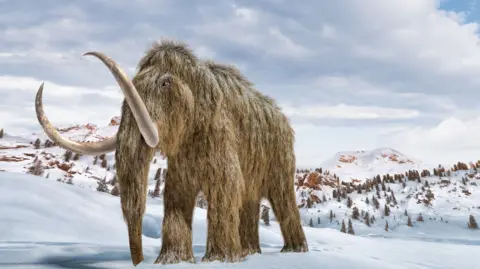
According to the Natural History Museum, woolly mammoths roamed parts of the northern hemisphere for at least half a million years before finally disappearing about 4,000 years ago.
Trustees at Holyhead Maritime Museum hope the new findings will spark fresh interest among local schools. Plans are being explored to scan the tooth and create 3D-printed replicas that pupils could handle in classrooms.
