'When you find something hard, you keep on going' - the children learning about resilience

 BBC
BBC"When you find something hard, you keep on going."
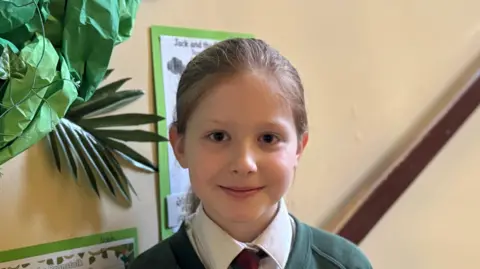
That is the definition of resilience from nine-year-old Phoebe who attends Nettlefield Primary school in Belfast.
The school is half way through a three year long programme called Resilient Child with local charity, Young at Art.
Phoebe said the classes have taught her how to do challenging things.
The programme is aimed to teach children how to be resilient through art, expression and creativity.
Eibhlín de Barra from the charity said the idea came about because, after the Covid pandemic, there was a real need recognised by teachers to build more resilience in their children.
'Difficulty in peer to peer interaction'
"All the challenges that the young people were facing were still there but they were exacerbated," she explained.
She said Resilient Child was born to support children in a new world, "as children were returning to the classroom, there was real difficulty in peer to peer interaction, socialisation and being able to settle back into the school year".
She said they were "really afraid of failing and making mistakes".
The programme works with six different schools across Belfast and focuses on lower-income areas.
What does it mean to be resilient?
De Barra said, sometimes being told to be resilient can be painted in a negative light and that a child has to have thick skin.
However, she said: "We see it as having a set of skills to help you be adaptable to a situation.
"If you are resilient, it means you are much better to fill your full potential and much better to have a hopeful mindset for your future."
Phoebe and other P4 and P5 children taking part in the Resilient Child programme had their art work showcased at Ulster University.
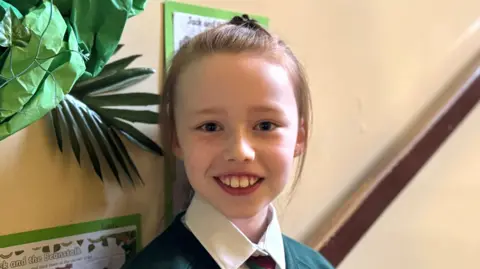
Scarlett, said her favourite part about the classes is the drawing and that she has learned a lot about art and nature.
When asked what resilience means to her, Scarlett said, "when you keep pushing hard".
This experience has made her really proud and excited about showing her family the exhibition.
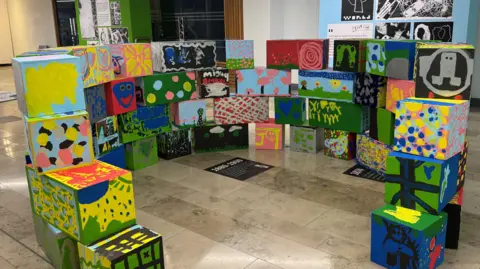
Duncan Ross is an art facilitator and helped the children create their exhibition.
Lots of brightly painted boxes, some resembling nature, joy and playfulness.
His approach was to focus more on the process of making the art than worrying too much about the end result.
"I gave them one colour at a time, and they had to wait until that colour dried before coming back next week and putting another colour on top.
"It teaches patience and that you don't get the result you want straight away".
"I'd also try to mix things up like, you have to share the resources, or you have to work in small groups, or you have to work in big groups and they had to then negotiate those kinds of challenges."
Ross said the mixing of personalities coupled with those different ways of working, meant they could learn how to cooperate and make concessions.
He said these were big lessons for the kids in building resilience.
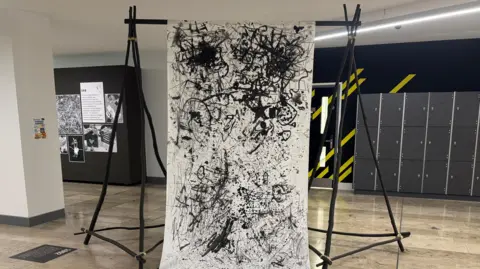
Another piece of art showcased is large scrolls of paper which appear to have nothing but black lines and squiggles plastered all over them.
But, like most art, there is more to this painting than meets the eye.
Ross had the children create it using pencils that were attached to the end of long sticks.
"They're drawing standing up, they have new ways of thinking about how to make images and represent ideas, they have to adapt and be put out of their comfort zone, physically they have to work out their space next to each other."
When the artwork is complete, Ross said discussion becomes the focus and this is where the real learning lies.
The children are asked: "How could we have adapted if we found something difficult, how could we consider the person next to us?"
Why is building resilience so important?
Simon McClean is the principal at Nettlefield Primary school.
McClean said it was very important for schools in lower income areas to get involved with these kinds of programmes.
Since the Covid-19 pandemic, McClean said we are seeing a backlog, "we see children who are so behind their peers because they didn't get access to therapeutic intervention in a time when it would have done the most good".
He said a preventative curriculum is key.
"We want to be empowering future adults to have the skills that they need to be resilient rather than trying to fix them when they do face hardship and then feel burnt out or broken from that".
McClean is incredibly proud of the children at his school and the exhibition they have created.
"Our children in working class places have not always had these opportunities to engage in creativity, imagination and art in a structured way that allows them to have a voice and be accepted".
He said, "we are building the foundations of appreciators of art and appreciators of culture that are coming into the future."
Young at Art has been running since 1998 and hosts an annual Children's Festival in Belfast which runs for 10 days with around 150 events, attracting around 25-30,000 visitors across the city.
