London may become a political patchwork quilt

 Getty Images
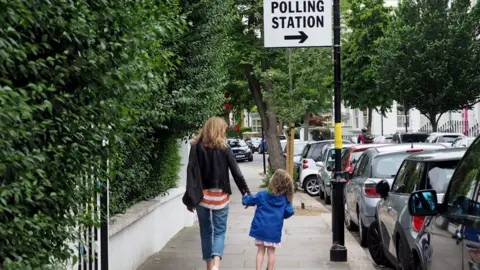
Six million voters, more than 1,800 councillors across 32 boroughs. The simple numbers behind what could be one of London's most complicated elections.
On 7 May every council in the capital will go to the polls to decide who will run their authorities over the next four years.
And no longer, it seems, can Labour, the Conservatives and the Liberal Democrats be confident that they alone will be running town halls.
The rise of Reform UK on the right and the Green Party on the left are presenting real and new challenges.
If you throw in the Aspire Party who run Tower Hamlets and the rising challenge of independent candidates, it's clear London's political make-up could shift dramatically.
After 7 May it's possible five or even six parties will be in charge of various councils in London.
The previous red blanket, with Labour currently running 21 boroughs, becoming more of a patchwork quilt.
'Entering a new era'
For the first time, Reform UK and the Greens are talking up their chances of winning not just seats, but control of councils.
Reform are targeting the line of councils on the Kent and Essex borders - from Bromley in the south-east, through Bexley and on to Havering in the north-east.
Their insiders will tell you that they see these elections very much as an attempt to 'plant the flag' in the capital ahead of the next mayoral election in 2028.
"If we can win in London," one told me, "we can win anywhere."
Leader Nigel Farage said they would make a "big dent in London", as he launched their London campaign in Croydon.
 Getty Images
For the Greens, winning the contest for mayor of Hackney is being talked up by party insiders and London political watchers alike.
The Greens say that February's parliamentary by-election victory in Gorton and Denton has given their local campaign a boost.
"People know a Green vote isn't a wasted vote, it can change things," I'm told.
They'll also be eyeing the mayoral race in Lewisham.
After winning just 18 councillors across 32 boroughs back in 2022, it's not impossible that they could have that many on single councils after May.
"It looks like London is entering a new era in its local politics," Prof Tony Travers from the London School of Economics told me.
"If the splintering of votes is anything like the polls are consistently showing, then the map of who governs this city will look like it never has before."
Travers added: "Although these are local elections and some people may vote on very local issues, there's no doubt many people will be voting on national issues, on what they think of the former big two parties."
State of play
At the moment, Labour are dominant in London - they have 59 of the capital's 75 MPs - and 21 of its councils, a record-equalling high.
The Conservatives run just five - having lost their former 'crown-jewel' councils of Wandsworth and Westminster to Labour at the last borough elections in 2022.
The Liberal Democrats run three councils in south-west London and will be looking to gain Merton from Labour.
The Aspire Party run Tower Hamlets and two boroughs are currently in no overall control.
Nick Bowes, insight director from the London Communications Agency, said: "These are likely to be the most consequential elections in London, certainly for the past 20 years - possibly since the first borough elections in 1964."
He added: "The ways things are fragmenting in the polls it's very difficult to predict exactly what's going to happen but it does look like being a very bad night for Labour and the Conservatives in London."
A new landscape
If that's true, and most political pundits believe it is, then the capital will face a very different future once the votes have finally been counted.
Potentially hundreds of new councillors who will have to learn the ropes of local government.
Council administrators, who've been used to dealing with one dominant party in their area, coming to terms with possibly five or six-party groupings.
Neighbouring boroughs, who perhaps worked together in the past because their ruling parties were the same, having to build new relationships.
And a Labour mayor of the city, used to dealing with mainly Labour councils, facing a new kaleidoscope of political colours to negotiate with.
It certainly won't be dull.
Listen to the best of BBC Radio London on Sounds and follow BBC London on Facebook, X and Instagram. Send your story ideas to hello.bbclondon@bbc.co.uk
