Constable sketch explored through location sounds

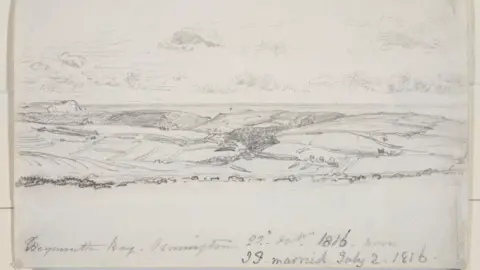 Colchester & Ipswich Museums: Ipswich Borough Council Collection
A live sound project celebrating the legacy of one of Britain's most important landscape artists is set to honour an important costal connection.
This year marks 250 years of the birth of Suffolk-born artist John Constable, inspiring nationwide exhibitions, including the Colchester and Ipswich Museums exhibitions at Christchurch Mansion.
Constable drew the double-sided Weymouth Bay, Osmington, on his six-week honeymoon with his wife Maria Bicknell, in 1816.
On Saturday, Huddersfield-based artist Louise K Wilson will respond to a recording made at the location which inspired "this small and quite simple drawing", in a live performance at the village hall.
 Louise K Wilson
The event is part of the Constable Ambisonic project, as part of which sound artist Stuart Bowditch has been making 360º spatial audio recordings of the locations of 20 paintings by Constable.
Wilson, who works with a wide range of media, said she had been more drawn towards working with sound over the last 25 years.
"I'm fascinated by what sound can tell us about a place, different conditions, different processes of change."
Her research was informed by Susan Owens's book Constable's Year.
"When his dad died, he inherited his money, and he was now able to marry his love, went on honeymoon, stayed with his friend, who was a vicar, and then went out and did lots of drawings in Osmington," Wilson said.
"It hard not to look at it and think about this obviously very happy artist."
But she added Constable "never came back to Osmington".
 Louise K Wilson
The year is remembered as the year without a summer, as large regions of the world were impacted by drought and famine as global temperatures plummeted.
The catastrophe was caused by the massive eruption of Mount Tambora in Indonesia in April 1815, which remains the most destructive volcanic eruption on Earth in the last ten thousand years.
"There was snow falling in June, there were frosts, and there were interesting atmospheric effects," Wilson said.
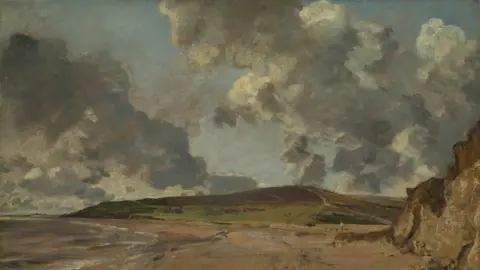
"This is interesting because Constable was so fascinated by meteorology, the sky, clouds, though it wasn't known at the time that the volcanic eruption had caused the strange weather he experienced in Dorset.
"The clouds are still there, but you don't get the colour that would have been really quite significant then."
 Fine Art Images/Heritage Images/Getty Images
Ahead of the Osmington event, which is the third in a series of six, Wilson said she had thought about how "such a simple drawing (a page from his sketchbook) could hold so many stories, layers about the past, present day and future".
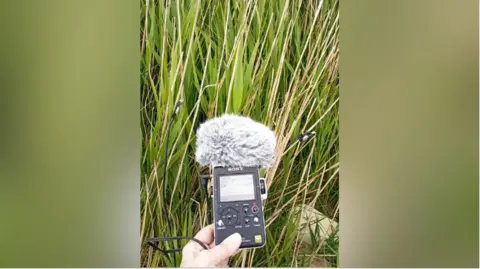
"The piece includes recordings I made in and around Osmington and Bowleaze, including bats, wind noise," she said.
"I went out and got different recordings of putting my hydrophones into the sea."
Also featured will be extracts from interviews with a volcanologist talking of the aftermath of Tambora and a curator discussing "more personal information about Constable, the drawing and his curiosity about the world".
The drawing will feature in Colchester & Ipswich Museums forthcoming exhibition The Hay Wain: Walking Constable's Landscape.
