Why did one of Britain's busiest tunnels have to close?

 National Highways
It is something that should not happen – an oversized vehicle entering and damaging a tunnel at one of Britain's busiest river crossings.
"Baffling" and "unfathomable" were just two words used to describe experts' confusion over how multiple safety systems failed to prevent the incident at the Dartford Crossing on 23 January.
The driver caused extensive damage along the entire length of the tunnel to multiple pieces of safety equipment, causing it to close for 30 hours.
National Highways says an investigation is under way, but MPs say motorists and residents are owed an apology as well.
So what went wrong?
How big are the tunnels?
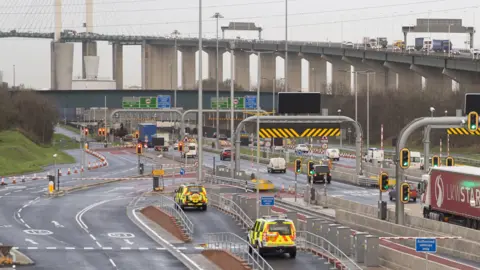
There are two tunnels at the Dartford Crossing, which both take northbound traffic from Dartford in Kent to Thurrock in Essex. (Southbound traffic uses the Queen Elizabeth II Bridge.)
The road itself is the A282, linking the two ends of the M25 at junctions 1A and 31.
One of the nation's busiest stretches of road, it handles an average of 150,000 vehicles a day, increasing to 180,000 on busy days.
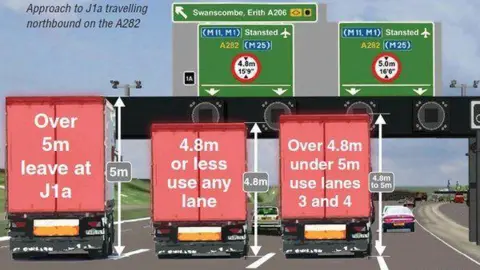
The right-hand tunnel is the larger of the two, accommodating vehicles up to 5m high (16ft 6in).
The left tunnel is slightly smaller than its neighbour, with a maximum height allowance of 4.8m (15ft 9in) – and it was this one which the vehicle in question entered at about midday, just a few hours before the Friday rush hour.
What damage did it cause?
 National Highways
National Highways said the vehicle – which was too tall – caused "significant damage to critical systems essential to [the tunnel's] safe operation".
The damage included overhead fans, the fire suppression system and CCTV monitoring equipment, and ran along the whole of the tunnel's 0.8 mile (1.3km) length.
Northbound motorists faced two-hour delays as all vehicles had to use the other tunnel while engineers worked overlapping shifts to repair the "extensive" damage.
The left-hand tunnel finally reopened at 20:00 GMT the following day, more than 30 hours after it had closed.
What safety measures are in place?
Vehicles deemed unsuitable to travel through the tunnels used to be identified by toll booth staff before they reached the crossing.
When the booths were removed in 2015, a new safety system was put in place. This system includes:
Signs
- Large signs warn drivers of the height and width restrictions of the tunnels, and are positioned on overhead gantries
- There are at least 10 different sets of signs, which start from junction 2 of the M25, more than two miles before the Dartford Crossing
- National Highways said ignoring the signs "is an offence"
Sensors
- There is a "specialised, automated and overhead sensor-based detection system" installed at the Dartford Crossing, according to National Highways
- These sensors identify vehicles which are too tall, too wide or potentially too hazardous to travel through the tunnels
Traffic lights
- These can be activated to stop the flow of traffic towards the tunnels
Barriers
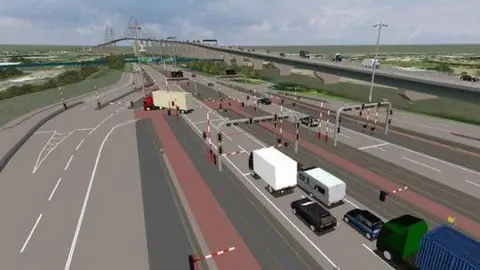
- If an unsuitable vehicle continues towards the crossing, barriers can be activated to stop it from entering the tunnels
Unsuitable vehicles are meant to make their way to a vehicle marshalling area to the side of the road, where they can be checked and escorted through the crossing once deemed safe.
If they are still deemed unsuitable to go through, they will be turned around and sent on an alternative route.
How did this vehicle get through?
 National Highways
It is unclear how this particular driver was able to enter the tunnel and cause so much damage.
The BBC has asked National Highways if the safety measures listed above failed to activate properly, or if they worked as intended but the driver was able to get past them.
National Highways said it was investigating what happened.
Kent Police has told the BBC that its inquiries are ongoing, adding that the driver allegedly failed to stop following the incident.
What reaction has there been?
The Labour MPs for Dartford – Jim Dickson – and Thurrock – Jen Craft – have both called for an investigation into what happened, and said residents and motorists deserved an apology.
"I'm upset that National Highways has allowed this to happen – where you've got height restrictions, they should work," Dickson told the BBC.
Craft said it was "quite astounding" that an over-height vehicle was able to enter the tunnel.
"I've visited the crossing control and it seems like they have really good procedures in place to prevent that from happening, but clearly on this occasion it just didn't work," she said.
Paul Hutton, a specialist in intelligent transport technology, said the safety measures had worked for 11 years.
"It is baffling as to how they didn't work this time," he told BBC Essex's Sonia Watson.
"It's also baffling how a driver could continue to drive the entire length of the tunnel, causing damage without stopping."
Rob Hollyman, a former haulage boss based in Purfleet and West Thurrock, said it was "not an unusual occurrence" for drivers of unsuitable vehicles to try to enter the tunnels, but they have been prevented from doing so by the safety measures.
"It's unfathomable as to why somebody could make that mistake," he said.
"We need to get to the bottom of why [the safety measures] failed and try to prevent a reoccurrence."
Follow Essex news on BBC Sounds, Facebook, Instagram and X.
