'Pill-on-thread' trial aims to detect cancer

 BBC
BBCA woman who lost her fiancé to oesophageal cancer has praised a trial involving a new test which aims to detect the illness earlier.
People over the age of 55 were invited to a mobile unit in Coalville, Leicestershire, to swallow the "pill-on-a-thread" which could detect early oesophageal cancer.
The screening trial will find out if the new test could be used to screen people with heartburn for Barrett's oesophagus – a condition that can lead to the cancer.
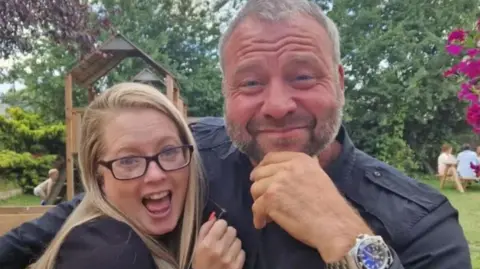
Stacey Chetwyn, whose fiancé Stuart Ashby died of oesophageal cancer in 2023, said: "I'm passionate about supporting research and anything that helps raise awareness and encourage early diagnosis."
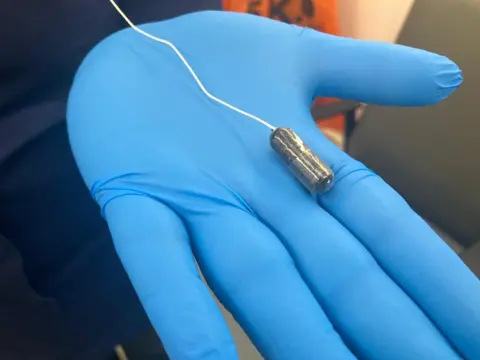
The procedures were carried out by lead nurse Irene Debiram-Beecham, who explained to people that the pill would stay in the stomach for up to 10 minutes.
The test is said to be much faster and cheaper than an endoscopy. The trial will find out if the capsule sponge test can detect oesophageal cancers earlier, reducing the need for intensive treatments.
The capsule sponge starts off as a small, coated pill attached to a piece of thread.
When a patient swallows the pill and it reaches the stomach, the coating dissolves and the sponge inside it expands to the size of a cherry tomato.
The sponge collects cells from the oesophagus as it is gently pulled out from the stomach, with the cells then sent for testing to detect if someone has Barrett's oesophagus or oesophageal cancer.
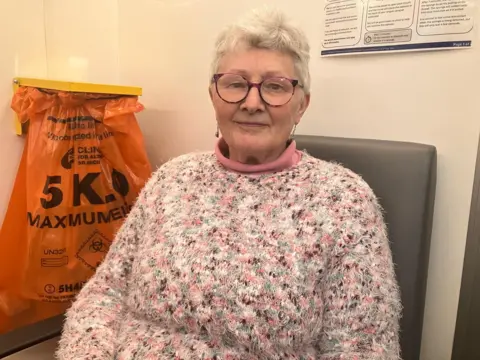
Shirley Woodhouse, 69, from Ashby-de-la-Zouch in Leicestershire, was one of the patients who took part in the trial.
She has been taking medication for heartburn for 11 years but has other symptoms.
She was invited to take part by her GP after they identified her as someone who would be a good candidate for the trial.
She said the trial was a good thing and jumped at the chance to take part.
"Doing the actual test was no problem... it hurt a bit as [the medical device] came out of the oesophagus, but not too much.
"I support any research to help medicine... I think it's excellent, the more screening programmes for cancer the better.
"I'm thrilled to bits to be part of the test. I think it can only be a good thing."
Woodhouse added that she will get her results in four weeks.
According to Cancer Research UK, 780 people over a three-year average are diagnosed with oesophagus cancer in the East Midlands.
Over the same period, on average, 660 die from the condition.
Stacey Chetwyn said her fiancé Stuart died of cancer just weeks after being admitted to hospital with a suspected heart attack.
At the time, she had just been diagnosed with secondary cervical cancer, for which she is still receiving treatment.
She said the loss of her fiancé has "been really tough" but said the trial had her full backing.
"I'm really pleased to see this incredibly important research happening, because early diagnosis for oesophageal cancer is vital," she added.
"Anything that helps raise awareness is crucial, too, because too many people dismiss symptoms and don't go to their GP."
"It was all such a whirlwind. We didn't have time to accept what was happening to us.
"At first Stuart thought his condition was back because he was struggling to swallow, but then, while I was in hospital, he was rushed to another hospital with a suspected heart attack.
"Tests showed he actually had cancer in his oesophagus, liver and spleen. It was an incredible shock when he died three weeks later and we're still coming to terms with it now."
The BEST4 screening trial is backed by £6.4m of funding from Cancer Research UK and the National Institute for Health and Care Research.
The trial is being led from Cambridge University Hospitals NHS Foundation Trust and the University of Cambridge.
Follow BBC Leicester on Facebook, on X, or on Instagram. Send your story ideas to eastmidsnews@bbc.co.uk or via WhatsApp on 0808 100 2210.
