What is different about new direct rail bid?

 BBC
BBCTimes have changed since Shropshire last had a direct rail link to London.
The county has not had a direct train link to the capital since Avanti West Coast stopped its single daily service in 2024 because, it said, of low passenger numbers.
Before that, another direct service which connected Shrewsbury with Marylebone ended in 2011.
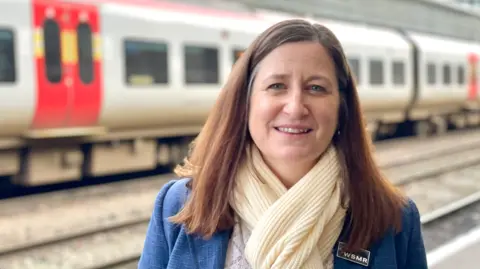
But Julia Buckley, the MP for Shrewsbury, said there was renewed interest in public transport and in improving rail infrastructure in the county. She was among a group of people who travelled by train to London to make the case for a new direct service between London and Wrexham and to deliver a petition to Downing Street.
Public transport user numbers had "really bounced back" since the Covid pandemic, she said, and businesses were also demanding more trains to the capital.
Buckley hoped the "Hollywood factor" could add some sparkle to the bid, believing there was new interest in Wrexham as a destination, since the football club was taken over by actors Ryan Reynolds and Rob McElhenney.
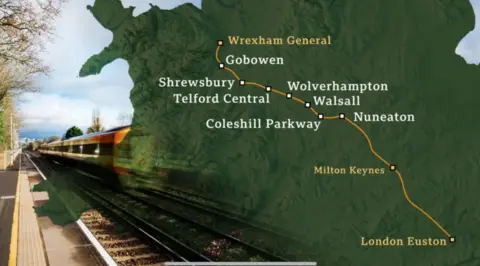
Wrexham, Shropshire and Midlands Railway (WSMR), led by international rail firm Alstom, submitted a bid at the end of last year to provide daily trains.
An initial bid for five daily services in each direction was rejected by the Office of Rail and Road, which said it had concerns over congestion on the line.
In the new application, WSMR reduced the number of daily services to three, with the option of a fourth in the future and included an additional stop at Wellington, Shropshire.
WSMR's mobilisation director Darren Horley said the aim was "linking towns and cities which aren't currently connected".
Previous services had been criticised for the time it took to reach the capital, but Horley said the new service would be quicker, taking about four hours from Wrexham to London.
 SLC
SLCCarl Jones, a director of Shropshire Chamber of Commerce said the county was currently the only one in England without a direct rail link to London. That could be quite damaging for businesses, he said, and for the hope of attracting more companies to the county.
Jones was supported by Nick Millington, the Network Rail Route director for Wales and Borders.
He said it was a growing area, with support from the Welsh Assembly and he was interested in proposals to improve the capacity of Shropshire stations.
Buckley said she felt there was now more support to improve the infrastructure including improvements to Shrewsbury station.
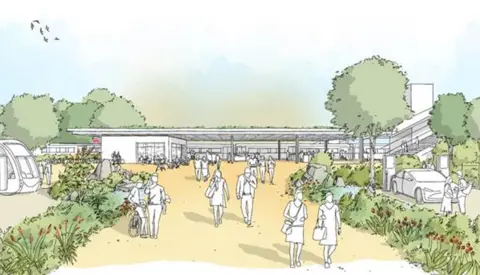
She said she hoped it could be redesigned as part of a 10-year vision for the town with a two-storey car park at the back, a new area at the front and better bus links.
"The front of the station should not be a car park, it should be a plaza with fountains where you can sit down and have a panini and a cappuccino", she said.
There is also a proposal for a new parkway station to the east of Shrewsbury.
Ian Baxter from rail company SLC is working on that plan.
A site has not yet been identified but he said it would have easy access to roads in and out of the county town
His company has worked on other parkway stations such as Warwick Parkway and Worcester Parkway and he said they typically took between four and six years to happen.
He said with tens of thousands more homes due to be built in the county there will be a lot more people who needed to use the railway.
Follow BBC Shropshire on BBC Sounds, Facebook, X and Instagram.
