'When dad came home it was in a coffin'

 BBC
BBCHalf a century on from Kingsmills, the daughter of one of 10 Protestant men killed on his way home from work says she feels his loss every day.
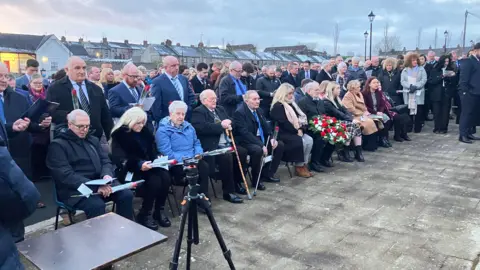
On Sunday, a memorial service marking 50 years since the attack was held in Bessbrook, the village that most of the victims called home.
Nobody has ever been convicted for the killings with the Police Ombudsman finding that police investigating the murders failed to arrest and interview 11 men identified by intelligence.
'No earthly justice'
The Kingsmills Memorial Committee held a 50th anniversary service of remembrance at 15:00 GMT in Bessbrook Town Hall.
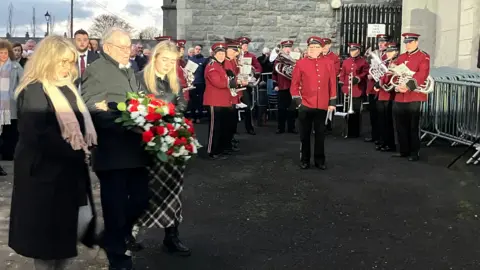
More than 400 people, including family members, friends, church, police and political dignitaries attended with music provided by the Tullyvallen Silver Band.
The crowd heard letters from family members unable to attend as well as addresses from local church leaders.
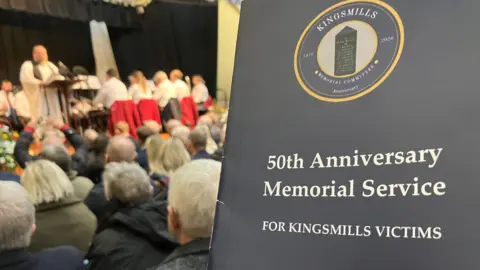
Among them was Presbyterian minister, Rev Keith McIntyre, who said: "There has been no earthly justice, those inquests have delivered nothing only pain."
Outside the town hall, roses were laid at the Kingsmills memorial by family members of those who died. Alan Black, the sole survivor then laid a wreath.
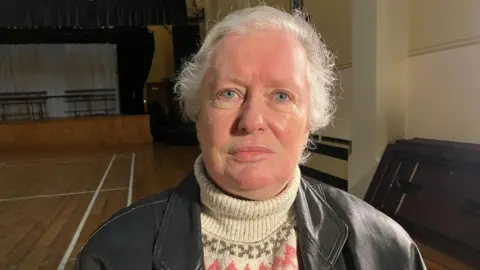
Shirley Norris (née Lemmon), was 18, as Christmas approached in 1975 and busy preparing for her wedding.
One thing she was not concerned about was the music and dancing. She had had a lifetime of lessons with her father Joseph.
"Home was a happy place. Daddy taught me how to waltz by standing me on his feet, and we would have waltzed around the living room," she recalled.
"He was a wonderful singer. He sang in the church choir every Sunday, and people, even to this day, say 'your father had a wonderful voice'."
But a week into the new year, her world collapsed when Joseph was shot dead alongside nine workmates, on the side of a south Armagh road.
One man, Alan Black, somehow survived despite suffering 18 bullet wounds.
'When he came home it was in a coffin'
Ms Norris said news of the attack "came through in dribs and drabs".
"That day we'd been in Newry with my twin nieces, they were four. They got their flower girl dresses and they wanted to show their grandad. But their grandad didn't see them because when he came home it was in a coffin," she said.
"We did our best. I had a son. He never knew his grandfather. My sister had sons. They never knew their grandfather. He would have been so good too."
She remembers her father every day, but the memorial highlights the horror of what people lived through to a younger generation.
"It can be difficult, but children today do need to know what happened in the past so that it'll not happen in the future," she said.
"I have four grandsons, four wonderful boys, and I try to teach them as my granny taught me, respect people, treat them the way you want to be treated."
'Kingsmills changed Bessbrook forever'
Alan Black lives just yards from Bessbrook's Kingsmills memorial. His story is well known but its horror does not diminish in the retelling.
"The mood in the factory that Monday was sombre because three of the Reavey boys had been shot the night before," he said.
"And the O'Dowds further down the country.
"Our minibus passed directly past the Reavey household. You could have leaned out of the minibus and touched the gate. What happened at Kingsmills changed Bessbrook forever."
Mr Black said he could hear moaning and groaning from his colleagues before the shooting stopped.
"But then this voice said, 'Finish them off'. Have you any idea how horrific that was to hear that voice? We were helpless. He turned the gun on me, and the shot hit me in the head."
Mr Black was taken to Daisy Hill hospital in Newry where he slowly recovered from his physical injuries.
The psychological impact took much longer to recede.
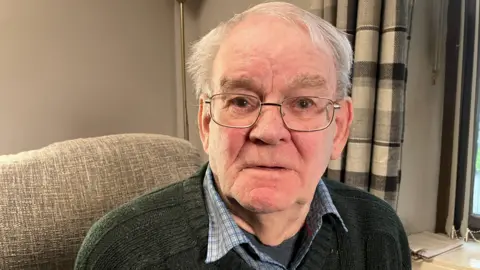
"It was an awful tough time for my wife Margaret because she had three children and now all of a sudden she has the three kids and another big kid with his head mashed," he said.
He moved to Scotland and his family followed once he had secured a flat.
"Margaret never settled. But I wasn't ready for going home. I said, 'After two years if you still don't like it I won't question it and we'll go home'. Two years nearly to the day later she said she wanted to go home so we went."
Mr Black said the time gave him "breathing space".
"I thought the other families would resent me. But when I came home all the families couldn't do enough for me," he said.
"The doctors said I was suffering from survivor's guilt."
For both Ms Norris and Mr Black the anniversary marks another opportunity to highlight that there has been no justice and few answers for families whose lives were torn apart on 5 January 1976.
What happened at Kingsmills?
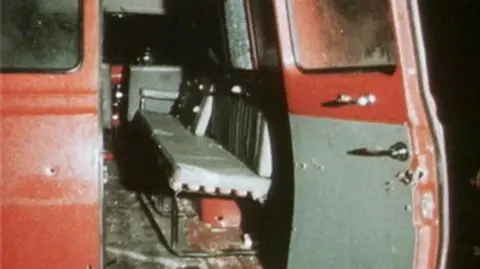
The attack took place on 5 January 1976, just after 17:30 GMT.
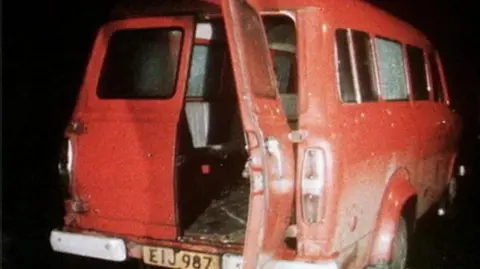
A red Ford Transit bus was carrying the men home from their workplace in Glenanne, along the rural road to Bessbrook.
As the bus cleared the rise of a hill, it was stopped by a man standing in the road flashing a torch.
As the vehicle came to a halt, 11 other men, all masked and armed, emerged from hedges around the road.
The IRA men ordered the passengers out of the bus demanding to know the religion of each of the men.
One of the workers, who identified himself as a Catholic, was told to leave.
The gang then opened fire on the remaining passengers, killing 10 Protestant workmen and seriously wounding another.
No-one has ever been held to account for the murders.
Who were the Kingsmills victims?
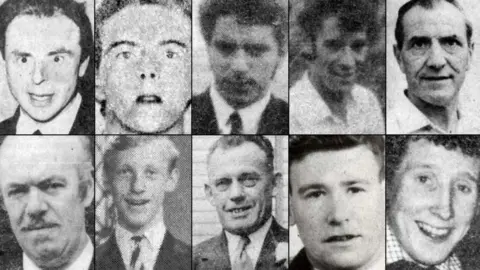
The 10 men who were killed at Kingsmills were:
- John Bryans
- Robert Chambers
- Walter Chapman
- Robert Freeburn
- Reginald Chapman
- Joseph Lemmon
- John McConville
- James McWhirter
- Robert Walker
- Kenneth Worton
A memorial service is held in south Armagh every year to remember them.
Only one man, Alan Black, survived the shooting.
He was shot 18 times and spent months in hospital recovering from his injuries.
Who carried out the Kingsmills murders?
In 2011, a report from the Historical Enquiries Team in Northern Ireland said the IRA was responsible for the attack.
It concluded that it had been a purely sectarian attack.
An inquest last year found there was no evidence of collusion or state involvement and that the attack was carried out by a unit consisting of at least 12 members of the IRA, pretending to be an Army patrol.
Shortly after the attack, the so-called South Armagh Republican Action Force claimed responsibility for it. The coroner said that was a lie.
The IRA has never admitted involvement and was supposed to be on ceasefire at the time of the attack.
The judge at the inquest added Kingsmills was "ostensibly in direct response" to attacks on the Catholic Reavey and O'Dowd families by loyalist terrorists the previous day, though Kingsmills was not spontaneous and had been planned "well in advance".
Throughout the Troubles, loyalist and republican paramilitaries carried out tit-for-tat murders, killing people simply based on their religion.
What is taking place to remember the victims?
On Monday, a roadside remembrance service, at the site of the atrocity, will be held at 11:00 GMT.
This service, organised by Families Acting for Innocent Relatives (Fair), will be conducted by local clergy.
