Money access concerns as cash machine numbers drop

 Getty Images
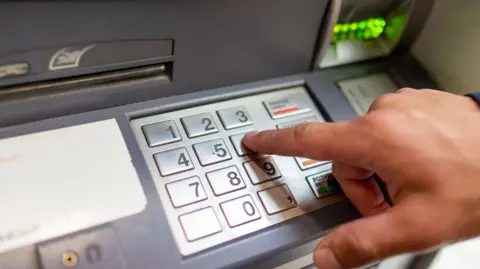
The number of cash machines in Norfolk has fallen by almost a third, according to a report looking into concerns about access to money.
The study by Norfolk County Council said cash remained "vital" for many people and that fees for card transactions could increase costs for small businesses.
It found that while there were 784 ATMs in Norfolk in 2019, there were now only 536.
Link, which oversees the UK's network of cash machines, said whenever an ATM, bank or post office closed, it looked at "what the local community needs".
The council report, which used data from Link, also found cash withdrawals in Norfolk had fallen by almost £420m – from £1.3bn in 2019, to £881m in 2025.
It said despite the pandemic accelerating the use of digital and card transactions, "cash remains vital for many residents and businesses, particularly those facing digital exclusion, low income or vulnerability".
It also warned that in Norfolk "many residents have at least a mile's journey to their closest ATM", and said smaller organisations were "disproportionally impacted by card fees or are vulnerable to breakdowns in digital connectivity".
 Paul Moseley/BBC
The growing importance of post offices and, to a lesser extent, banking hubs were also highlighted.
At a meeting of the authority's infrastructure committee, Conservative councillor Christopher Dawson, who first called for an investigation into cash access, said physical money remained important.
"It's the coin of the realm, we need to protect that," he said.
He was also concerned that charities were losing out, with fewer people using notes and coins.
For Liberal Democrat Rob Colwell, who said he never used cash, the report was an eye-opener.
"It was really interesting to actually realise and appreciate... the impact it does have on the community," he said.
He felt there was "an inevitable move toward a cashless society", and the council should do more to seek funding for training to prevent digital exclusion.
 Paul Moseley/BBC
However, the Green Party's Catherine Rowett warned the country could become "very insecure if we build up a total reliance on digital transactions".
Labour's Chrissie Rumsby said many people on lower incomes in the Mile Cross area she represented in Norwich still relied on cash.
She said she had seen "chaos" and "panic" when card systems stopped working in shops.
"Tech is wonderful when it's working, but it doesn't always work," she said.
Nick Quin, Link's head of financial inclusion, told the BBC that accessing cash remained "critical".
"Whenever an ATM, post office or bank branch closes in Norfolk, we will look at what the local community needs, whether that is a free-to-use ATM, improvements at the local post office or in some cases a banking hub."
Follow Norfolk news on BBC Sounds, Facebook, Instagram and X.
