House prices in Wales rise faster than UK average - see how your area compares

 Getty Images
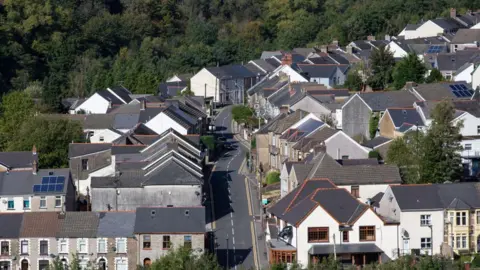
House prices in Wales rose faster than the UK average last year, with some areas seeing increases of 7%.
Data published by the Office for National Statistics (ONS) shows average property prices in Wales increased by 5% in the year to December 2025, more than double the UK-wide rise of 2.4%.
Blaenau Gwent and Anglesey were among the areas which saw the biggest increases, while average prices fell slightly in Ceredigion and Merthyr Tydfil.
Experts said the data showed more affordable areas were continuing to attract buyers, even as higher mortgages and economic uncertainty weighed on demand elsewhere.
The average house price for Wales was £215,000 in December 2025, up 5.0% (£10,000) from a year earlier.
Among Welsh local authorities, Blaenau Gwent and Anglesey recorded some of the strongest annual increases with house prices rising by 7% and 7.2% respectively.
In Ceredigion, average house prices fell by 4.1% while in Merthyr Tydfil they fell by 4.4%.
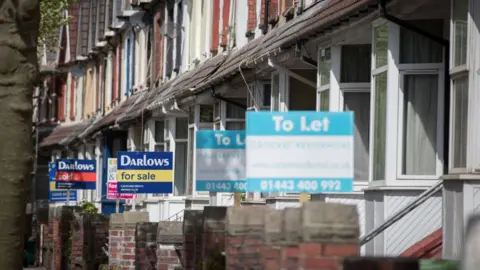
Joseph Tibbs, who works for Asset Estates estate agency in Abertillery, Blaenau Gwent, said the number of buyers had fallen slightly compared with last year, even though sales were still being agreed.
"The overall demand is ever so slightly down, not quite as many looking at the moment since last year," he said.
 Getty Images
There were also fewer inquiries compared with previous years, when popular properties would quickly attract multiple viewings, Tibbs said.
"It used to be that a property would go up and the phone wouldn't stop ringing. You'd get anything from 10 to 15 viewings in the first two or three weeks. Now it seems to have really quietened down.
"It's becoming more quality over quantity."
He said many buyers were moving from more expensive areas.
"We get a lot of people from Cardiff, Newport and even Bristol, especially since working from home became more popular. They come up this way for the house prices."
'I wouldn't really be living'
For some first-time buyers the barrier is no longer saving for a deposit, but affording the monthly mortgage repayments.
Sam Cartwright, 25, from Wrexham, has saved £15,000 and began looking at properties locally, priced at around £150,000. But he said the ongoing cost of owning a home made buying on his own feel unrealistic.
"You're constantly being told 10% deposit. I've got a 10% deposit, but it's the additional costs to the mortgage rates," he said.
"You're talking between £700 and £1,000 per month for a mortgage, and then you've got your council tax, your heating, your electric, your water... and that's before you even get to food and fuel."
 Sam Cartwright
He added: "I would be left with maybe £50 a month after all the housing costs were done. It's unattainable in the sense that I have the deposit money, I just wouldn't be able to afford the upkeep of the house on my own.
"It just begins to snowball and then it makes me think, I wouldn't really be living if I did get a house, you know?"
Among his friends, Sam said, buying alone was rare.
"I'm 25. Not many of the people around me have got a house, or even anywhere near."
He added: "Something's got to give. Either the wages have got to rise or the housing prices have got to drop, there can't be both."
'Relative affordability'
Dan Hill, research analyst at Savills, said lower house prices relative to earnings meant buyers in Wales faced fewer constraints than those in more expensive areas of England.
"Wales outperforming the UK average is down to its relative affordability," he said.
"With lower house prices relative to local earnings, buyers in Wales are less constrained than those in more expensive parts of England, which is supporting price growth."
 Savills
However, Dan said some coastal areas had bucked the wider Welsh trend.
Ceredigion and Pembrokeshire both recorded annual price falls of more than 3%, following sharp increases during the pandemic.
"Coastal holiday hotspots within Wales have been notable outliers in the last year," he said, adding that prices in those areas rose by more than 35% between 2020 and 2022.
He said recent changes to council tax rules in Wales, which allow councils to charge up to 300% of the standard rate on second homes, had reduced demand from that group of buyers.
"This has substantially limited demand from this group and localised price falls are the result."
Looking ahead, he said prices in Wales were likely to continue rising.
"House prices in Wales should continue to outperform the UK average. This will be supported by a gradually improving economy and the likelihood of further interest rate cuts to come."
