Why do horse trams stop halfway along the original route?

 MANX SCENES
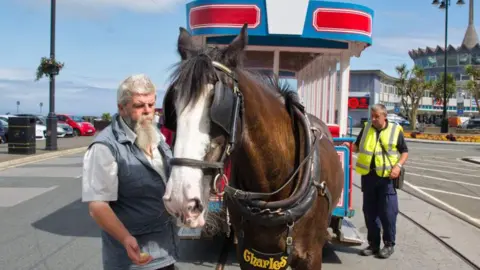
The Isle of Man's historic horse trams celebrate their 150th anniversary this year.
Currently the heritage transport travels between Derby Castle and Broadway – a stretch representing roughly half of the original 1.6 mile (2.6km) tramway.
A political debate over the extension of the line to the Sea Terminal - the full original route - is set to resume, with a backbench motion tabled for March, and a pledge by the infrastructure minister to bring a business case to Tynwald in May.
But why does the island currently have a shortened tramline, and how did we get here?
Origins
Established in 1876 by Thomas Lightfoot, the Douglas Bay Horse Tramway was opened to capitalise on the island's tourist boom in Victorian times, and continues to serve as a popular attraction.
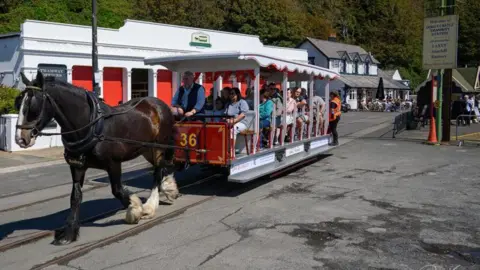
The 3ft (0.9m) gauge tramway still operates with many of its original cars, and forms part of the island's heritage transport offering alongside the Manx Electric Railway and Isle of Man Steam Railway.
Initially running between Summerhill and Broadway when the tramway officially opened in the summer of 1876, the track was extended to the Sea Terminal the following year.
Although the positioning of the tracks was subject to change as the Douglas seafront evolved, the trams continued to take passengers the full length of the promenade for more than 140 years.
 MANX SCENES
Ownership
Originally operated as a private enterprise – owned first by Lightfoot, then subsequently by the Isle of Man Tramways & Electric Power Co. Ltd – the service was bought by Douglas Corporation in 1902.
After running the trams for more than a century, in January 2016 the local authority announced plans to discontinue the service because of the financial burden on ratepayers in the capital.
In July the same year, the island's parliament backed saving the trams, with the Department of Infrastructure (DOI) taking control of the service.
Initially the proposal was for a two-year period while plans were drawn up to make the service profitable.
A new single-line track between Derby Castle and the War Memorial - midway along the original tramline - was confirmed, as part of a planned refurbishment of the promenade.
However, an attempt by the DOI to shorten the line, meaning it would terminate at the midway point was blocked.
Another vote the following year cemented the political will for the entire line to be reinstated, running the full length of the promenade.
Promenade revamp
While the profitability of the service was under review, plans for a major refurbishment of the Douglas Promenade carriageway got under way.
Work on the £26m project began in September 2018 and was originally meant to finish in October 2020, but faced significant delays - with work eventually concluding in March 2022.
That lead to a three-year hiatus in the running of the trams – eventually making their comeback in July 2022. The first full season on the truncated track to the Villa Marina, on Broadway, took place the following year.
 MANX SCENES
Positioning and funding
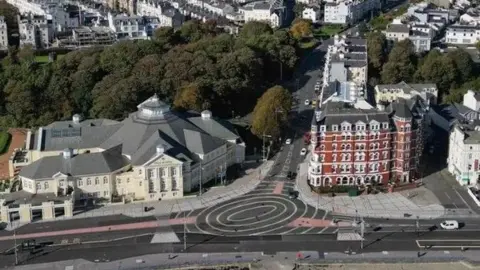
For much of its previous lifespan, the trams ran on a double-track system down the centre of the road.
Later proposals to move the entire line on to the Douglas Promenade Walkway faced a backlash and were shelved.
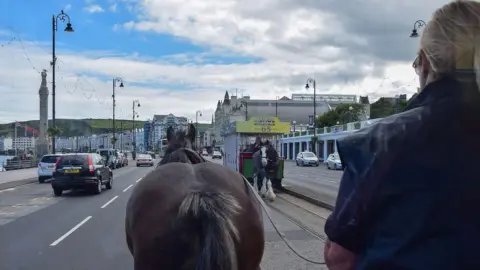
The design eventually agreed upon combines a double-track to the Villa Marina, transitioning to a single line on the seaward side of the carriageway as far as the Sea Terminal.
Although the northern section of the track was re-laid, the second section was initially paused to give businesses along the promenade "a break" from building works. That led to the creation of a "horse tram corridor" where the tracks were earmarked to be laid at a later date.
Funding for the full line was originally budgeted for within the initial refurbishment, but it was revealed in 2022 that the £1.2m needed for that single-track extension had been spent elsewhere on the revamp.
So, while the tracks for the line had been purchased and remain in storage, further funding is needed to lay them.
 MANX SCENES
What next?
Questioned over the future of the line last month, Infrastructure Minister Tim Crookall said he planned to bring forward a business case for the line's completion to Tynwald in May.
Ahead of that, Sarah Maltby MHK, will make a bid to have the document brought forward for debate a month earlier.
She wants Tynwald to task the DOI with bringing forward a capital funding request, implementation plan and business case for the reinstatement of the full line in April.
Maltby said while her motion would not see a commitment to spending any money, it would create "direction" for the future of the scheme.
It remains to be seen if - after two successive previous administrations backed safeguarding the horse trams along the full length of the promenade – current politicians will do the same.
Read more stories from the Isle of Man on the BBC, watch BBC North West Tonight on BBC iPlayer and follow BBC Isle of Man on Facebook and X.
