Trust your instincts, says student who lost limbs to meningitis

 Ketia Moponda
A student who had her lower legs amputated after contracting meningitis during a freshers week has urged people to trust their instincts and seek medical help if something does not feel right.
Ketia Moponda of Wolverhampton also lost parts her fingers and was lucky to survive issued her warning following an outbreak of the illness which has left two people dead in Kent.
The 19-year-old was diagnosed with meningococcal septicaemia in September 2024, one week after arriving at De Montfort University in Leicester.
What she initially believed to be freshers flu rapidly worsened and she was rushed to hospital where doctors initially did not expect her to survive. She spent five months in hospital.
"They didn't think I would make it at all," she told BBC Radio WM.
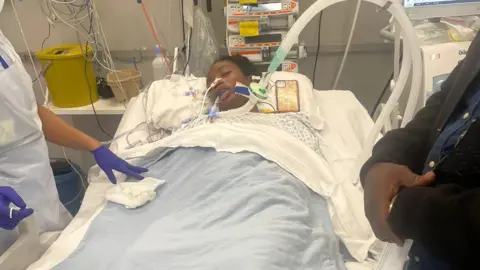 Ketia Moponda
The speed at which her condition deteriorated was frightening, she said.
"I didn't really know too much about [meningitis] but it spreads and it progresses so quickly, extremely quickly, that it's so fatal," she said adding it had started off like a common cold.
"If something doesn't feel right with your health don't second-guess it," she said.
"Trust your instincts and go and get help. Tell someone, go and get help."
Moponda has shared her story on social media to raise awareness following her life-altering experience.
She said she was now doing well and has managed to start going back to the gym having previously been an avid gym-goer.
 Getty Images
Samantha Field, from Kidderminster, Worcestershire, was a student at Royal Birmingham Conservatoire in 2022 when she contracted the disease.
She said it only took two days to deteriorate, by which point she added: "I couldn't see or talk, I couldn't walk, my bladder had shut down completely and I was basically on the verge of sepsis.
"At that moment, my mum took the decision to go to hospital, and thank God she did, because she saved my life."
Field said she "struggled" in the years that followed but is "doing better" now, and gave birth to her first child in 2025.
She is now encouraging others not to ignore the symptoms like she did.
"I should have known when I lost the ability to walk. I remember standing up and feeling like I was on a drop ride, everything felt like it had dropped and I was struggling to see," Field recalled.
"I should have thought then it was more serious. I couldn't walk, my vision was going really bad and the fact I hadn't gone to the toilet in days, that should have been the sign really."
 Samantha Field
The stories from Moponda and Fields come after the UK Health Security Agency (UKHSA) confirmed meningitis B was behind 13 cases in the Canterbury area last weekend. An 18-year-old school pupil named Juliette and a 21-year-old University of Kent student have died.
The MenB vaccine has been routinely offered to babies and young children since 2015, meaning the current generation of university-age students was not covered by the programme.
According to the NHS, meningococcal septicaemia is less common than viral meningitis but more serious, requiring urgent treatment with antibiotics. Symptoms of meningitis include high temperature, vomiting and confusion.
Follow BBC Birmingham on BBC Sounds, Facebook, X and Instagram.
