Summary

  1. 'My sister is in hospital with suspected meningitis - we've come for antibiotics as a precaution'published at 13:10 GMT

    One of those waiting in the queue at the University of Kent for antibiotics is Josh - who is not a student there but was with his sister yesterday. She is now in hospital with a suspected case of meningitis.

    Speaking to the BBC, Josh says: "From our perspective, we've got to come up here as a precaution.

    "Me and my partner both feel fine, my sister is in hospital with a rash and a couple of other symptoms - it's suspected at the moment."

    He explains his sister appears to be doing fine at the moment.

    "Considering my sister didn't go to this university [...] as far as I can tell she's picked it up from somewhere else - that is quite concerning," he adds.

    Media caption,

    Kent resident's concern for his sister with suspected meningitis

  2. Ashford Year 13 pupil in hospital with suspected meningitis - schoolpublished at 12:53 GMT

    Parents and guardians from Norton Knatchbull School in Ashford, Kent, have been notified that a Year 13 student has been admitted to hospital with a suspected case of meningitis.

    "At this stage, we have no confirmed diagnosis," the school says in a letter seen by the BBC, adding that they are taking "precautionary steps in line with public health guidance".

    The update to parents and carers goes on to warn them of the symptoms of meningitis, instructing them to seek urgent medical help if symptoms are severe.

    Norton Knatchbull School say they are following Public Health England's (PHE) advice, which includes reinforcing hygiene measures across the school and ensuring any close contacts of the affected student are identified and advised. For now, the school adds, "PHE has not advised any school closure or additional measures beyond those listed above".

    The BBC understands that 11 people were seriously ill with the disease. As things stand, it is unclear how many people are infected and the UK Health Security Agency (UKHSA) has not yet identified the strain of the disease.

  3. National Union of Students says there is 'not enough' awareness of meningitispublished at 12:40 GMT

    Amira Campbell, president of the National Union of Students, says the union is "saddened" to hear of all those affected by the outbreak as she encourages people to follow advice being shared by health professionals.

    "There is simply not enough awareness of meningitis, especially as young people head off to university," she adds.

    "While we all expect the inevitable freshers flu, there are deadly viral strains also circulating, which students need to be protected against and aware of."

  4. Analysis

    Why such a large outbreak?published at 12:34 GMT

    James Gallagher
    Health and science correspondent

    It is rare to have a large outbreak of meningitis like this in the UK - so what could be going on?

    The most likely answer is a lack of immunity to the strain of bacteria causing the outbreak.

    It will take laboratory analysis to be certain, but senior scientists have told me the most likely culprit is group B meningococcus bacteria.

    These are the most common cause of invasive meningitis in the UK and crucially this group of teenagers and young adults have not been vaccinated against it.

    A Men B vaccine was introduced a decade ago, but only for babies.

  5. Queues continue at University of Kentpublished at 12:26 GMT

    Long queues of people waiting for antibiotics have continued to snake around the University of Kent campus, following the death of a student from the illness.

    Many people are wearing face masks and standing apart in scenes reminiscent of the Covid pandemic.

    A group of people with blue face masks on.Image source, PA Media
    A long queue of people outside a big building.Image source, PA Media
    Aerial view of long queue of people waiting outside an octagonal cement building hosting the University of Kent SenateImage source, PA Media
  6. Sixth form student who died from meningitis namedpublished at 12:04 GMT
    Breaking

    Nick Johnson
    BBC News

    We've just heard from Amelia McIlroy, headteacher at Queen Elizabeth’s Grammar Faversham, who has named the Year 13 student who died due to the meningitis outbreak as Juliette.

    McIlroy says: "She loved our school and was very happy.

    "She embraced everything the school had to offer and was genuinely caring - love and thoughts with family and friends."

  7. Vaccines and meningitis - what we knowpublished at 11:51 GMT

    Malu Cursino
    Live reporter

    Last October, the government warned that, external vaccinations offer "crucial protection" against meningitis. The remarks were made as the UK Health Security Agency (UKHSA) recorded an increase in meningitis cases, with MenB accounting for 82.6% (313 of 378) of all cases.

    Most jabs are offered freely on the NHS to newborns and infants, and children should receive most vaccines as part of the NHS vaccination schedule.

    The specific strain of meningitis responsible for the Kent outbreak has not yet been identified.

    Meningitis Now, a UK charity that specialises on the disease and its impact, explains that jabs against MenB are not available on the NHS for teenagers and young adults. "Currently the vaccine is only available privately through high-street and supermarket pharmacies," the charity explains.

    The disease can affect anyone, but it is most common among babies, teenagers and young adults, the charity adds.

    Here's what the NHS says about jabs available, and who can get vaccinated:

    • MenB vaccine: offers protection against meningococcal group B bacteria, which are a common cause of meningitis in young children in the UK. This vaccine is recommended for babies aged eight weeks, followed by a second dose at 12 weeks and a booster at one year
    • 6-in-1 vaccine: offers protection against diphtheria, tetanus, whooping cough, hepatitis B, polio and Haemophilus influenzae type b (Hib). Hib are a type of bacteria that can cause meningitis. The vaccine is given on four separate occasions - when children are eight weeks, 12 weeks, 16 weeks and 18 months old
    • Pneumococcal vaccine: offers protection against serious infections caused by pneumococcal bacteria, including meningitis. Babies are offered the jab at 16 weeks, with a booster at one year of age. Adults aged 65 or over are offered a single dose
    • MMRV vaccine: offers protection against measles, mumps, rubella and chickenpox. Meningitis can sometimes happen as a complication of one of these infections. The vaccine is offered to children in two doses, when they're one year old and 18 months old
    • MenACWY vaccine: offers protection against four types of bacteria that can cause meningitis. It's offered to teenagers aged 14 years old and those aged 25 and under who have never had a vaccine containing MenC
  8. Canterbury school says it is 'monitoring' studentspublished at 11:37 GMT

    A school in Canterbury says it is monitoring its students following a meningitis outbreak in the area.

    Dr Ken Moffat, headteacher at Simon Langton Boys School, says Year 13 pupils are studying at home today.

    "This is an ongoing situation," he says. "We are in contact with UKHSA [the UK Health Security Agency] and are monitoring our students.

    It comes after Queen Elizabeth's Grammar School in Faversham said one of its sixth form pupils died on Saturday from meningitis.

  9. Send us your questions about the meningitis outbreakpublished at 11:26 GMT

    Have you been affected by the meningitis outbreak? Do you have any questions about this? You can get in touch in the following ways:

    Please read ourterms & conditionsandprivacy policy

    In some cases a selection of your comments and questions will be published, displaying your name and location as you provide it unless you state otherwise. Your contact details will never be published.

    your voice branding
  10. 'That could have been one of my mates,' says Kent studentpublished at 11:17 GMT

    Simon Jones
    BBC South East Today, reporting from Canterbury

    A young man in a hoodie is standing against a building.

    A man studying at the University of Kent says he is "lost for words" after it was announced a student had died from meningitis.

    "It's crazy," Sawyer tells the BBC. "It's come out of nowhere".

    He says the death had hit him "hard" because it was "so close to home".

    "That could have been one of my mates," Sawyer continues.

    The student, who was meant to have exams this week, adds that the university had handled the situation well. "They're doing what they can," he says.

    The University of Kent said earlier it was working to move in-person events online following the outbreak.

  11. Watch: 'It's been a difficult morning here at the University of Kent'published at 11:10 GMT

    The BBC's Simon Jones has been at the University of Kent this morning, where one student has died from meningitis.

    Watch his full report below:

    Media caption,

    Meningitis outbreak kills two people in Kent

  12. Club Chemistry contacted by UKHSA, will stay closed until further noticepublished at 11:01 GMT

    Close up of main entrance of Club Chemistry in Canterbury. The nightclub is located in a Victorian red-brick buiildingImage source, PA Media

    The owner of Club Chemistry says the UK Health Security Agency (UKHSA) informed them that somebody who was in their nightclub has "since been diagnosed with meningitis".

    Louise Jones-Roberts tells the Press Association that the UKHSA has asked if they have any methods for tracing who has been in the premises, but there are some hurdles.

    "We have an ID scanner but that is more of a security measure... It takes pictures of some driving licences, ID cards and so on." They could trace ticket holders, but she explains that most people pay on the door.

    The club will stay closed until they get further advice from the UKHSA, she adds.

    "I can't imagine what the families are going through," she says, adding: "Meningitis affects healthy, young people and this is devastating."

  13. Two people dead and 11 seriously ill - what we know about the meningitis outbreak so farpublished at 10:51 GMT

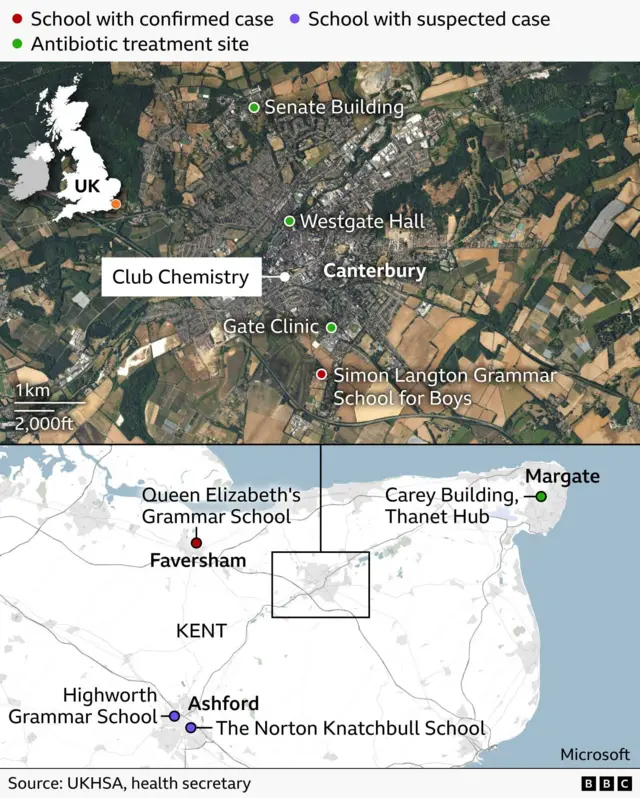
    Two people have died following an outbreak of meningitis in Kent and the BBC understands 11 more in the Canterbury area are in hospital and are seriously ill.

    If you're just joining us, here's what we know so far:

    An aerial map showing where the University of Kent campus is located in relation to the city of Canterbury and in the top left corner a red dot shows where it is located within the UK
  14. How is meningitis spread?published at 10:41 GMT

    Some people can carry bacteria in their nose without getting sick, but can spread it to others in spit or saliva through coughs and sneezes, kissing and sharing utensils.

    The infection can also be spread by someone with meningitis, although this is less common.

    It's possible to get meningitis more than once.

    The BBC understands the outbreak in Kent is thought to be linked to a social event in Canterbury, which some of those who fell ill attended.

    Outbreaks of meningococcal disease are rare, but can occur in settings where people group together, such as college campuses.

  15. 'Immediate protection is by giving an antibiotic,' says local GPpublished at 10:34 GMT

    The immediate response to the outbreak will now focus on protecting anyone who may have been socialising with those who died from meningitis, according to a local GP.

    “Immediate protection is by giving an antibiotic," Dr Julian Spinks tells BBC Radio Kent. “Longer-term protection is by vaccination.”

    “Most people who’ve not been in closer contact, the risk is still pretty low," he adds.

    “The main emphasis is contacting people who have been at the nightclub or particular halls of residence."

  16. Local MP says she wants briefings for local schools for advice on next stepspublished at 10:27 GMT

    A headshot of Helen Whately against a blurred backgroundImage source, PA Media

    Conservative MP for Faversham and Mid Kent, Helen Whately, has told the Press Association she is expecting to receive a briefing update from the UK Health Security Agency this morning.

    "I'm trying to get information about what is being done locally to trace contacts and identify which students and school pupils are at risk," she tells the news agency.

    "Also I want schools to be given briefings on what steps they should take and the advice to give to parents."

    In a post on X, Whately sent condolences to the families of the two people who have died.

    "Just seen the shocking and sad news of two young lives lost to meningitis.

    "It’s a deeply worrying time for others in hospital or at risk of this horrible illness."

  17. Students at the University of Kent feel shellshockedpublished at 10:17 GMT

    Simon Jones
    BBC South East Today, reporting from Canterbury

    Large group of students (over 50) queue up outside the University of Kent Senate buildingImage source, PA Media

    Students and staff here on the campus at the University of Kent feel shellshocked.

    There had been talk on chat groups that people had been taken ill. But last night students started receiving emails confirming the worst.

    Some are in the middle of exams - a stressful enough time as it is.

    Hundreds of people are queuing this morning to get antibiotics. Many are wearing masks.

    They want reassurance and they want information. The university says it’s doing all it can to keep people informed.

  18. Long queues for antibiotics seen at University of Kentpublished at 10:08 GMT

    People, many wearing face masks, have formed lengthy queues at the University of Kent campus to get antibiotics this morning.

    A long queue of people on a university campus.
    A long queue of people on a university campus.
  19. GP advises people to keep informed but not to panicpublished at 09:55 GMT

    GP Dr Fari Ahmed mid-speaking as she sits on the BBC Breakfast sofa

    Speaking to BBC Breakfast this morning, GP Dr Fari Ahmed says people do not need to panic and they will have been contacted if they had been a close contact of one of the cases.

    "When something like this happens, we've got a system in place," she explains.

    "They're now contacting potential contacts - and they've got to be close contacts - and I think they're all being offered antibiotics [as a] prevention to clear any of the bacteria you have.

    "If people are worried there are good sources of information around - the NHS website, some meningitis organisations.

    "It never hurts to be aware or be informed but I wouldn't be rushing or panicking about it unless you've been contacted."

    Our previous posts have more on the symptoms of meningitis and the advice from the UK Health Security Agency (UKHSA).

  20. Canterbury nightclub says 'some people' who may have been at club could have been affected by outbreakpublished at 09:44 GMT

    Brick building hosting a nighclub, the sign Chemistry features at the top of the main door, two cars parked slightly to the left of the entranceImage source, PA Media

    The BBC understands the outbreak is thought to be linked to a social event in Canterbury.

    A local nightclub, Club Chemistry, issued a statement on Sunday saying: "Some people who may have attended Club Chemistry could have been affected by the current outbreak."

    The nightclub says their thoughts are with the families of those who have died and all those affected.

    It advises people to call 111 urgently if they present with certain symptoms.

    "We are awaiting further information from the Health Security Agency, which we will share with you as soon as we have it," the nightclub adds.

    "Please look out for each other, our thoughts are with everyone affected by this."