Full size version of emergency aircraft to be made

 CraneAero
A design of a new class of emergency vertical take-off aircraft has made it through to the next stage of a global competition.
Researchers at Cranfield University, Bedfordshire, said it would use AI and advanced navigation systems for real-time missions.
The CRANE (Cranfield Rapid Aerial Network for Emergency) is one of only eight Stage Two winners in the GoAero Challenge.
Dr Dmitry Ignatyev, senior lecturer in flight dynamics and control, said they were "redefining what fast, accessible, life-saving aviation can look like with our remotely piloted aircraft".
 CraneAero
The CraneAERO team is made up of staff, students and researchers. It is the only UK team progressing to the next phase of the GoAero Challenge.
It was selected from 1,800 innovators from 85 countries.
"Progressing to the next stage of this global competition is great validation of our concept and the hard work of the whole team," said Dr Ignatyev.
"We're proud to be creating technology that makes a real difference."
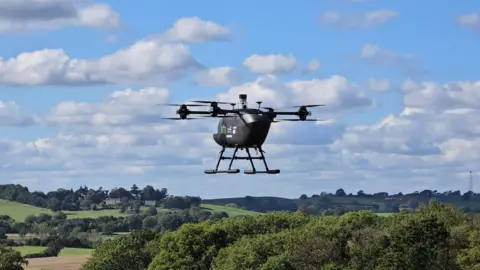
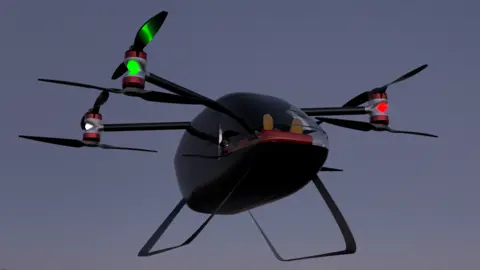
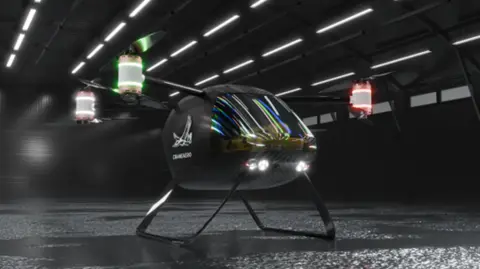
The CRANE is a fully autonomous, remotely piloted quad-rotor electric vertical take-off and landing (VTOL) aircraft.
It is designed to carry people, supplies and equipment in search and rescue and disaster relief situations.
The aim is to give first responders access to hazardous or difficult to reach emergencies.
Test flights of a scaled-down version of the prototype were successfully carried out in September.
 CraneAero
For the second stage of the GoAero Challenge the team consulted with charities and organisations to further understand the operational needs of an emergency response aircraft.
The researchers tested their design in Cranfield's Drone Flight Arena.
An advisory panel has been established with input from the Advanced Air Mobility Institute, London Air Ambulance Service and additional stakeholders.
The team will now refine the design further, and prepare for a Fly-Off Qualifier round in December 2026, where a full-scale prototype must be demonstrated in flight.
This will secure the team's entry to Stage Three which is a full-scale build and live flight demonstration in challenging conditions at NASA's Ames Research Centre in Silicon Valley in California in the USA in 2027.
Follow Beds, Herts and Bucks news on BBC Sounds, Facebook, Instagram and X.
