'All children are still into Roald Dahl'
 Family
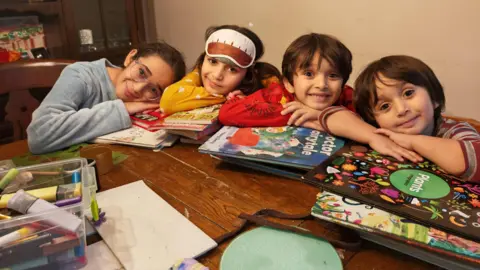
It's after the library closes its doors for the night that four young children creep into the building with their mother, in a scene they imagine as being like the film Night at the Museum.
Avid readers, they "max out" their borrowing, taking 20 books each under their individual library cards, the most they are allowed. Mum Zahra frequently leaves with a huge bag of up to 80 titles.
It's a treat to go there after hours, as part of the Library Plus scheme, when staff have gone home.
"It's a magical moment," Zahra said. "It's dark, we're like little thieves, there's no-one around. There can be other members, but it's very quiet."
Her two daughters, Hajar, 11, and Amina, 10, have worked out their favourite genres. Hajar loves fiction and Amina goes for non-fiction, particularly books about the environment, animals and the human body.
The boys, Zakaria, six, and Ismaeel, four, are still on cars, dinosaurs and picture books.
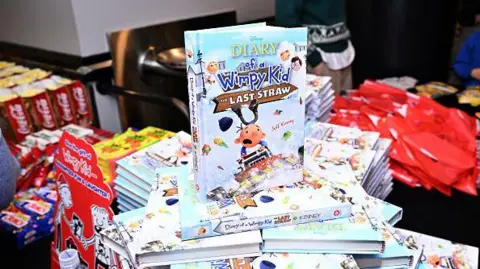
It's Diary of a Wimpy Kid that unites the whole family.
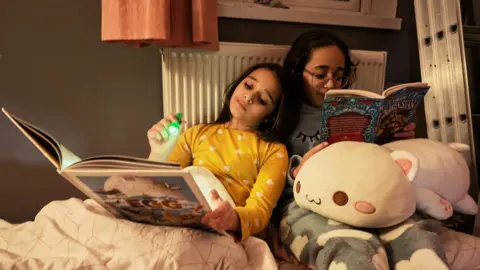
Reading is mainly done at bedtime and each child has a stack of books by their bed at their West Bromwich home.
Both Zahra and her husband Vasim learned English as a second language - Zahra in France and Vasim in India. They read to their children in English as a "great way to connect with a language".
 Getty Images
Sandwell's Library Plus scheme enables the whole family to use a library card and a pin code to get in, when there are no staff present.
The rules are that children have to be accompanied, CCTV is in use and members receive a safety induction.
As researchers document a decline in children enjoying reading, libraries, schools and councils are doing everything they can to get youngsters reading early.
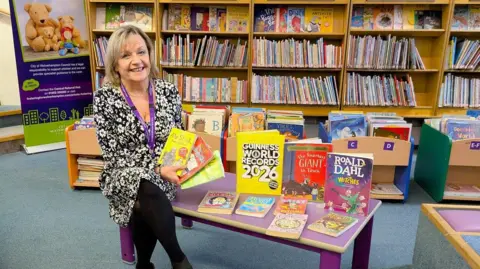
Wolverhampton librarian Elisabeth Whitehouse can tell which children have been read to in their early years.
"They'll listen. Their speech and vocabulary is better… they'll sit and they can read.
"I can tell the children who don't know what to do with a book, whether they turn it upside down."
 Handout
She said Wolverhampton had areas of deprivation and many youngsters "had nothing", prompting staff to always encourage them to take a book.
Ms Whitehouse said girls still sought out tales of fairies and princesses, while boys make a beeline for the Guinness Book of Records.
But one author still wins. "All children are still into Roald Dahl," she says.
 Victoria Park Academy
Next year is the National Year of Reading, a campaign to address the decline in reading among children, young people and adults, and councils have been asked to stage events.
Some set to go ahead include "Book Bingo" in Warwickshire, where library members can read or listen to 12 books to complete a bingo card and enter a prize draw. The event aims to "bring people together through the joy of reading", county councillor Mike Bannister said.
A new book club starts in January at The Hive in Worcester, with the genre changing each session. The first meeting kicks off with comedy and satire, "a chance to laugh, reflect and explore witty storytelling in good company".
Newport Community Library in Shropshire urged people to pick up a book instead of "doom-scrolling" and said: "You just might find you feel a lot better for it."
In Stoke-on-Trent, the National Literacy Trust plans to spend the year working with partners from publishers to football clubs "to make reading a daily delight".
'Words coming to life'
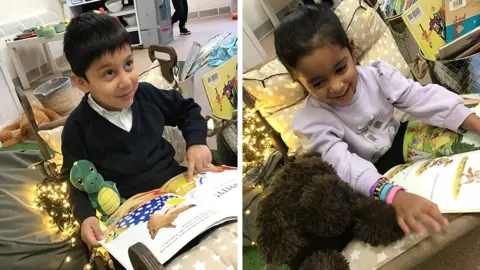
In the reception class at Smethwick's Victoria Park Academy, Aria, four, loves books that make her giggle.
Her favourite is The Smartest Giant in Town by Julia Donaldson and Axel Scheffler, because of the fox sleeping in a sock and the giraffe's funny tie.
"My favourite book makes my tummy funny, because I laugh," she says.
Classmate Yahya, four, loves it when his mum reads to him, and he likes to read to his sister. His favourite book is Mr Wolf's Pancakes by Jan Fearnley.
"I like it because my aunty makes chocolate pancakes at home," he said. "My favourite is when Mr Wolf gobbled up all the pancakes."
When assistant head teacher Rebecca Howell, a bookworm herself, walks into a classroom, a child will always bring her a book and ask her to read it.
"As soon as you sit down, you're surrounded by children who want to listen," she said. "They listen over and over again, embedding new language. It's magical."
 Getty Images
The school takes advantage of all the free resources it can get, and adopted a rocking chair for a reading corner.
Before schools broke up, Ms Howell noticed four children had climbed on the chair to look at a book.
"They were swinging on the rocking chair, looking at the book, talking about the pictures and giggling," she said. "I love to hear that."
 Getty Images
Many children came from homes with no books in the house, Ms Howell said, adding: "When I see that I think, 'What can we do to support these families?'."
The school has coffee mornings for parents and runs English as a second language classes.
The early years teacher is clear that children deserve the best.
"We put the ratty-tatty books to one side," she said. "It needs to be good enough for them.
"If they're given a nice book, they're not going to scribble on it with a crayon. It's something 'wow' and magical."
Soon the school will have the Coolest Little Library for families to help themselves to reading material - in a repurposed fridge.
The 'magic triangle'
Reading charity Booktrust works to get children reading, especially those from low-income and vulnerable backgrounds.
Director of children's books, Lizzie Catford, confirmed research had shown a decline in children's reading habits.
The key, she said, was to build enjoyment through reading from the start.
She also described the physical closeness, attention and shared emotional journey of reading to a youngster, describing it as a "magic triangle" of adult, book and child.
Educational outcomes were important but reading was "so much more", she adds – it supports emotional regulation, empathy, relationship-formation and routines.
"We need to slow things down for young children," Ms Catford continued.
"You can navigate a book at your own pace. You can stare at a book for as long as you want to, without it going at so many frames per second and it's gone."
 Family
Sandwell librarian Nicola Morris said next year's National Year of Reading would focus on people's reading habits, in a world full of distractions for adults and children, with busy lives, economic instability and changing populations.
Ms Morris said there was a lot of habitual technology-use and perseverance with a book might not have the same dopamine hit, but she added: "The paper book will always have its place."
There was nothing better than a child taking a book to an adult, she added.
"It says, 'Spend time with me, talk to me'," Ms Morris said.
Follow BBC Birmingham on BBC Sounds, Facebook, X and Instagram.
