The man who sparked a recorder revival in UK music

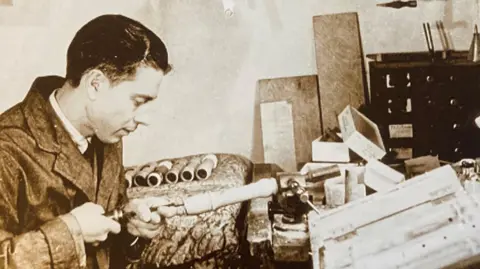 Dolmetsch Family
A generation of talented young wind musicians may have been inspired by the invention of the plastic recorder in a Surrey town, its creator's daughter says.
Carl Dolmetsch is credited with inspiring a recorder revival in schools all across the UK thanks to his creation of the plastic version of the instrument in the mid-20th Century.
And Haslemere proved to be the base for the Dolmetsch family to create and restore instruments, such as the recorder, in the public consciousness.
Reflecting on her father's creation, Marguerite Dolmetsch told Secret Surrey: "You could begin teaching a child in September, and by Christmas they would be able to play two or three of their favourite carols."
She added: "Seeing the excitement of the child at performing, and that of their parents and grandparents, is magic indeed.
"The instrument inspired so many children to make music their career. I think England had more fine wind players than anywhere else in Europe."
Marguerite's grandfather, and Carl's father, Arnold Dolmetsch, was born in France and trained as a musician and instrument maker before settling in England.
Carl, who was born in 1911, would pick up his father's passion for early music, in particular for instruments from the 15th to 18th Century.
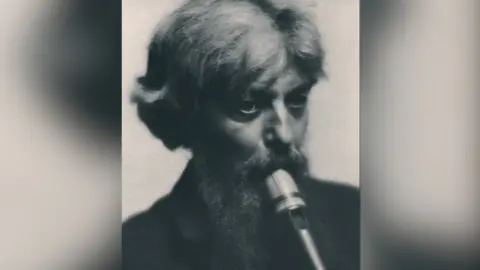 Dolmetsch Family
In a BBC recording from the 1980s, before his death in 1997, Carl recalled how he first got his hands on a recorder when he was given it by his father while boarding a train - before promptly leaving it on the platform.
He said: "My father said if he couldn't get his old one back, I must make one."
Following the outbreak of World War One, the family initially moved to a cottage in Thurley, before later moving into Jesses, now a Grade II Listed building in Haslemere.
After Arnold set up a workshop in the town creating harpsichords, viols and similar historical instruments, Carl took over the business in 1925, aged 14, and in the same year created the Haslemere Festival of Early Music.
But then came World War Two, and production of instruments shifted to producing seating for aircraft guns.
Marguerite said that, at this point, her father came across some of the new plastics and other materials which later inspired him to create his plastic recorders.
Under his leadership, the Haslemere workshop expanded production, supplying schools and ensembles across Britain.
By the mid-20th Century, the recorder had become a fixture in music education, introducing generations of children to woodwind playing.
Plastic recorders remained a staple of musical education, and for many young musicians they are still the first instrument they touched.
That fact, as Marguerite attests to, is the enduring legacy of her family, whose pioneering work helped to re-embed the recorder into the modern musical world.
Follow BBC Surrey on Facebook, on X, and on Instagram. Send your story ideas to southeasttoday@bbc.co.uk or WhatsApp us on 08081 002250.
