Mosquito study welcomed in village 'plagued' by insects

 Getty
GettyResearch to determine Northern Ireland's mosquito population has been welcomed in a village where people say they have been "tormented" by the insects.
The four-year MosquitoNI project is led by researchers from Queen's University Belfast, who are asking the public to help document mosquito numbers.
It aims to "challenge the narrative that mosquitoes do not exist in Northern Ireland" and assess the risk they pose, QUB's Dr Ross Cuthbert said.
Clare Smyth, from Ballykelly in County Londonderry, where residents say mosquitoes have been a serious problem in recent years, described the research as a "good and welcome thing".
 Clare Smyth
"Over the last four summers we have been plagued by them in Ballykelly," she told BBC News NI.
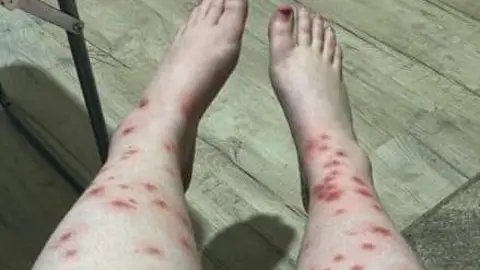
"My eldest girl was bitten so many times that we said she looked like a dartboard."
Those bites required treatment with antibiotics and her mother said the insects had put a "real dampener" on the summer holidays in recent years.
The family are nervous ahead of this summer, too.
"Tormented isn't the word for it," she added.
"We used to spend a lot of time in Ballykelly forest but that had to stop, it was so bad," she said.
"It gets so much worse on a muggy day or anywhere near water.
"People have been bitten alive."
She hopes the QUB-led research will challenge the perception that mosquitoes are not a problem in Northern Ireland.
She said her own research had identified different species in the County Derry village.
 Other
OtherWhat is a mosquito?
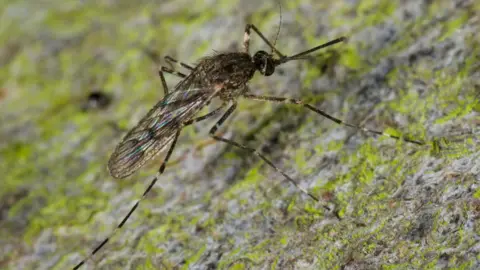
A mosquito is a small, slender insect found worldwide, acting as pollinators and providing food for other animals.
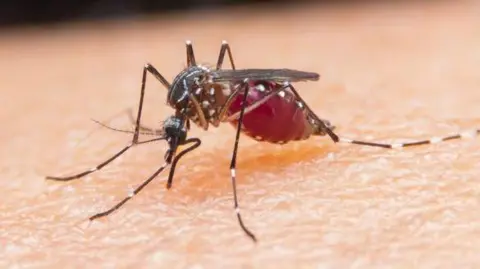
They are larger than midges – common across the island of Ireland - have long legs and a narrow proboscis, or elongated sucking mouthpart, used for feeding.
Only females bite humans and animals, taking blood needed to develop their eggs.
 University of Glasgow
This means mosquitoes are feared across the world as carriers of deadly diseases such as dengue and Zika.
Malaria is transmitted to people primarily through the bites of infected female Anopheles mosquitoes.
The World Health Organisation estimates there were approximately 282m malaria cases worldwide in 2024, resulting in 610,000 deaths.
There are about 3,500 species of mosquito globally.
'Surprisingly high numbers'
To date mosquito-borne diseases have not been detected here but Cuthbert said that risk was "shifting" as "as climate changes and species invade from more tropical regions".
He said mosquitoes were generally overlooked in Northern Ireland.
Previous QUB research, however, had found "surprisingly high numbers of mosquitoes across Northern Ireland".
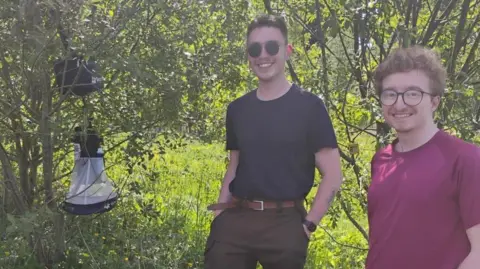
"Last year, thousands of mosquitoes were collected in specialised traps set around various wetlands and urban sites where mosquitoes breed," he said.
Around 20 different species had been found across the island of Ireland, including species known to carry disease in other parts of the world.
 Aidan Desjardins
PhD student Ryan Carmichael said the MosquitoNI research would allow them to gain insights into whether mosquitoes here were currently carrying diseases.
As part of the project – which also includes teams from the University of Glasgow and the UK Centre for Ecology and Hydrology – the public are being asked to submit sightings of mosquitoes through the 'Report a Mosquito' form on the MosquitoNI website.
What can you do to help protect against mosquito bites?
Some experts say the hotter and sweatier you are, the more likely you are to get bitten.
Mosquitoes are also more likely to strike at dawn and dusk and you are most vulnerable below the knee, so wear long trousers, socks and a good repellent.
If you do get bitten, do not scratch.
It is recommended using a block of ice to reduce swelling, dabbing the area with either a mix of bicarbonate of soda and water or using antihistamine cream or a bite relief product.
