'Cut VAT so I can take on hairdressing trainees'

 BBC
BBCIncreased taxes on businesses have been blamed by a Liverpool hairdresser for not being able to offer training opportunities for the stylists of tomorrow.
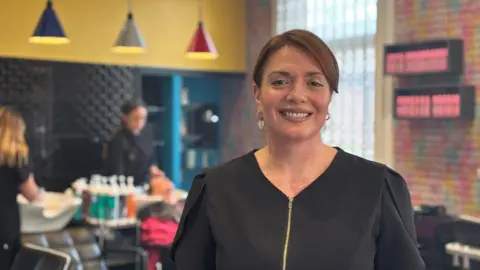
Victoria Davies has owned Aura on Aigburth Road in the south of the city for 25 years, along with her business partner Janet Lamb.
Victoria said she developed a passion for hairdressing after leaving school "with no qualifications", did work experience at a local salon, and "fell in love with it". She said it was "sad" she could no longer offer young people apprenticeships or early career jobs.
The Treasury acknowledged there were "lots of issues"but stressed VAT was a vital source of revenue that paid for public services.
 Google
"I get a lot of young girls phoning up, and you can hear the enthusiasm in their voice and you know they're excited, just like I was when I left school," said Victoria.
While she once had the funds to offer apprenticeships and training to new starters, the experienced businesswoman stressed that money was now being eaten up by rising utility bills, national insurance contributions and Valued Added Tax (VAT).
"It's a female-dominated industry and we're turning young girls away that they might have left school with not enough qualifications and be really good at hairdressing, and we can't give them the opportunities," she added.
Victoria said salons were "the most taxed businesses on the high street", and called on the government to change the way it views hairdressers for VAT purposes.
"I would be happy to agree to take two apprentices on, if they cut the VAT down to maybe 10%," she said.
'VAT crippling salons'
Victoria said the UK should take inspiration from Ireland, where VAT for hairdressers will be cut to 9% from July.
Businesses in the UK must currently pay VAT when their turnover is higher than £90,000.
It stands at 20% and is added to the price of most goods and services.
The personal care sector is subject to VAT in the same way as hospitality and retail.
But hairdressers like Victoria and Janet argued their sector was unique because it was inherently labour-intensive.
They argued they could not reclaim tax on staffing costs in the same way they could for goods, putting labour-intensive businesses such as hair or beauty salons at a comparative disadvantage.
A report commissioned by the British Hair Consortium in 2025 found that many salons were moving away from traditional employment towards the so-called "chair rental model", where stylists rent a chair in a salon, but are self-employed.
Victoria said this model would lower her overheads, but she would resist the move as long as she could.
She said her staff "like having the holidays and they like the benefits that come with employment, but it's just getting harder and harder to carry on doing that".
Victoria added: "I'm not asking for this money for myself. I'm asking to save an industry that is falling apart, really,"
The situation was raised in parliament this week by Wavertree MP Paula Barker, who said VAT was "crippling" some salons and asked what could be done to help owners support and recruit apprentices.
In response, Treasury Minister Dan Tomlinson said: "VAT is a broad-based tax; in fact, it is our third largest revenue raiser, raising £180 billion last year.
"That is vital revenue that pays for our public services.
"There are lots of issues in relation to VAT, including the differential treatment depending on how salons decide to set themselves up and pay their employees.
"Those are important issues, and we will consider tax changes in the usual way in the run-up to future Budgets."
Listen to the best of BBC Radio Merseyside on Sounds and follow BBC Merseyside on Facebook, X, and Instagram. You can also send story ideas via Whatsapp to 0808 100 2230.
