UK government officials said IRA man organised £26.5m bank raid

 Pacemaker
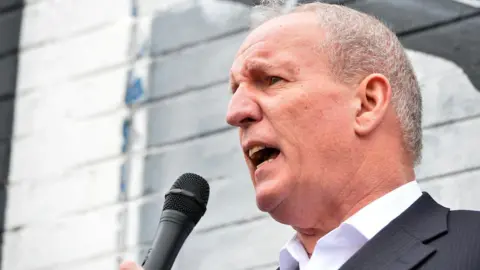
UK government officials told their Irish counterparts in January 2005 that they were "given to believe" IRA figure Bobby Storey was responsible for the Northern Bank robbery the month before.
Some £26.5m was stolen from the bank at Donegall Square in Belfast in December 2004 in a crime that threatened to destabilise the peace process.
Newly released state papers by the National Archives of Ireland, more than 20 years later, reveal the privately held views of senior civil servants, politicians and public figures at the time of the heist.
One of those views is about Bobby Storey, a senior republican, whose funeral in 2020 made headlines after claims it broke lockdown guidelines.
He was considered the head of intelligence of the IRA for a period from the mid-1990s - being named as such under parliamentary privilege.
More recently, he was the northern chairman of Sinn Féin.
He spent more than 20 years in jail, beginning with internment without trial when he was 17, a year after he joined the IRA in 1972.
Security sources linked him to several major incidents, including the Northern Bank robbery.
Irish State papers now reveal the UK government "were given to believe" the raid had been organised by Mr Storey and was too complex to have been solely "a brigade job".
Sinn Féin has not responded to requests for comment.
'Not a brigade job'
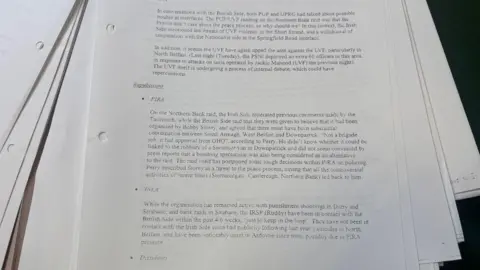
Both British and Irish sides agreed there "must have been substantial co-ordination between south Armagh, west Belfast and Downpatrick".
In the documents Nick Perry, a senior official at the Northern Ireland Office, said it was "not a brigade job, it had approval from GHQ" (general head quarters).
Mr Perry also described Mr Storey as a "threat to the peace process, saying that all the controversial activities of recent times (Stormontgate, Castlereagh, Northern Bank) led back to him".
The papers also shine a light on what the money from the raid may have been used for.
Money may have been used for 'lifestyle spending'
Fiona Flood, from the Department of Foreign Affairs, met a former Ulster Volunteer Force (UVF) prisoner to get insight into what the IRA may have done with the money from the robbery.
He is described as being a "long standing contact from the loyalist community".
The UVF man speculated how money from the robbery would be used for "lifestyle spending" rather than a "pension fund" or on political campaigns.
He believed the raid was less about the money and instead the aim of the robbery was to show IRA followers that the force could still pull off a "spectacular".
Influential Irish Americans
Even though the British side believed Mr Storey masterminded the operation, influential Irish Americans were less willing to accept that republicans were behind it.
Bill Flynn, who served as chairman of Mutual of America, a Fortune 1000 financial services company, was "prepared to bet the lives of his grandchildren that [Gerry] Adams and [Martin] McGuinness knew nothing about the robbery".
His company colleague Tom Moran, who would later serve as Chancellor of Queen's University Belfast, was "adamant that Adams and McGuinness (whom he speaks to regularly) were not aware in advance of the robbery", but conceded that "a rogue element within the IRA might have been responsible".
In 2012, the Northern Bank was rebranded, changing its name to the Danske Bank after its Danish parent.
The comments can be found in the National Archives of Ireland Department of Foreign Affairs, under file number 2025/125/248.
Is King Charles a Westlife fan?
 Vinnie Zuffante/Getty Images
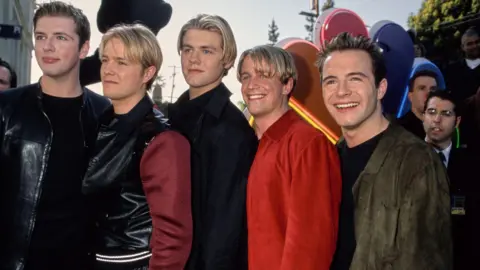
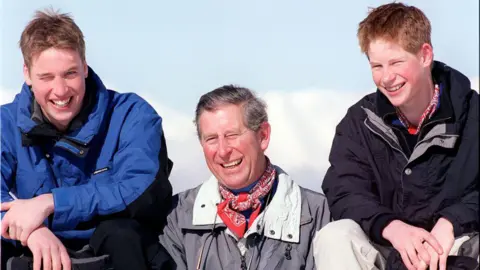
King Charles III and his sons, the Prince of Wales and the Duke of Sussex, may be fans of Irish pop group Westlife, the papers suggest.
In December 2000, the King, then Prince Charles, was "clearly keen to pay another visit" to Ireland, according to letters from Ted Barrington, the Irish ambassador to London.
The King also noted the "success of Irish pop and rock bands in the field of popular music".
 Ken Goff/Getty Images
The Ambassador attributed his interest to having heard Westlife perform at the Royal Variety Concert and the "interests of his two sons", then aged 18 and 16.
Further can be read about this letter from the Ambassador in the National Archives of Ireland Department of Foreign Affairs and Trade file 2025/127/101.
The new release of State archive papers are available for public reading from 2 January.
Professor Marie Coleman is Professor of Twentieth Century Irish History at Queen's University Belfast.
